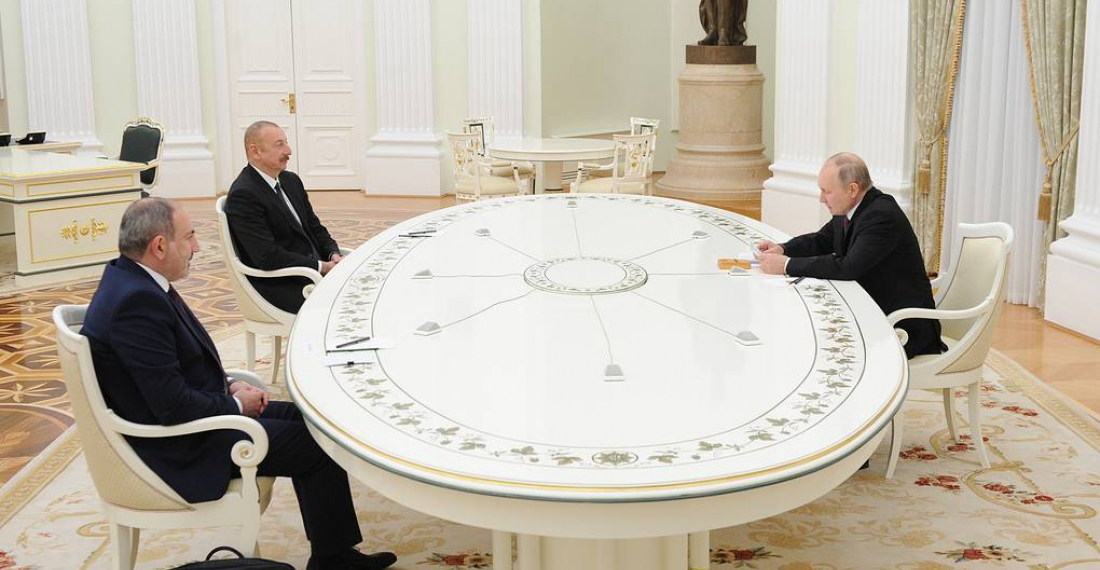
Russian president Vladimir Putin on Monday hosted the leaders of Armenia and Azerbaijan at the Kremlin in Moscow for discussions on the implementation of the Karabakh settlement envisaged in the 10 November trilateral statement which ended fighting in the second Karabakh war.
The meeting lasted four hours after which a joint statement was signed by the three leaders.
Russian President Vladimir Putin called the talks important and useful.
"I consider today's meeting extremely important and useful, since we were able to come to an agreement and signed a joint statement on the development of the situation in the region," the Russian leader said following the results of trilateral talks on Monday. He clarified that he meant concrete steps to develop economic ties and infrastructure projects
President Putin added that for this purpose "a working group will be created, headed by the vice-prime ministers of three governments - Azerbaijan, Armenia and Russia." Putin said that in the near future the deputy prime ministers of the governments will create working subgroups, present concrete plans for the development of the transport infrastructure and the economy of the region. "I am sure that the implementation of these agreements will benefit both the Azerbaijani and Armenian peoples, without any doubt it will benefit the region as a whole, and therefore the interests of the Russian Federation," the head of the Russian state emphasized.
Putin again thanked his interlocutors for agreeing to come to Moscow. He also added that all three parties agreed that the terms of the agreement of November 9, 2020 are generally respected, no serious incidents have been noted, and the Russian peacekeeping group is fully fulfilling its obligations. The Russian leader noted that over 48 thousand displaced persons and refugees have already returned to Nagorno-Karabakh, and intensive work is underway to restore infrastructure, energy and various structures.
------------------------------------------------------------
The atmosphere before the meeting appeared tense. Russian President Vladimir Putin was expecting his guests near a large round table in the representative office of the first building of the Kremlin. Putin shook hands and hugged Aliyev, then greeted Pashinyan in the same way. Sitting down at the table, the President of Azerbaijan and the Prime Minister of Armenia merely acknowledged each other and nodded.
All the leaders were wearing no masks. After the opening remarks of the President of Russia, the negotiations continued behind closed doors.
"Today it would be important, first of all, to outline the next steps in the key areas of settlement, outlined in the joint statement of November 9 last year. I mean the issues related to the activities of the Russian peacekeeping contingent, clarification of demarcation lines, solution of humanitarian problems, protection of cultural heritage sites", the Russian president said welcoming the two leaders.
The Russian leader noted that the task of "unblocking economic, trade and transport links in the region, opening borders" deserves special attention. "It is assumed that these issues will be dealt with by a special trilateral working group chaired by the deputy prime ministers of Russia, Azerbaijan and Armenia," Putin said.
Putin expressed hope that the talks "will take place in a businesslike atmosphere and will serve to ensure lasting peace, security and progressive socio-economic development in the region." "What we are all certainly interested in," he added.
The President stated that the agreements on Karabakh are being consistently implemented, this creates the preconditions for the settlement of the conflict on a fair basis. "Today we can state with satisfaction that the trilateral agreements are being consistently implemented. In our opinion, this creates the necessary preconditions for a long-term and full-scale settlement of the long-standing conflict on a just basis in the interests of [both] the Armenian and Azerbaijani peoples," he said.
The Russian leader noted that he is grateful for the response to the proposal to jointly discuss the implementation of the trilateral statement on Karabakh. Putin stressed that Russia values the partnership and good-neighborly relations linking all three countries. "Therefore, we followed the outbreak of an armed conflict with concern and sincere concern for the fate of people," the Russian president said. He expressed regret that large-scale hostilities led to significant human casualties and exacerbated the already difficult situation in the Caucasus, increased the risks of the spread of terrorism.
Putin thanked Aliyev and Pashinyan for their positive perception of Russia's active mediation efforts aimed at stopping the bloodshed and stabilizing the situation. The head of the Russian state recalled that the diplomatic and military departments of the countries worked hard to solve this difficult task. "We were in constant contact, together we were looking for a compromise. It was as a result of our joint efforts, after intensive, including, as you remember, nighttime telephone conversations, on November 9, a trilateral statement was agreed, which we signed with you." - said the Russian leader.
The President of the Russian Federation also noted that at the request of the Armenian and Azerbaijani sides, a Russian peacekeeping contingent was deployed, a system of effective enforcement of the ceasefire regime was created to monitor compliance with the ceasefire on the contact line in Nagorno-Karabakh and along the Lachin corridor, 23 observation posts and 4 additional posts are responsible for traffic safety along the corridor.
Putin emphasized that in all its actions Russia sought to follow the key developments achieved in the OSCE Minsk Group. According to him, the Russian side continues to check its actions with partners and the chairman of the Minsk Group.
According to the President of Russia, the situation in Nagorno-Karabakh remains calm, 48 thousand refugees have already returned to the region. "Now the situation in the region is calm. We are doing a lot for the safe return of internally displaced persons and refugees. Over 48 thousand people have already returned to Karabakh since November 14 (2020)," the Russian head of state said.
According to him, with the mediation of Russia, the exchange of prisoners and bodies of the dead was carried out. In addition, the International Center for Humanitarian Response is successfully operating, within the framework of which "pressing issues related to the establishment of normal life in settlements, the reconstruction of destroyed infrastructure, and the protection of historical, religious and cultural monuments are being resolved."
"Employees of the center are engaged in the restoration of energy and heat supply. Over 800 tons of building materials and more than 1.5 million tons of humanitarian supplies have already been delivered from Russia to the conflict zone. Medical assistance is provided to the population. Over 479 hectares of land have been cleared from mines, 182 kilometers of roads have been checked, 710 buildings and structures, more than 22 thousand explosive objects were discovered and destroyed, "the Russian leader stated.
Explanatory note: The trilateral declaration Russia-Armenia-Azerbaijan was signed just before midnight Moscow time on 9 November and just before 0100 hours Baku and Yerevan time on 10 November. which is why it is sometimes referred to as the 9November statement , and sometimes as the 10th November statement.
Source: commonspace.eu with the press service of the President of Russia
Photo: President Putin of Russia on Monday (11 January) hosted the leaders of Armenia and Azerbaijan for discussions on the Karabakh settlement (picture courtesy of the press service of the president of Russia).