


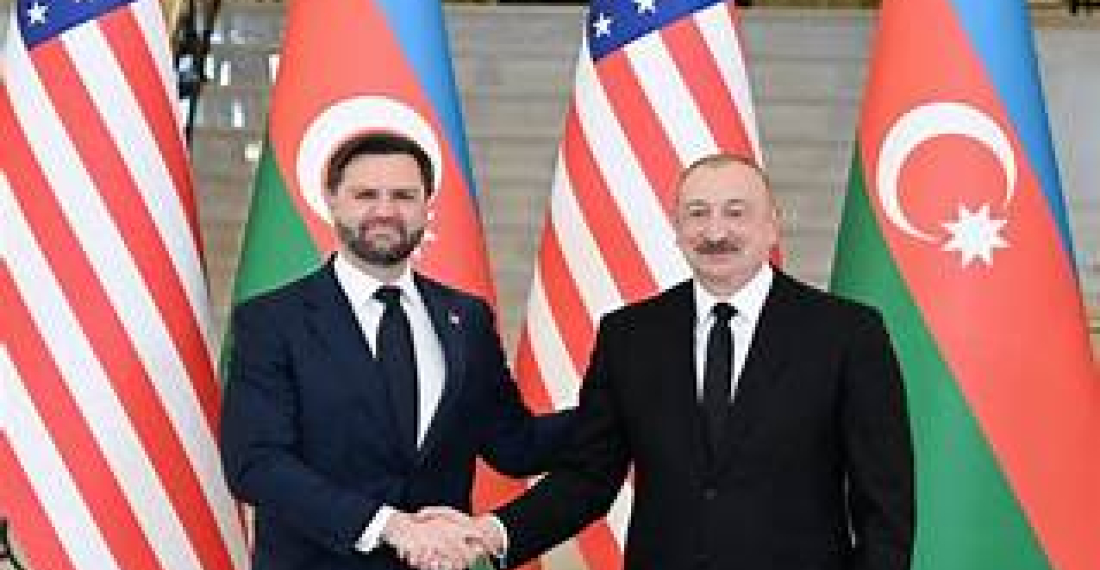
U.S. Vice President J.D. Vance’s February 9–11 visit to Armenia and Azerbaijan marked a structural turning point in the South Caucasus. Unlike previous high-level engagements of the United States that generated rhetorical alignment but limited follow-through, this visit embedded the region into long-term American economic, technological, and strategic frameworks. Taking place on the heels of the latest agreement (January 14) between Washington and Yerevan on the implementation framework for the Trump Route for International Peace and Prosperity (TRIPP), the visit served to consolidate the American influence in the region and taking it to higher levels. The consequences are unfolding along two axes: domestically, within Armenia and Azerbaijan’s political economies; and geopolitically, in the region’s recalibrating balance between the United States and Russia, with Georgia seeking entry into the new configuration.
Domestic Political and Economic Implications
In Armenia, the visit arrived at a sensitive political moment. With parliamentary elections approaching in June 2026, Prime Minister Nikol Pashinyan received an unusually explicit endorsement from Vance. “To the extent my endorsement means anything, he certainly has it”, the US Vice President said in his press conference with the Armenian premier. While carefully framed, the message was clear: Washington sees leadership continuity as essential to safeguarding the 2025 peace framework and Armenia’s Western-facing trajectory.
More consequential than the endorsement, however, was the nuclear energy agreement. The framework for peaceful nuclear cooperation could generate up to $5 billion in U.S. exports, alongside long-term fuel and maintenance contracts. Nuclear fuel supply chains, safety oversight, training programs, and regulatory harmonization would embed Armenia into Western technological networks for decades. This has immediate domestic resonance. Armenia’s only nuclear facility – the Armenian Nuclear Power Plant – currently supplies up to 40 percent of national electricity and operates with Russian support. A shift toward American small modular reactor (SMR) technology would reconfigure Armenia’s energy sovereignty and reduce structural dependence on Moscow.
The visit also introduced a tangible military dimension to U.S.–Armenia relations. During the trip, Washington confirmed the planned transfer of U.S.-manufactured V-BAT unmanned aerial systems, and the sides agreed to broaden cooperation in military education and professional training. While the scale remains limited compared to Armenia’s longstanding security ties with Russia, the formalization of UAV procurement, training programs, and structured defense consultations represents a measurable diversification of Armenia’s security partnerships.
In Azerbaijan, the visit produced a parallel, but distinct, shift. The signing of a Charter on Strategic Partnership elevated bilateral relations between Washington and Baku to a structured, institutional level. President Ilham Aliyev framed it as a “new phase” in the US-Azerbaijan relations. Connectivity, digital infrastructure, energy transit, and defense dialogue were formalized under a unified framework.
Most notably, the visit occurred just before Aliyev chaired a government meeting on “Azerbaijan’s New Digital Architecture.” The sequencing may not be coincidental. The Charter explicitly referenced data centers, artificial intelligence, and cooperation with leading American firms. Following the visit, President Aliyev proposed accelerating the digitalization of public administration, expanding unified digital platforms, and appointing deputy ministers responsible specifically for artificial intelligence and digital transformation across key ministries. The goal is to embed AI governance capacity directly within executive structures rather than treating it as a peripheral innovation policy. The cooperation with the United States is going to play a key role in Azerbaijan’s plans concerning digitalization and the establishment of an AI industry.
The defense component of the Charter is particularly significant. Azerbaijan and the United States “intend to expand the scope of their defense and security cooperation, including defense sales”, the Charter states. The two sides expand structured dialogue on regional security, maritime cooperation in the Caspian basin, counterterrorism coordination, and defense modernization. Although Azerbaijan maintains a diversified military procurement policy, the institutionalization of U.S.–Azerbaijan defense consultations introduces a new balancing vector in Baku’s foreign policy.
Meanwhile, the US-supported connectivity normalization between Armenia and Azerbaijan – particularly through the Trump Route for International Peace and Prosperity (TRIPP) – is slowly transforming former conflict lines into economic channels. Azerbaijan has lifted transit restrictions and begun supplying oil products to Armenia. These incremental steps reinforce peace through interdependence.
Geopolitical Realignment and Regional Rebalancing
Vice President Vance’s visit carried significant geopolitical implications, decisively deepening both Armenia’s and Azerbaijan’s institutional ties with Washington. Therefore, it is no surprise that the visit raised eyebrows in Moscow, where it was read through the lens of West-Russia rivalries. Russian Deputy Foreign Minister Mikhail Galuzin argued that “for the West… Armenia is a tool in its geopolitical struggle in its confrontation with Moscow.” He warned of the “incompatibility” between EU integration and membership in the Eurasian Economic Union, underscoring Russia’s concern that Yerevan’s Western tilt could carry structural consequences.
Strains are visible in Russia–Azerbaijan relations as well. Speaking on the sidelines of the Munich Security Conference – a couple of days following Vance’s Baku visit and after his meeting with the Ukrainian President Volodymyr Zelensky on the sidelines of the conference – President Aliyev accused Russia of deliberately targeting Azerbaijani energy infrastructure and diplomatic facilities in Ukraine last year. He described Moscow’s actions as “an unfriendly step towards Azerbaijan,” reflecting a widening trust deficit. The relations between Baku and Moscow have not recovered from the crisis triggered by the crash of Azerbaijani airlines in December 2024 and continue to deteriorate.
Georgia, observing these shifts, is maneuvering to secure relevance within the new configuration. During a February 6 visit to Washington, Deputy Foreign Minister Lasha Darsalia met with U.S. officials to discuss transport, digital technologies, and AI. According to Georgia’s Foreign Ministry, “attention was focused on Georgia’s role in the development of the Middle Corridor,” while the Georgian delegation underscored its readiness to “reset relations with the United States.” Prime Minister Irakli Kobakhidze has publicly stated that Georgia seeks to “start afresh with the United States, guided by a specific and pragmatic roadmap”.
Collectively, these developments suggest that the South Caucasus is entering a new phase. The United States is embedding itself not primarily through military basing, but through nuclear supply chains, connectivity projects, semiconductor exports, AI data centers, and structured strategic charters. In that sense, Vance’s visit did more than consolidate a peace process – it began rewiring the South Caucasus through energy, AI, and infrastructure. The region’s future alignment may well be determined less by traditional security blocs and more by who controls the region’s transport routes, builds its reactors, powers its data centers, and lays its fiber-optic cables.



