


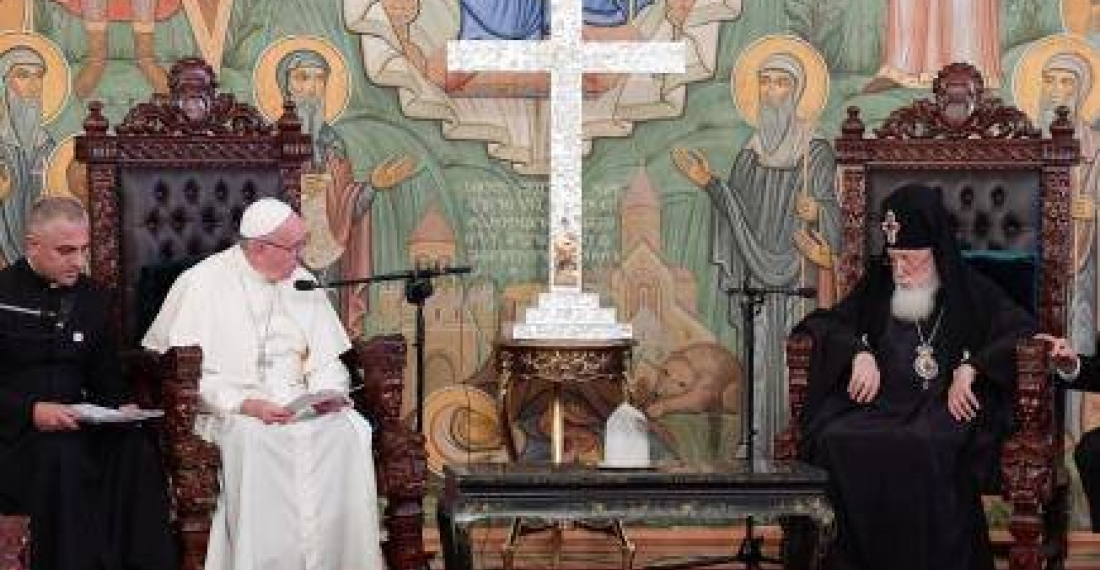
Pope speaks in warm terms about his visit to Georgia and Azerbaijan

Pope Francis has spoken in warm terms about his visit to Georgia and Azerbaijan a few days ago. Addressing a general audience at the Vatican Pope Francis said that "Patriarch Ilia's presence at the airport upon my arrival [in Georgia] was a very important sign, as well as our visit to the Patriarchal Cathedral and our meeting which was very moving".

The Pope said,

I thank the Lord for the grace of my recent visit to Georgia and Azerbaijan, and I renew my gratitude to the civil and religious authorities of both countries, in particular to the Patriarch of All Georgia, Ilia II, and to the Sheikh of the Muslims of the Caucasus. This visit complemented my visit to Armenia in June, and fulfilled my desire to visit all three nations of the Caucasus to confirm the Catholic community and to encourage all the people in their journey toward peace and fraternity.

Though Georgia and Azerbaijan enjoy ancient historical, cultural and religious roots, they have only just celebrated twenty-five years of independence, and are experiencing great challenges. The Catholic Church is called to be close to them, especially through works of charity and promoting the good of the human person, in communion with the other Churches and Christian communities, and in dialogue with other religious communities. In Georgia, our cooperation is naturally with our Orthodox brothers and sisters, and so Patriarch Ilia's presence at the airport upon my arrival was a very important sign, as well as our visit to the Patriarchal Cathedral and our meeting which was very moving. Our unity is seen in the blood of so many Christian martyrs of different Christian confessions, especially the Assyrian-Chaldean, with whom we prayed for peace in Syria, Iraq and the whole Middle East.

In Azerbaijan, a primarily Muslim country, I was able to participate in an interreligious meeting and to celebrate Mass with the small Catholic community. Our communion of faith inspires us to deepen our encounter and dialogue with all who believe in God, so that together we can build a more just and fraternal world. May God bless Armenia, Georgia and Azerbaijan, and guide his holy people in those countries.

source: commonspace.eu with Vatican Radio

Related articles

Editor's choice
News
Borrell tells the European Parliament that the situation in Afghanistan was critical, but the EU will remain engaged

Borrell tells the European Parliament that the situation in Afghanistan was critical, but the EU will remain engaged

Borrell underlined that the European Union will make every effort to support the peace process and to remain a committed partner to the Afghan people. "Of course, we will have to take into account the evolving situation, but disengagement is not an option.  We are clear on that: there is no alternative to a negotiated political settlement, through inclusive peace talks.
Editor's choice
News
Germany accuses Russia of cyberattacks and disinformation campaign

Germany accuses Russia of cyberattacks and disinformation campaign

The German government holds Russia responsible for a cyberattack on German air traffic control, and for targeted disinformation campaigns before the last federal election. According to the German Foreign Office in Berlin, the incidents could be clearly attributed to the Russian military intelligence service, the GRU. In response, the Russian ambassador to Berlin was summoned to the Foreign Ministry. "We have been observing a massive increase in threatening hybrid activities by Russia for some time now," a spokesperson for the Foreign Ministry stated. These range from disinformation campaigns and espionage to cyberattacks and sabotage attempts. The aim is to divide society, sow distrust, and undermine confidence in democratic institutions. The spokesperson added that with these actions, Russia is "very concretely threatening our security, not only through its war of aggression against Ukraine, but also here in Germany."  The Foreign Ministry spokesperson explained that the cyberattack on air traffic control in August 2024 was clearly attributed to the hacker collective "APT28," known as "Fancy Bear," and to the responsibility of the Russian military intelligence service, the GRU. Furthermore, it could now be "conclusively stated" that Russia had attempted "to influence and destabilize both the last Federal election and the ongoing internal affairs of the Federal Republic of Germany." There was "absolutely irrefutable evidence" for this". The so-called "Storm 1516" campaign, which has been running since 2024, is allegedly backed by "reliable information" that the Moscow-based think tank "Center for Geopolitical Expertise" is behind it. The Center is also said to be supported by Russian military intelligence. Its primary aim is to influence democratic elections in the West. (Click the image to read more).

Popular

Editor's choice
News
Germany accuses Russia of cyberattacks and disinformation campaign

Germany accuses Russia of cyberattacks and disinformation campaign

The German government holds Russia responsible for a cyberattack on German air traffic control, and for targeted disinformation campaigns before the last federal election. According to the German Foreign Office in Berlin, the incidents could be clearly attributed to the Russian military intelligence service, the GRU. In response, the Russian ambassador to Berlin was summoned to the Foreign Ministry. "We have been observing a massive increase in threatening hybrid activities by Russia for some time now," a spokesperson for the Foreign Ministry stated. These range from disinformation campaigns and espionage to cyberattacks and sabotage attempts. The aim is to divide society, sow distrust, and undermine confidence in democratic institutions. The spokesperson added that with these actions, Russia is "very concretely threatening our security, not only through its war of aggression against Ukraine, but also here in Germany."  The Foreign Ministry spokesperson explained that the cyberattack on air traffic control in August 2024 was clearly attributed to the hacker collective "APT28," known as "Fancy Bear," and to the responsibility of the Russian military intelligence service, the GRU. Furthermore, it could now be "conclusively stated" that Russia had attempted "to influence and destabilize both the last Federal election and the ongoing internal affairs of the Federal Republic of Germany." There was "absolutely irrefutable evidence" for this". The so-called "Storm 1516" campaign, which has been running since 2024, is allegedly backed by "reliable information" that the Moscow-based think tank "Center for Geopolitical Expertise" is behind it. The Center is also said to be supported by Russian military intelligence. Its primary aim is to influence democratic elections in the West. (Click the image to read more).


