


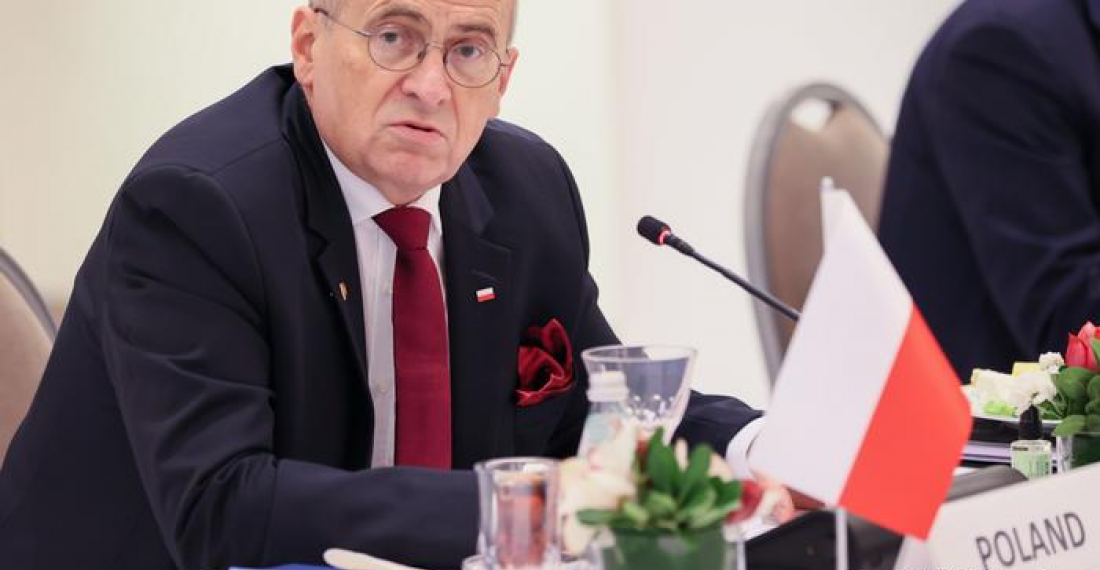
Poland formally demands $1.3 trillion WWII reparations from Germany

Poland has formally demanded $1.3 trillion in World War II reparations from Germany after Poland’s governing Law and Justice party (PiS), announced in September that a Polish parliamentary commission had estimated Polish financial losses resulting from the German occupation to be 6.2 trillion zlotys ($1.26 trillion), exceeding the 2019 estimate of $850 billion. 

German officials have previously dismissed these claims, stating that the 1953 Soviet-Polish decision to renounce reparation claims settled all financial claims relating to WWII. However, PiS holds that agreement to be invalid considering that the Polish people were not given an opportunity to negotiate fair compensation at the time. They argue that they were pressured into settling by the Soviet Union, who wanted to free East Germany, another Soviet satellite state, from any liability. 

This call for reparations from the Polish government is not new. PiS has been vocal about its objection to the 1953 agreement, and has been a proponent of reparation negotiations with Germany since they came to power in 2015. Even before this, on 10 September 2004, the Polish Sejm adopted a resolution which reiterated the Polish claim of inadequate reparations for the country’s devastation during WWII. 1 in 6 Poles died as a result of the German occupation, while over three-quarters of their infrastructure and nearly two-thirds of their industry was destroyed.

Some argue that the claim is being made for political reasons. Since over 80% of Polish voters are in favour of reparations, these discussions could earn PiS political capital in the country; others have argued that the issue is an attempt to distract people from internal issues, such as fuel shortages and inflation. Some critics also believe that the issue of reparations is only being brought up by the Polish government now when Germany, and other institutions in Brussels, have found the Polish government to be acting in violation of EU rules. 

In any case, the history and memory of WWII and the occupation is deeply entrenched in Polish society, making acknowledgement and restitution a general expectation. There is also a perception of German moral responsibility, and the financial and human loss incurred is still fresh in the minds of many Poles.

source: commonspace.eu with agencies
photo: Deutsche Welle

 

Related articles

Editor's choice
News
Aden under curfew, as problem in Yemen's south deepens

Aden under curfew, as problem in Yemen's south deepens

The port city of Aden, in Yemen's south, has been put under curfew, as the rift in the country between  the Saudi led coalition which  backs Yemen's presidential governing council, and the southern forces led by the Southern Transitional Council (STC), deepens. Abdul Rahman al-Mahrami, a member of the Yemeni Presidential Governing Council and commander of the al-Amalik brigades, has ordered a curfew in the temporary capital, Aden, "to maintain security". "A curfew has been imposed throughout Aden Governorate from 9:00 p.m. to 6:00 a.m., in accordance with the instructions of Commander Abdul Rahman al-Mahrami, a member of the Presidential Management Council," the statement said. It states that only security and military personnel, as well as medical and technical teams with approved permits, will be allowed to move in the area during these hours. Yemen's presidential council, which is backed by Saudi Arabia and which already is in a struggle with the Houthi Movement in the north of the country who also occupy the capital Sanaa, two days ago issued an order for the arrest of the head of the Southern Transitional Council (STC),, Aidarous al Zubaidi. The STC have wide support among people in the South, and advocate that South Yemen restores its independence. The coalition warned of further escalation in Aden, long regarded as an STC stronghold, as the Presidential Leadership Council (PLC) chief accused STC leader Aidarous Al Zubaidi of “high treason” and announced the revocation of his membership in the governing body. The moves mark a sharp escalation in tensions within the anti-Houthi camp, despite National Shield Forces, rivals of the STC and former allies, having recently retaken control of Hadhramaut and Mahra from southern fighters. The STC’s takeover of the two regions last month angered Saudi Arabia and contributed to igniting the current internal conflict. (click the picture to read more)

Popular

Editor's choice
News
Aden under curfew, as problem in Yemen's south deepens

Aden under curfew, as problem in Yemen's south deepens

The port city of Aden, in Yemen's south, has been put under curfew, as the rift in the country between  the Saudi led coalition which  backs Yemen's presidential governing council, and the southern forces led by the Southern Transitional Council (STC), deepens. Abdul Rahman al-Mahrami, a member of the Yemeni Presidential Governing Council and commander of the al-Amalik brigades, has ordered a curfew in the temporary capital, Aden, "to maintain security". "A curfew has been imposed throughout Aden Governorate from 9:00 p.m. to 6:00 a.m., in accordance with the instructions of Commander Abdul Rahman al-Mahrami, a member of the Presidential Management Council," the statement said. It states that only security and military personnel, as well as medical and technical teams with approved permits, will be allowed to move in the area during these hours. Yemen's presidential council, which is backed by Saudi Arabia and which already is in a struggle with the Houthi Movement in the north of the country who also occupy the capital Sanaa, two days ago issued an order for the arrest of the head of the Southern Transitional Council (STC),, Aidarous al Zubaidi. The STC have wide support among people in the South, and advocate that South Yemen restores its independence. The coalition warned of further escalation in Aden, long regarded as an STC stronghold, as the Presidential Leadership Council (PLC) chief accused STC leader Aidarous Al Zubaidi of “high treason” and announced the revocation of his membership in the governing body. The moves mark a sharp escalation in tensions within the anti-Houthi camp, despite National Shield Forces, rivals of the STC and former allies, having recently retaken control of Hadhramaut and Mahra from southern fighters. The STC’s takeover of the two regions last month angered Saudi Arabia and contributed to igniting the current internal conflict. (click the picture to read more)


