


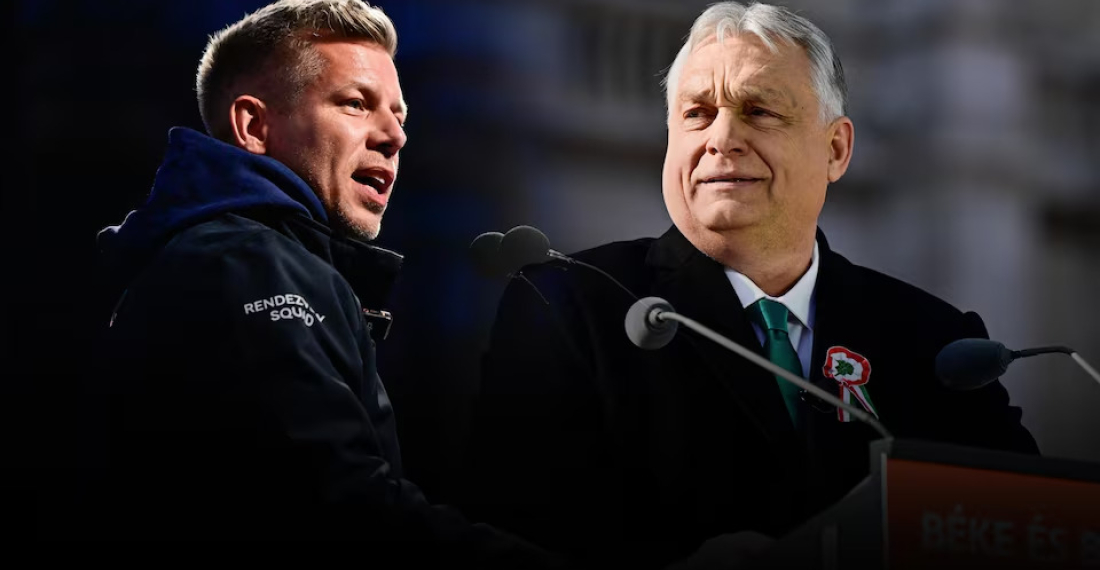
Orbán concedes defeat in Hungarian election

With 81.49% of votes counted on Sunday night (12 April), the Tisza party led by Péter Magyar is set to win a supermajority in the Hungarian general election. 

Current projections show that the Tisza party is projected to win 137 out of 199 seats. Orbán’s Fidesz party is projected to win 55 seats. 

Prime Minister Viktor Orbán ends his 16-year rule, and conceded defeat in a brief speech. He congratulated the winning opposition party, and pledges to serve “the Hungarian nation from the opposition”.

He says that “we have experienced difficult and easy, beautiful and sad years,” but insists he will “never, never, never give up.”

Orbán’s electoral defeat is widely perceived to strengthen EU cohesion after years of democratic backsliding under Fidesz.

“Hungary has chosen Europe. Europe has always chosen Hungary. Together, we are stronger. A country reclaims its European path. The Union grows stronger,” says President of the European Commission Ursula von der Leyen. 

Pedro Sánchez of Spain said "today Europe wins and European values win, while French President Emmanuel Macron welcomed what he called Magyar's "victory of democratic participation, the Hungarian people’s commitment to the values of the European Union, and Hungary’s commitment to Europe".

Source: commonspace.eu with The Guardian, CNN, and Reuters

Related articles

Popular

Editor's choice
Interview
Thursday Interview: Murad Muradov

Thursday Interview: Murad Muradov

Today, commonspace.eu starts a new regular weekly series. THURSDAY INTERVIEW, conducted by Lauri Nikulainen, will host  persons who are thinkers, opinion shapers, and implementors in their countries and spheres. We start the series with an interview with Murad Muradov, a leading person in Azerbaijan's think tank community. He is also the first co-chair of the Action Committee for a new Armenian-Azerbaijani Dialogue. Last September he made history by being the first Azerbaijani civil society activist to visit Armenia after the 44 day war, and the start of the peace process. Speaking about this visit Murad Muradov said: "My experience was largely positive. My negative expectations luckily didn’t play out. The discussions were respectful, the panel format bringing together experts from Armenia, Azerbaijan, and Turkey was particularly valuable during the NATO Rose-Roth Seminar in Yerevan, and media coverage, while varied in tone, remained largely constructive. Some media outlets though attempted to represent me as more of a government mouthpiece than an independent expert, which was totally misleading.  Overall, I see these initiatives as important steps in rebuilding trust and normalising professional engagement. The fact that soon a larger Azerbaijani civil society visits to Armenia followed, reinforces the sense that this process is moving in the right direction." (click the image to read the interview in full)


