This Monday Commentary was written by Dr Dennis Sammut, Director of LINKS Europe and Managing Editor of commonspace.eu
Empires tend to self-destruct. They peak to greatness and military might, and then gradually decline, either as a result of military defeats, or internal discord, or more likely, a mix of both. Decline can take along time. The Roman Empire, first split in two and the Eastern part survived until the fall of Constantinople in 1453. The British and French empires, that dominated the world in the last part of the 19th and early 20th centuries never recovered from WWII. They emerged victorious but weakened. The formal end of the British empire happened with the withdrawal from the Gulf and South Yemen in the 1970s. The British left because they simply could not afford to stay. The emerging states, roughly the six GCC states and Southern Yemen (an independent country until 1991), did not even bother to join the British Commonwealth.
These days we call empires superpowers, and for 30 years there has only been only one – the United States. It remains the richest and best armed country n the world, but its ability to act as global arbiter and policeman is fading away. The current Iran war has exposed the limits of American power, to the incredulity of friends and foe alike.
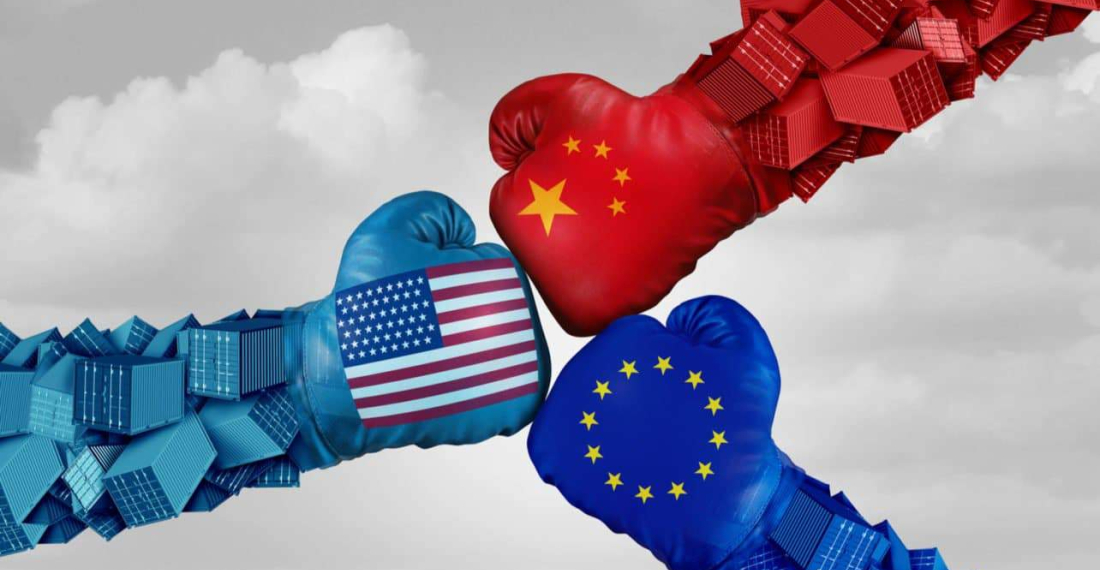
The international system does not like vacuums. What is left empty is often quickly filled by something else. People look at China as the new superpower, that will fill whatever space US decline will empty. It will not happen. China’s economic resurgence is nothing short of miraculous. It has the second largest economy in the world, and growing. Its armed forces have gone through a major transformation, and are designed primarily to deal with a confrontation with the United States. Under president Xi, in the “new era”, China is ready to make its mark on the world. It will, and is already, a global player that must be taken seriously. But it lacks the ability to be a global hegemon. There are several reasons: first, it will always be seen by the US as the primary threat, and even a weakened US can still take on China. China will spend much of its effort at managing this. Second, China is boxed in, not only through its maritime arteries, but also through its two strong Asian neighbours: Japan and India. The Chinese navy, and a robust and assertive Chinese policy in the South China Sea is trying to mitigate this weakness, but with mixed results. This means that China cannot even become a hegemon in Asia, let alone the world; Third is the issue of Taiwan, which remans China’s priority, and which will always be a distraction; and fourthly, last but not least, the Chinese political model is unattractive to everyone else. The reaction of most nations when confronted by the Chinese model is, “Thank you, but No thank you”.
In this situation the likely scenario for the rest of this century is likely to be the absence of a global hegemon, and the rise, or consolidation of strong big powers, assisted by smaller but not insignificant regional powers, with areas of competition, where conflict is likely as big powers, assisted by regional powers, fight each other through proxies.
One can already see this taking shape: The United States has already identified the Western Hemisphere (Latin America, the Caribbean etc.) as its primary area of interest. Its adventure in Venezuela, and increased threats to Cuba are part of it. The noise around Canada and Greenland can be seen in this context too.
In Asia the predominant power will be China, but its role will be contested by India and Japan, and in Oceania, by Australia.
China has a number of allies that it will use increasingly, even though they come with their own baggage. Interestingly all three are nuclear powers: Russia, North Korea and Pakistan. In all three China needs to ensure it will use them, and not let them use it – not an easy task. Russia’s Putin was in Beijing last week; president Xi is going to North Korea next week, so the work is ongoing.
In between the Western Hemisphere and Asia is Europe, emerging slowly but surely, as a power in its own right. At the core is the EU, which has pledged to spend billions on defence going forward. Very much part of the European configuration, are the UK, Turkiye, and increasingly Ukraine.
Russia remains the biggest threat to Europe, but after Ukraine Russia will no longer be an independent player. In the Arctic, Russian and Chinese interests will join forces, and Europe will have to make a stand
This still leave the issue of the “near abroad”, Russia’s former Soviet Empire. Europe and Russia will increasingly see the Caucasus and Central Asia as contested regions, where they will confront each other.
The situation in the Middle East will not calm down completely, even if the US and Iran make a deal. Iran is a genie that has come out of the bottle. It is impossible to put it back. Israel has big regional ambitions that are not going to be muted soon. In between the GCC countries need to forge a future independent of both. The Middle East will remain contested territory for influence and power, and for a slice of the large financial cake, with the big powers, US, Europe and China, and some regional big powers, such as Turkiye, UK, Israel, India and Pakistan, competing.
In Africa, we are already seeing wars of terrible destruction on going, and this is likely to get worse as outsiders use proxies to hurt each other.
One can argue that Artificial Intelligence and other high tech developments might change all these consideration, but this is an area where big powers and important regional powers are already competing aggressively.
Finally, despite all the justified pessimism can one still have hope in international institutions.
On Tuesday (26 May), the United Nations Security Council (UNSC) will hold a high-level open debate on “Upholding the Purposes and Principles of the UN Charter and Strengthening the UN-Centred International System”. It is a Chinese initiative, coinciding with their chairmanship of the Council in May. Chinese Minister of Foreign Affairs Wang Yi will chair the meeting, during which UN Secretary-General António Guterres is expected to brief.
Security Council Report, an authoritative publication on the work of UNSC says:
“Tuesday’s open debate takes place at a time of heightened uncertainty about the future of the multilateral system and ongoing mutual recriminations between the major powers about their failure to adhere to international law, including to the Charter, and the resulting adverse effects on vulnerable populations. The Security Council, the UN body entrusted with the primary responsibility for the maintenance of international peace and security, is more divided now than at any point in the post-Cold War era, struggling in recent years to adequately address many pressing conflicts on its agenda—for example, Haiti, Gaza, Myanmar, Sudan, and Ukraine—notwithstanding the significant time and energy it devotes to these issues. Member states and regional organisations have increasingly taken on a leading role in diplomatic efforts to resolve crises in places like Gaza, the Democratic Republic of the Congo (DRC), and Sudan, largely sidelining the UN in these processes.”
It is good that countries ponder this topic, but world opinion must be more vocal in making the case for multilateralism. The empire system must not be reconstructed in any form.
source: This Monday Commentary was written by Dr Dennis Sammut, Director of LINKS Europe and Managing Editor of commonspace.eu