NATO leadership in Tbilisi in show of solidarity with Georgia

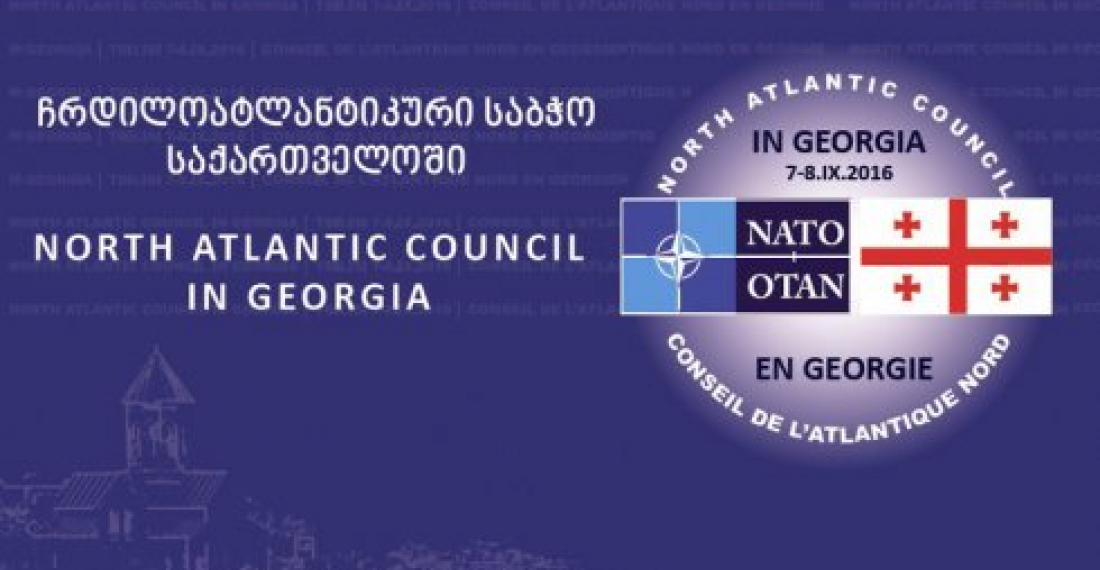
The Secretary-General of NATO, accompanied by the members of the North Atlantic Council are in Tbilisi on a historic visit that affirms the commitment of the Atlantic alliance to the peace and prosperity of Georgia.

The visit starts today when a meeting of the NATO-Georgia Commission - chaired by Secretary General Jens Stoltenberg - will bring together ambassadors from all NATO Allies with Prime Minister Giorgi Kvirikashvili to discuss Georgia's contributions to transatlantic security, regional security, and Tbilisi's reform progress.

On 8 September, the NATO delegation will meet with President Giorgi Margvelashvili, Foreign Minister Mikheil Janelidze, Defence Minister Levan Izoria, Chairman of the Parliament David Usupashvili, and Members of the Georgian Parliament.

During the visit, Secretary General Jens Stoltenberg and several ambassadors will participate in the Tbilisi International Conference, while Deputy Secretary General Alexander Vershbow will open the new venue of the Information Centre on NATO and the European Union in Tbilisi. The NAC will also visit the NATO-Georgia Joint Training and Evaluation Centre, which is helping to enhance the interoperability of forces from Georgia, NATO Allies and partners through training and exercises.

Front Tbilisi the Secretary-General of NATO is expected to travel to Turkey for talks with the Turkish leadership. Jens Stoltenberg two-day visit to Ankara on Sept. 8 and 9 will both show the alliance's support and solidarity with Turkey following the defeated coup attempt on July 15 and enable the NATO chief to discuss developments in Syria, after the Turkish army launched an incursion into its southern neighbor to fight against jihadists.

source: commonspace.eu with nato.int and agencies.
 

Related articles

Editor's choice
News
Uzbekistan calls for bigger voice for Central Asia in the UN

Uzbekistan calls for bigger voice for Central Asia in the UN

Uzbekistan called for a more effective and representative United Nations on September 23, as presidential administration chief Saida Mirziyoyeva used her address to the UN General Assembly to seek support for the country’s candidacy for a nonpermanent Security Council seat in 2035–2036. Speaking at the Assembly’s 81st session in New York, Mirziyoyeva argued that international cooperation remains necessary despite growing geopolitical divisions. She endorsed UN Secretary-General António Guterres’ UN80 reform initiative and called for an expanded Security Council, arguing that international rules should be applied consistently rather than according to the interests of powerful states. Uzbekistan’s planned chairmanship of the Non-Aligned Movement in 2027 was presented as another platform for promoting dialogue. Her emphasis on multilateralism also fits a broader Central Asian effort to increase the region’s role in international institutions. Kyrgyzstan, for example, will hold its first Security Council seat in 2027–2028. Mirziyoyeva also highlighted regional cooperation, pointing to improved relations among Central Asian states over longstanding border and water disputes. On Afghanistan, she urged countries not to view it solely as a security threat, stressing the importance of creating conditions for peaceful development. She linked Uzbekistan’s international agenda to domestic reforms, citing economic growth, falling poverty and expanded education. Climate and water security also featured prominently, with the Aral Sea serving as an example of the consequences of poor environmental management. (click image to read more)

Popular

Editor's choice
Interview
Thursday Interview: Murad Muradov

Thursday Interview: Murad Muradov

Today, commonspace.eu starts a new regular weekly series. THURSDAY INTERVIEW, conducted by Lauri Nikulainen, will host  persons who are thinkers, opinion shapers, and implementors in their countries and spheres. We start the series with an interview with Murad Muradov, a leading person in Azerbaijan's think tank community. He is also the first co-chair of the Action Committee for a new Armenian-Azerbaijani Dialogue. Last September he made history by being the first Azerbaijani civil society activist to visit Armenia after the 44 day war, and the start of the peace process. Speaking about this visit Murad Muradov said: "My experience was largely positive. My negative expectations luckily didn’t play out. The discussions were respectful, the panel format bringing together experts from Armenia, Azerbaijan, and Turkey was particularly valuable during the NATO Rose-Roth Seminar in Yerevan, and media coverage, while varied in tone, remained largely constructive. Some media outlets though attempted to represent me as more of a government mouthpiece than an independent expert, which was totally misleading.  Overall, I see these initiatives as important steps in rebuilding trust and normalising professional engagement. The fact that soon a larger Azerbaijani civil society visits to Armenia followed, reinforces the sense that this process is moving in the right direction." (click the image to read the interview in full)