


Military in Burkina Faso plan a three year transition to civilian rule

A national conference in Burkina Faso has authorised the ruling military junta to organise the transition period leading to a return to constitutional order and civilian rule within three years.

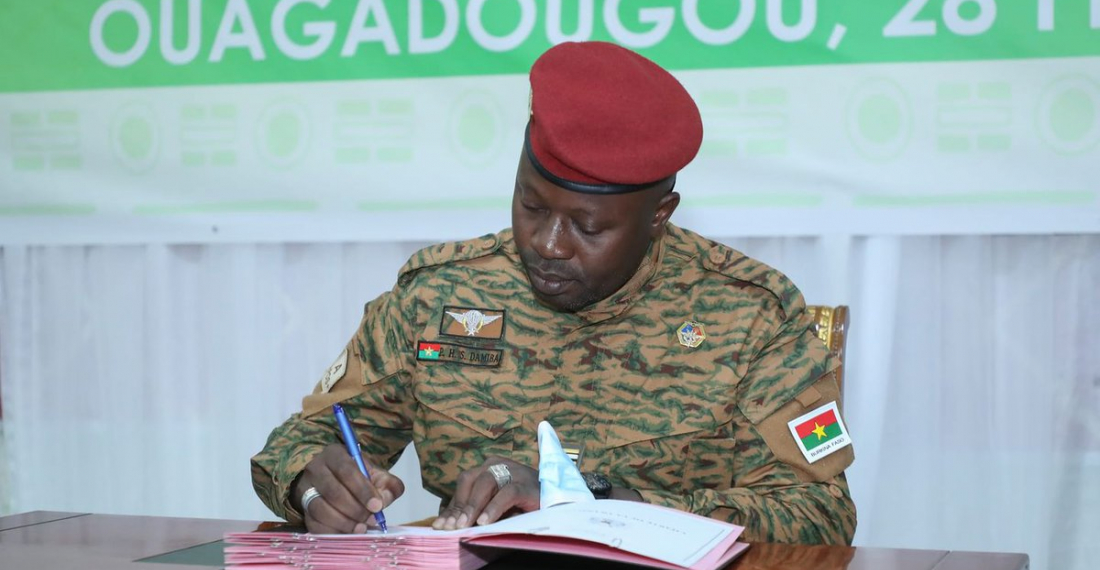
Thus, Lieutenant-Colonel Paul-Henri Damiba, who ousted the elected president Roch Marc Kabore on the 24 January coup d’état, is expected to rule the country for the next three years until elections are held.

Lieutenant-Colonel Damiba will finally be sworn in as Head of State tomorrow (2 March) by an assembly gathering the junta, different opposition parties and trade unions, some civil society organisations as well as people displaced by the jihadist attacks that have hit Burkina Faso since 2015.

However, the charter approved on Tuesday  (1 March) states that the new interim president or his government members will not be eligible to run for the next presidential, legislative and municipal elections that will be organised at the end of the transition period. The transitional government will consist of 25 ministers and a 71-member parliament.

The decision could put the West African country on a collision course with international partners who had called for a swift return to constitutional order following a coup that was widely supported by the population as the former president was considered incapable of containing the growing violence of Islamist militants in the country.

Indeed, Burkina Faso was suspended by the 15-member Economic Community of West African States (ECOWAS) and the African Union following the coup. ECOWAS subsequently asked the new military junta to present a "reasonable timetable for the restoration of constitutional order". Discussions should therefore be initiated quickly between these regionall organisations and Burkina Faso to determine whether a three-year transition period is acceptable.

Although ECOWAS has not yet imposed financial sanctions against Burkina Faso whilst the latter's neighbour Mali is subject to economic sanctions that have forced Bamako to pay more than $100 million in interest and capital payments on its debt.

In a region that has experienced more than four coups in 18 months - with two successive ones in Mali, one in Guinea, and recently one in Burkina Faso - the length of transitions is at the heart of negotiations between the countries affected by the coups and ECOWAS. Deemed "unacceptable" by ECOWAS for being too lengthy, the five-year transition proposed by Mali was not accepted by the institution.

Once a region that had a reputation as the continent's "coup belt”, West Africa has been weakened by the numerous attacks perpetrated by armed militants linked to Al-Qaeda and the Islamic State who have killed more than 2,000 people and caused the displacement of more than 1.5 million citizens.

By appropriating swathes of territory, the terrorists have succeeded in instilling fear in the West African populations, who are now demanding and supporting political change that is militarily capable of pushing Al-Qaeda and the Islamic State from their territory.

The new interim President Damiba stated that his main transitional tasks were the “fight against terrorism and the restoration of the national territory” as well as the strengthening of governance through the “fight against corruption”.

The government is therefore expected to satisfy the security needs of his frightened population while respecting the transitional deadlines demanded by Burkina Faso's international partners.
 

Sources: Commonspace.eu with Reuters (London), Le Monde (Paris) and Al Jazeera (Doha)
Picture : Burkina Faso's new interim President Paul-Henri Damiba signs a charter requiring him to organise elections within three years ; Twitter: @actu_salade

Related articles

Editor's choice
News
Council of Europe launches new International Claims Commission for Ukraine

Council of Europe launches new International Claims Commission for Ukraine

Thirty-four countries and the European Union have signed a new convention establishing an International Claims Commission for Ukraine at a diplomatic conference co-hosted by the 46-nation Council of Europe and the Netherlands in the Hague. The diplomatic conference was attended by leaders and high-level representatives from over 50 states, including the President of Ukraine, Volodymyr Zelenskyy, the President of the Republic of Moldova, Maia Sandu, and the Prime Minister of the Netherlands, Dick Schoof.  “Today marks a major step forward in ensuring accountability for Ukraine. The International Claims Commission represents justice and hope for tens of thousands of victims—our determination that those who have suffered will not be forgotten. I call for quick ratifications so we can get the commission rapidly up and running for the people of Ukraine,” said Council of Europe Secretary General Alain Berset. Ukrainian President Volodymyr Zelenskyy said: “We expect that every mechanism for compensation from the Register of Damage and Claims Commission to the actual payments – will start working and receive strong and sufficient international support, so that people can truly feel that any kind of damage caused by the war can be compensated. This war, and Russia’s responsibility for it, MUST become a clear example – so that others learn not to choose aggression.” “Accountability is about creating the conditions for peace that endures. And therefore, accountability is a condition of security – today and for the future. But accountability is not only about Ukraine. And it is not only about one aggressor and one victim. Accountability is about Europe. About every country in Europe. It is about whether Europe, as a whole, is willing to defend its peace,” said Maia Sandu, President of the Republic of Moldova, which currently holds the Presidency of the Council of Europe’s Committee of Ministers. The Prime Minister of the Netherlands, Dick Schoof, said: “Every day Russia is deliberately bombarding homes, destroying businesses and damaging infrastructure in Ukraine. Russia must compensate Ukraine for the damage caused. That is why we have launched the International Claims Commission for Ukraine and we are honoured to host it.” The International Claims Commission will be the second part of a comprehensive compensation mechanism related to Russia’s war of aggression, building on the existing Register of Damage for Ukraine. The claims commission will be established within the framework of the Council of Europe and will also be open to other countries. The Register of Damage for Ukraine, created in 2023, collects and records compensation claims submitted by individuals, organisations and public bodies in Ukraine. Forty-four states and the European Union have so far joined the Register, which has already received 86,000 claims. The International Claims Commission will review, assess and decide upon claims submitted to the Register of Damage for Ukraine and determine the amount of compensation, if any, which is due in each case. The convention establishing the commission will enter into force once it has been ratified by 25 signatories, as long as sufficient funds have been secured to support its initial work.

Popular

Editor's choice
News
Council of Europe launches new International Claims Commission for Ukraine

Council of Europe launches new International Claims Commission for Ukraine

Thirty-four countries and the European Union have signed a new convention establishing an International Claims Commission for Ukraine at a diplomatic conference co-hosted by the 46-nation Council of Europe and the Netherlands in the Hague. The diplomatic conference was attended by leaders and high-level representatives from over 50 states, including the President of Ukraine, Volodymyr Zelenskyy, the President of the Republic of Moldova, Maia Sandu, and the Prime Minister of the Netherlands, Dick Schoof.  “Today marks a major step forward in ensuring accountability for Ukraine. The International Claims Commission represents justice and hope for tens of thousands of victims—our determination that those who have suffered will not be forgotten. I call for quick ratifications so we can get the commission rapidly up and running for the people of Ukraine,” said Council of Europe Secretary General Alain Berset. Ukrainian President Volodymyr Zelenskyy said: “We expect that every mechanism for compensation from the Register of Damage and Claims Commission to the actual payments – will start working and receive strong and sufficient international support, so that people can truly feel that any kind of damage caused by the war can be compensated. This war, and Russia’s responsibility for it, MUST become a clear example – so that others learn not to choose aggression.” “Accountability is about creating the conditions for peace that endures. And therefore, accountability is a condition of security – today and for the future. But accountability is not only about Ukraine. And it is not only about one aggressor and one victim. Accountability is about Europe. About every country in Europe. It is about whether Europe, as a whole, is willing to defend its peace,” said Maia Sandu, President of the Republic of Moldova, which currently holds the Presidency of the Council of Europe’s Committee of Ministers. The Prime Minister of the Netherlands, Dick Schoof, said: “Every day Russia is deliberately bombarding homes, destroying businesses and damaging infrastructure in Ukraine. Russia must compensate Ukraine for the damage caused. That is why we have launched the International Claims Commission for Ukraine and we are honoured to host it.” The International Claims Commission will be the second part of a comprehensive compensation mechanism related to Russia’s war of aggression, building on the existing Register of Damage for Ukraine. The claims commission will be established within the framework of the Council of Europe and will also be open to other countries. The Register of Damage for Ukraine, created in 2023, collects and records compensation claims submitted by individuals, organisations and public bodies in Ukraine. Forty-four states and the European Union have so far joined the Register, which has already received 86,000 claims. The International Claims Commission will review, assess and decide upon claims submitted to the Register of Damage for Ukraine and determine the amount of compensation, if any, which is due in each case. The convention establishing the commission will enter into force once it has been ratified by 25 signatories, as long as sufficient funds have been secured to support its initial work.

