


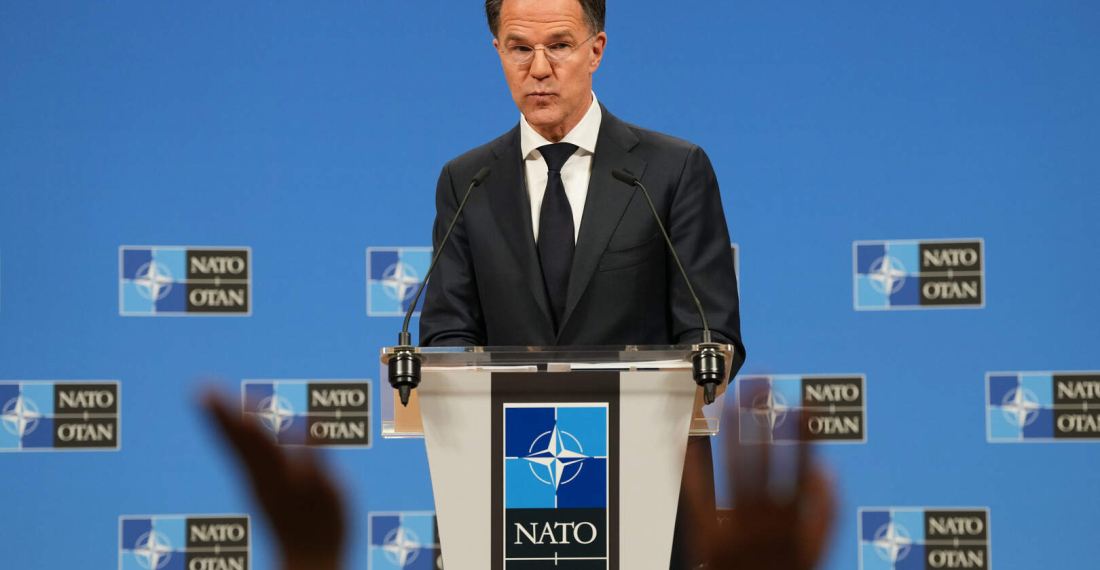
At NATO headquarters in Brussels on Thursday (26 March), Secretary General Mark Rutte presented the Secretary General's Annual Report 2025, saying NATO had adapted to a more dangerous security environment marked by Russia’s war against Ukraine, growing hybrid threats, China’s military build-up, and the continuing danger from terrorism. In his opening remarks, Rutte said 2025 had been “a landmark year for NATO”.
Rutte said the report showed that all 32 allies met the long-standing 2% of GDP defence spending benchmark in 2025, the first time this had happened since the target was agreed in 2014. He added that European allies and Canada increased defence spending by 20% in real terms compared with 2024, and said NATO was now “stronger today than it has ever been”.
A central theme of Rutte’s presentation was the decision taken at the 2025 Hague summit to raise defence investment to 5% of GDP. NATO’s official summit declaration specified that this commitment is to be reached by 2035, with 3.5% allocated to core defence requirements and 1.5% to broader security-related investments. Rutte said the decision reflected the need for “ a stronger, fairer and more lethal NATO”, and argued that allies must now match higher spending with greater defence production and innovation.
On Russia, Rutte said Moscow remained “the most significant and direct threat” to Euro-Atlantic security. He pointed to Russian airspace violations, sabotage, cyber activity, political interference, and threats to undersea infrastructure. He said damage to critical infrastructure had prompted the creation of Baltic Sentry, while Russian drone violations over Poland in September led to the launch of Eastern Sentry along the eastern flank from the High North to the Black Sea.
Rutte also stressed that support for Ukraine remained central to NATO’s work. He said allies provided the overwhelming majority of military assistance to Ukraine in 2025, opened the Joint Analysis, Training and Education Centre (JATEC) in Poland in February 2025, and launched the Prioritised Ukraine Requirements List, or PURL, in summer 2025 to channel billions of euros’ worth of American military equipment to Kyiv, funded by allies and partners. His remarks came as The Washington Post reported that the Pentagon is considering redirecting some Ukraine-bound military aid to the Middle East.
Responding to a question, he argued that US pressure had accelerated European defence spending. Rutte said that without Trump, many large economies “would not have reached” the 2% benchmark, and credited Washington with reopening a diplomatic deadlock to end the war in Ukraine.
He faced several difficult questions on Iran and his comments backing the US-Israeli operation. On the Middle East, Rutte said that the alliance has long agreed that Iran must not obtain nuclear weapons, and warned that Tehran’s missile programme poses an increasing threat to the region and beyond. He added that allies are working with partners to ensure the security of key maritime routes like the Strait of Hormuz. Responding to criticism that he had overstepped his role, Rutte said differences of opinion among allies were normal, but insisted that NATO remained united on the core issues of Iran’s nuclear ambitions and missile capabilities.
On Ukraine’s future, Rutte avoided framing the country as part of NATO’s defence structure, but reaffirmed that Kyiv remains on a path towards eventual membership. He said that, in the meantime, allies are working to define post-war security guarantees once a ceasefire or peace agreement is reached.
Source: commonspace.eu, reporting on Secretary General Rutte’s presentation on Thursday (26 March).



