Kazakhstan and European partners announced four transport-related agreements worth $462 million in Brussels on Monday (22 June). These agreements aim to strengthen the Trans-Caspian International Transport Route, also known as the Middle Corridor. The Middle Corridor links China and Europe through Central Asia and the South Caucasus, crossing the Caspian Sea and connecting onward to Black Sea and European routes. It has gained greater strategic importance as governments and companies look for more resilient trade routes between Europe and Asia.
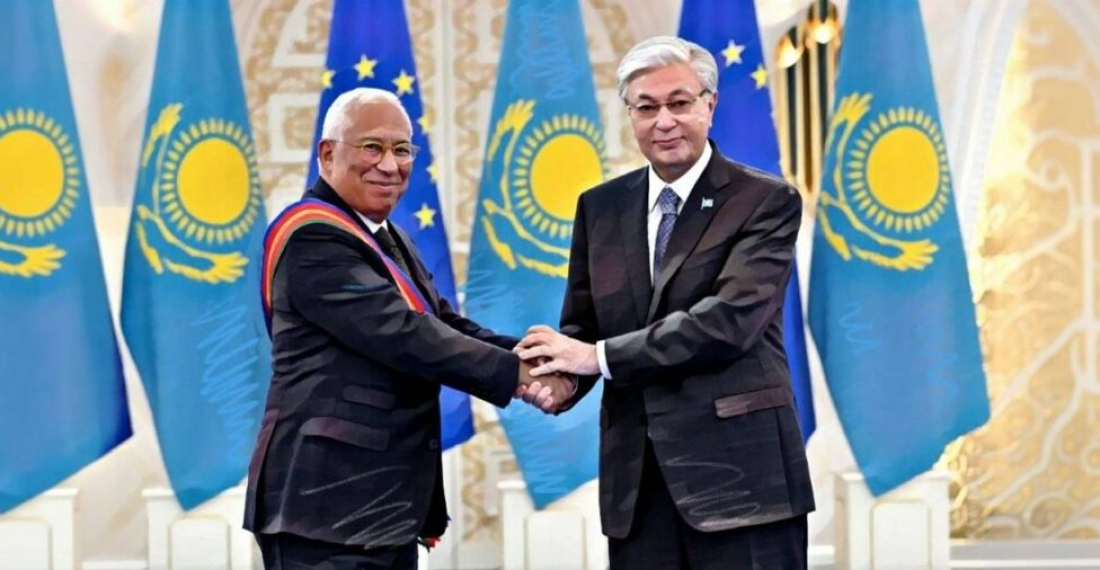
The agreements were presented during the business conference “Strengthening EU-Kazakhstan Connectivity: Perspectives and Strategic Potential of the Middle Corridor”, organised by Kazakhstan Temir Zholy during President Kassym-Jomart Tokayev’s visit to Belgium.
The package includes a memorandum between Kazakhstan’s Ministry of Transport and SITA on the digitalisation of state airports, including biometric identification. Kazakhstan’s national road operator QazAvtoZhol also signed a loan agreement with the European Bank for Reconstruction and Development for the Aktobe-Ulgaisyn road project. The 234-kilometre road section forms part of the Western Europe-Western China corridor and is expected to improve both domestic and transit connectivity.
KTZ Express, a subsidiary of Kazakhstan Temir Zholy, signed an agreement with Midia Marine Terminal for a joint project at Romania’s Port of Midia. The project is intended to expand Black Sea infrastructure linked to the route and improve cargo handling. KTZ Express also reached an agreement with A.P. Moller-Maersk on developing container transport along the Trans-Caspian route and attracting additional cargo volumes.
The Brussels conference brought together representatives of the European Commission, the European Parliament, international financial institutions, and major European transport and logistics companies, including DHL Global Forwarding, Alstom, DB Cargo, Rhenus Logistics, Hellmann Worldwide Logistics, and Maersk.
The agreements come as the European Union continues to support the development of the Trans-Caspian corridor under its Global Gateway strategy. Earlier this month, EU representatives in Astana said around €2.5 billion had been committed by the EU and international financial institutions since 2024 to connectivity projects across the region.
Source: commonspace.eu with Times of Central Asia and other agencies