Houthis reignite Yemen civil war also attacking Saudi border region

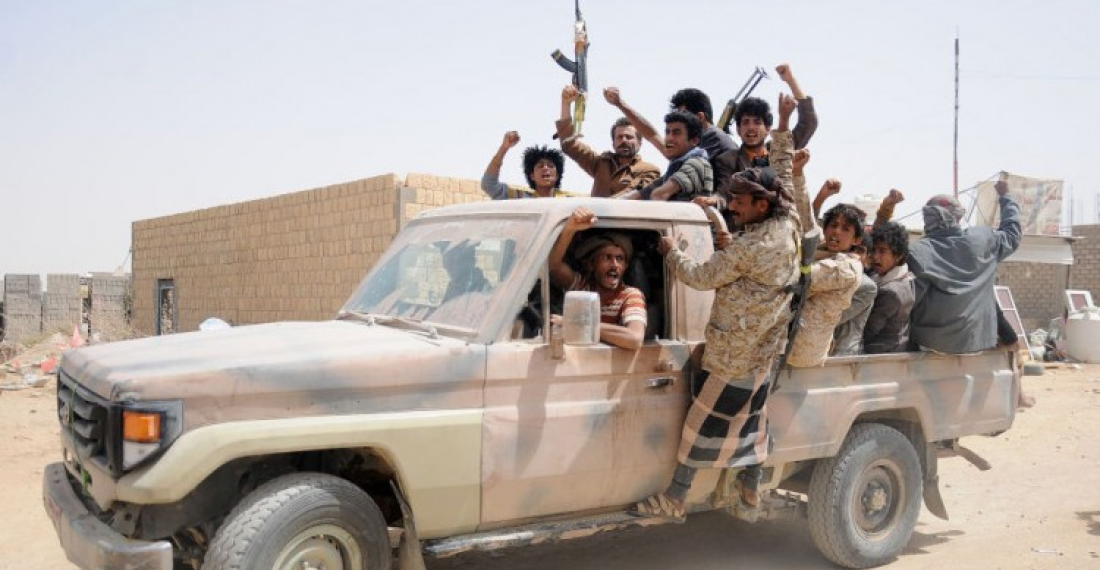
The Houthi Movement, that controls Sanaa and other parts of Yemen, have reignited the civil war in the country, and launched attackes on Saudi border regions.

At least 30 Yemeni government troops have reportedly been killed in Houthi rebel attacks on military camps in central Yemen.

The defence ministry said ballistic missiles and drones struck several camps in the provinces of Marib and Hadramawt, resulting in the death and injury of a number of Yemeni personnel. It did not give an exact toll.

The ministry denounced the attacks as "treacherous" and vowed to "respond to this aggression at an appropriate time and place".

The Houthis, who control much of north-western Yemen and are backed by Iran, said they had targeted "large Saudi military build-ups" preparing for an offensive. A Saudi-led coalition has supported the government during the civil war.

In a separate attack, the coalition's spokesperson said that 11 civilians had been wounded in the Saudi Arabian border region of Najran, in what they described as a Houthi strike.

In their statement, shared to X, they said the wounded included seven Saudi nationals, including a woman and a four-year-old child who both suffered second-degree burns.

The other four civilians were from Yemen, Pakistan and Egypt.

The Houthi attacks in central Yemen happened at 10:40 local time (07:40 GMT) on Thursday, according to Yemen's defence ministry.

A military official told AFP news agency that missiles and drones hit a camp in the al-Ruwaik area of Marib province, as well as camps in the al-Abr and al-Wadiah areas of Hadramawt, near the border with Saudi Arabia.

At least 30 have died but the exact death toll was has not been verified. AFP cited a military source as saying at least 58 Yemeni troops had been killed, an increase from the 38 dead it had previously reported.

Military sources have told the pro-government newspaper Aden al-Ghad and the anti-Houthi Belqees TV website that more than 40 troops were killed.

Houthi military spokesman Yahia Sarea claimed the attacks caused the death and injury of "hundreds of Saudi enemy mercenaries", and destroyed a large number of buildings, weapons and military vehicles at camps in the al-Ruwaik, al-Abr and al-Thaniyah areas.

He said the camps belonged to the Saudi-backed Yemeni Emergency Forces and that the Houthis had observed "large Saudi military build-ups in their final stages, aimed at escalating the aggression against the liberated provinces and the Yemeni people".

Deputy UN spokesperson Farhan Haq called on all parties to "exercise restraint and refrain from actions that could lead to further military escalation".

"Renewed fighting risks reversing the hard-won gains made towards reducing violence in the past years," he told reporters.

Yemen has been devastated by a civil war that began in 2014, when the Houthis ousted the government from Sanaa, the capital. The conflict escalated in 2015, after the Saudi-led coalition of Arab states intervened in an attempt to restore the government's rule.

The fighting has reportedly left more than 150,000 people dead and triggered one of the world's worst humanitarian crises, with more than 22 million people in need of some form of aid, according to the UN.

A UN-brokered ceasefire has largely held since 2022, but there has been a significant escalation in recent weeks.

The Houthis announced a "maritime embargo" against Saudi Arabia on 20 July and began launching missile and drone attacks on Saudi airports, oil facilities and tankers in the Red Sea.

The group said it was retaliating for a Saudi blockade of ports and airports in the territory they control, as well as an air strike on Sanaa airport that they blamed on the kingdom despite a claim from the Yemeni government.

Saudi Arabia has responded with strikes targeting Houthi positions and by forming a new naval coalition to protect shipping in the Red Sea and the Gulf of Aden.

On Thursday, representatives of 43 countries attended the coalition's founding meeting, where the new commander stressed it was "purely defensive in nature and does not target any country, organisation or coalition", Saudi state media reported.

source: commonspace.eu with BBC (London)

Latest

Editor's choice
Monday Commentary
Monday Commentary: PEACE IN OUR TIME?

Monday Commentary: PEACE IN OUR TIME?

Making peace between Armenia and Azerbaijan was never going to be simple, nor easy, nor quick. It is taking time, writes Dennis Sammut in this Monday Commentary. “There is a sense of realism coming from the leaders of the two countries – President Ilham Aliyev of Azerbaijan and prime minister Nikol Pashinyan of Armenia, that frankly, is necessary and welcome”, he writes. At a time when conflicts are raging all over the world – from Ukraine to the Gulf, from Africa to South Asia, the prospect that Armenia and Azerbaijan had finally, after decades of conflict that left thousands of dead and many more displaced, decided on embarking on a journey of peace was welcomed. Peace between Armenia and Azerbaijan can be top-down up to a point. Both leaders have spent political capital preparing for a peace deal. But both are aware that their people are not ready for peace yet. In fact, in Armenia, most of the elite are negative toward a peace deal with Azerbaijan. Pashinyan needs time to persuade his countryfolk. That is why 2031 is realistic. Ilham Aliyev runs a tighter shop, but he is also not immune to public opinion. Every time someone hits a landmine in Karabakh, which unfortunately happens often, peace comes into question. Which is why Aliyev chooses to sound hardline, more often than not. In pursuing the peace agenda, both Aliyev and Pashinyan need to proceed cautiously. But they are right in making peace the central issue in their agenda. It is the main issue, and the one that will define them in history. So forward, cautiously but resolutely! In pursuing the peace agenda, Aliyev and Pashinyan need to be supported clearly and unambiguously. There are too many people in Baku and Yerevan who are sitting on the sides, waiting. The international community is not doing enough. It is time to be counted. Otherwise, the spoilers will win, and the region will go back to its bad habits. (Click the image to read the full commentary).
Editor's choice
News
UN Security Council Presidential Statement on the Role of Diplomacy during Active Hostilities

UN Security Council Presidential Statement on the Role of Diplomacy during Active Hostilities

The United Nations Security Council is today expected to adopt a presidential statement on the role of diplomacy during active hostilities. The draft text, which was authored by Pakistan, underscores the importance of maintaining diplomatic engagement even after the outbreak of armed conflict, with a view to containing escalation, facilitating cessations of hostilities and ceasefires, and creating conditions conducive to peaceful political settlements. Resolution 2788 of 22 July 2025, which was initiated by Pakistan, reaffirmed the Council’s commitment to the peaceful settlement of disputes under Chapter VI of the UN Charter. A year later, on 23 July, the Council convened an open debate to review the resolution’s implementation and examine ways of making more effective use of the peaceful dispute settlement tools available under Chapter VI.   The draft presidential statement builds on previous Council products, such as resolution 2788, but it is the first to focus specifically on the role of diplomacy in containing and de-escalating active hostilities. Since the open debate in July, Council members have continued to call for intensified efforts towards de-escalation and dialogue, although differences persist over how proactively the Council should promote mediation and other peaceful means of dispute settlement, particularly in situations where the consent of the parties is contested. In his statement opening the general debate of the 81st session of the General Assembly on 22 September, Secretary-General António Guterres highlighted the devastating consequences of ongoing conflicts in Ukraine, Sudan, and the Middle East, warning that these and other crises illustrate what happens when “force outpaces diplomacy” and stressing the urgency of sustained diplomatic engagement. The negotiations on the draft presidential statement do not appear to have been particularly contentious, although Council members expressed differing views on some elements of the text. Pakistan circulated the initial draft to Council members on 14 October. Following informal consultations with Council members to address comments on the initial draft, Pakistan circulated a first revised draft on 23 October, incorporating several proposed amendments. On 29 October, Pakistan circulated a second revised draft, which it placed under silence procedure until the following day (30 October). After the US broke silence, a third revised draft was circulated on 3 November and placed under silence procedure until this morning (4 November). The draft subsequently passed silence. The agreed presidential statement emphasises the importance of maintaining direct and indirect channels of communication between parties to armed conflict to reduce the risk of miscalculation and create opportunities for sustained political engagement. (click image to read more)

Popular

Editor's choice
Monday Commentary
Monday Commentary: European-Azerbaijan relations need an intensive and multifaceted dialogue that is frank and honest

Monday Commentary: European-Azerbaijan relations need an intensive and multifaceted dialogue that is frank and honest

Last week I visited Baku, Azerbaijan. My visit was relatively short, but very intensive, and had many meetings with stakeholders and colleagues. When I arrived in Baku first time in 1996,  Azerbaijan was a different country: weak, poor, and shaken by defeat in war. For thirty year the Karabakh issue dominated the agenda: the political agenda but also the popular mindset. Now, thirty years later, Azerbaijan has returned to Karabakh, and peace with Armenia is on the horizon. It is a new era for Armenia-Azerbaijan relations, for the South Caucasus, but also for Europe.  But we cannot be complacent: the Peace agreement has been initialed but not signed; borders remain closed; TRIPP is ambitious but remains an idea; and there are spoilers who want to turn the clock back. We must not allow them, and in this Europe and Azerbaijan must work together. Europe’ vanguard organization is the European Union – it is a free union of 27 member states; it is a strong global economic force, and increasingly a diplomatic and military force too. But it remains “work in progress” and can often appear dysfunctional. It often lacks collective and institutional memory. In its dealings with Azerbaijan the EU has made many mistakes – not least opening the delegation here late – in 2008. It sometimes appears condescending. Some utterances from the European Parliament and from some quarters in some member states are not understandable even for me. They irritate the Azerbaijanis, but serve no other purpose But Azerbaijan has also not handled relations with the EU well. It has failed to respond when the hand of friendship reached out; and it confused irritating actions, sometimes by well-meaning people; sometimes by outright spoilers, with strategic action. In short, EU-Azerbaijan relations have suffered from a lack of proper dialogue. This dialogue must be frank, honest and multi-faceted involving different segments of society on both sides.   Is Azerbaijan Europe? When Azerbaijan applied to join the Council of Europe in the 1990s, there were some who opposed, saying this was not Europe. I was one of the people who argued that Armenia and Azerbaijan may be on the periphery of the continent geographically, but were European in essence. Certainly their elites. During the discussion on 4 September in Baku, my friend Farhad Mammedov, mentioned that Azerbaijan is not interested in joining the EU, and was now close to the Central Asian countries in the 5 plus 1 format. Neither things mean that Azerbaijan is not Europe. There are several European countries that are not in the EU, and do not want to be, for example Norway and Switzerland. Iceland has recently voted to stay out of the EU. The UK was a member and left. Europe is bigger than the EU, and the holding of the European Political Community summit in Baku in 2027 proves that. Despite all the rhetoric, I never heard the president of Azerbaijan  saying that Azerbaijan is not Europe, nor have I heard any European president say it either. Not wanting to join the EU and forging close relations with neighbouring regions does not make Azerbaijan any less European. It is only logical that when Europeans talk to Azerbaijan they talk like family. The conversation is often frank. It must also be honest, and Europeans need always to remember this too. A frank, honest and multi-faceted dialogue A frank, honest and multifaceted dialogue will contribute to relations between Azerbaijan and the rest of Europe: it will avoid misperception, which unfortunately is very common on both sides; it will provide a forum where problems can be discussed and resolved, and it will increase mutual trust, so that together common problems can be addressed. (click image to read the full Monday Commentary)
Editor's choice
Monday Commentary
Monday Commentary: “The barren rocks of Aden” and “These lands of Yemen are so ruthless”

Monday Commentary: “The barren rocks of Aden” and “These lands of Yemen are so ruthless”

There are two early 20th-century tunes that mark foreign attempts to occupy and “pacify” Yemen. The Scottish tune “The barren rocks of Aden” marks the mobilisation of Highland soldiers, enlisted to be deployed to the Yemeni port of Aden, that in 1837 became the last colony to be incorporated into the British Empire. The tune talks of the harshness of the terrain, but is celebratory, It was even played as a farewell tune to Sir William Luce at the parade in Sharjah celebrating his end as “British Viceroy” in the Middle East in 1966. The second tune is an Anatolian lament. As Ilker Sezer reminded us this weekend, in his weekly feature on “Turkiye Today”, it “mourns the tragic fate of Ottoman soldiers dispatched to the harsh, remote deserts of Yemen during the fall of the empire, young men who marched away from their villages and never returned home. Most of their names, and numbers, were never recorded. Yet, their fate left a mark on the Turkish psyche.” Subsequent invaders have discovered that Yemen is a grave that cannot be overcome by the strength of modern technology, and that whilst Yemeni society is splintered and divided, building a reliable alliance with Yemeni factions is difficult. These are the harsh lessons facing Saudi Arabia, as the Kingdom faces its biggest challenge in its modern history. The leadership of the Kingdom now has to respond decisively. At stake is their very credibility. This is likely to be a long and messy conflict. Saudi military objectives need to be focused: to box in the Houthis rather than destroy them. This is likely to include: (a) regaining territory lost on the Red Sea coast; (b) control over Bab el Mandeb Strait; (c) some kind of cordon sanitaire on the Saudi-Yemeni border; and if things go well (d) the capture of Sanaa. All this would not eliminate the Houthi problem, but it will contain it. In the end the Saudis will have to continue managing Yemen with a mixture of carrot and stick. For the moment, the stick is likely, but the carrot cannot be forgotten either. (click the image to read the Monday Commentary in full)