


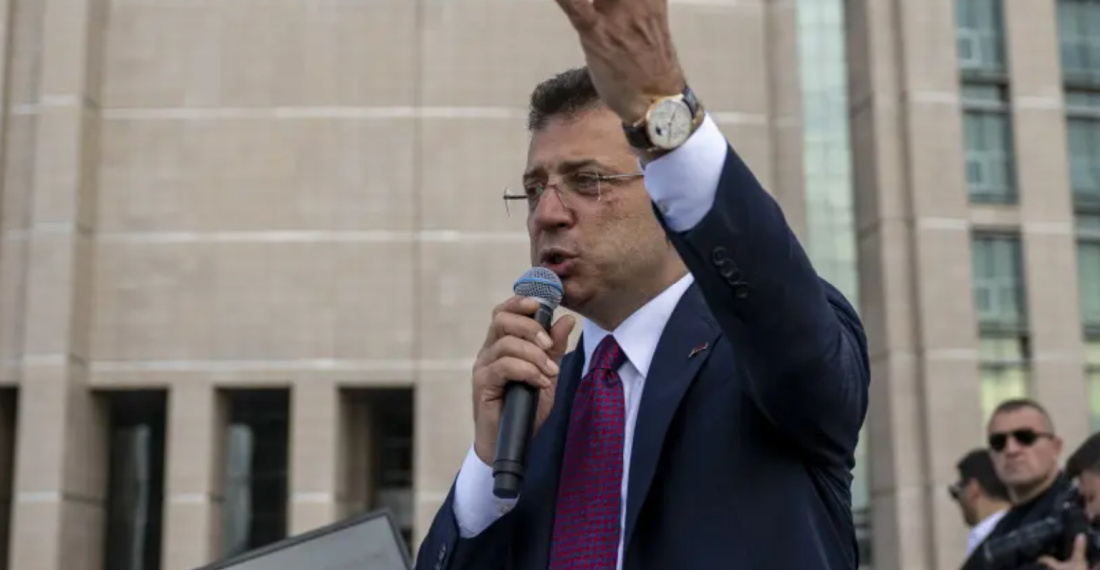
Istanbul Mayor Ekrem Imamoglu appeared in court on Monday (April 6) alongside 402 co-defendants in a large-scale corruption case. Imamoglu, a leading figure in the opposition Republican People’s Party (CHP), has been detained since 19 March last year. His arrest triggered weeks of nationwide protests, the largest in Turkey in over a decade. Critics argue that his detainment is a way of targeting the country’s political opposition – Imamoglu is widely seen as a key challenger to President Recep Tayyip Erdogan, in power for more than two decades.
According to reports, Imamoglu requested to address the court during the morning session but was denied permission. Judges accused him of disrupting proceedings before leaving the courtroom, prompting a temporary suspension. Resuming in the afternoon, Imamoglu’s defense lawyer requested the replacement of the judges, a motion the court rejected.
The indictment spans approximately 3,900 pages and outlines 142 charges against Imamoglu. Prosecutors allege he led a criminal network established in 2015 during his tenure as mayor of Istanbul’s Beylikduzu district. The charges include bid-rigging and financial misconduct, with authorities claiming the network was used both for personal enrichment and to support his political rise within the CHP. Charged also for terrorism, espionage, falsifying his university diploma, and insulting officials, if convicted, Imamoglu could face a cumulative sentence exceeding 2,000 years.
Many of the co-defendants are municipal employees or CHP officials, while some journalists are also among those accused. People have come out in support of Imamoglu and his co-defendants, gathering near the Silivri complex, despite a ban on such demonstrations. They raised concerns about the fairness of the trial, highlighting the citing of “secret witnesses” whose identity is unknown to defense lawyers. The defendants were also forced to testify against each other, going against fair trial rights. Human rights organisations, including Human Rights Watch, have criticised the broader wave of cases against opposition figures. In a statement for Human Rights Watch on 3 March, Benjamin Ward, the group’s Europe and Central Asia deputy director, said the prosecutions risk “weaponizing the criminal justice system” and undermining democratic processes.
The role of Akin Gurlek has also drawn attention. Gurlek, who previously served as Istanbul’s chief prosecutor, initiated a series of investigations targeting CHP figures after his appointment in late 2024. Last month, Gurlek was appointed justice minister. Critics argue that his involvement raises concerns about political influence over the judiciary. The Turkish government maintains that courts operate independently and impartially.
Source: commonspace.eu with AP News.



