


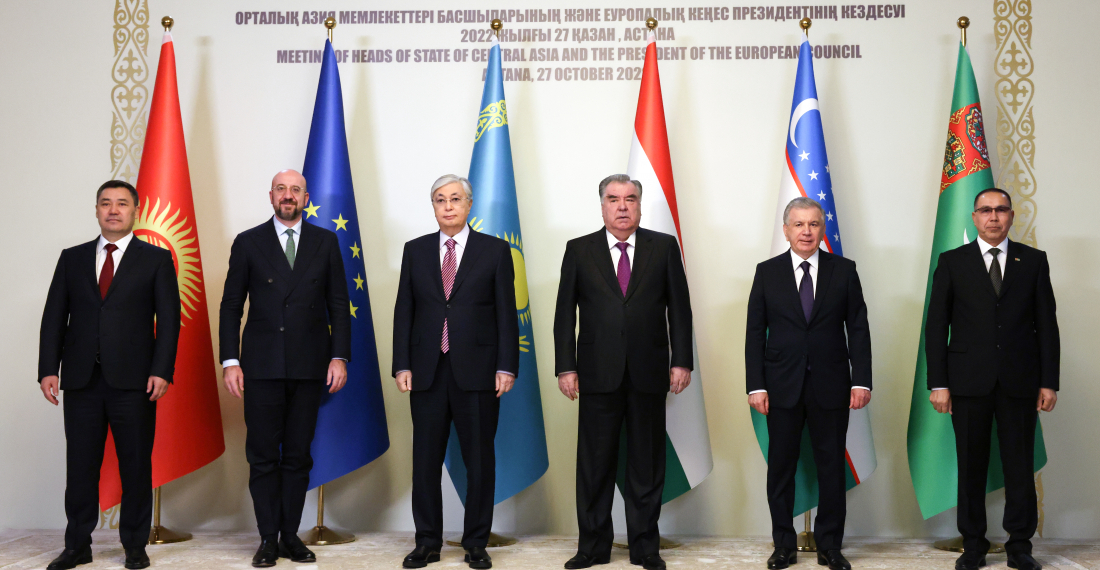
Historic first EU-Central Asia regional high level meeting

On 27 October 2022, President of the Republic of Kazakhstan Kassym-Jomart Tokayev, President of the Kyrgyz Republic Sadyr Zhaparov, President of the Republic of Tajikistan Emomali Rahmon, President of the Republic of Uzbekistan Shavkat Mirziyoyev and President of Turkmenistan Serdar Berdimuhamedov (represented by Turkmenistan's Deputy Chair of the Cabinet of Ministers) and President of the European Council Charles Michel welcomed the first regional high-level meeting in Astana.

A joint statement issued after the historic meeting said that:

In an open and friendly atmosphere of mutual respect and trust, the participants summarized the past period of multifaceted and mutually beneficial cooperation between Central Asian states and the EU and reaffirmed their commitment to continue building a strong diversified and forward-looking partnership underpinned by shared values and mutual interests. They reaffirmed their commitment to work together for peace, security, democracy, rule of law and sustainable development in full respect for international law. They expressed continued commitment to uphold the UN Charter, particularly the principles of respect for the independence, sovereignty, territorial integrity of all countries., non-use of force or threat of its use and peaceful settlement of international disputes.

The statement added:

"In the 30 years since the establishment of diplomatic relations between Central Asian States and the EU, interregional cooperation has advanced in many areas and sectors and serves as an example of a multilateral partnership for prosperity and sustainability.

The Leaders confirmed the importance of strengthening dialogue on the rule of law, human rights, gender equality and the work of institutions, which are guiding principles for inter-regional cooperation in the framework of the EU Strategy for Central Asia of 17 June 2019.

Participants welcomed the institutionalization of the relationship between the Central Asian nations and the EU through the work of existing high-level platforms, and stressed the importance of active involvement of civil society in developing interregional cooperation.

The President of the European Council welcomed the efforts of Central Asian leaders to strengthen regional cooperation and connectivity as set out in the Joint Statements of the Consultative Meetings of Central Asian Heads of State.

In their turn, the Heads of State of Central Asia highly appreciated the EU's contribution to intensifying economic development after the pandemic, overcoming socio-economic challenges caused by COVID 19 and promoting cross-border cooperation in the region. Support and expansion of mutual trade and investment mechanisms gives a qualitative impetus to socio-economic development of all parties. Parties underlined that creation of favourable business environment would help to further boost investments in the region, connectivity and trade. In this context, parties welcomed the new EU-Central Asia Economic Forum platform.

The Participants expressed common concern over the situation in Afghanistan and recognized the need to expand interaction in providing humanitarian aid to the Afghan people. The Participants stressed the importance of the promotion of and respect for human rights and fundamental freedoms of all Afghans, in particular women, girls and minorities, and the establishment of an inclusive and representative government. In this context, the interim results of the EU-UNDP pilot project on the training of Afghan women at universities in Kazakhstan and Uzbekistan, as well as in the framework of the special education programmes in the Kyrgyz Republic, Tajikistan and Turkmenistan are significant. The initiatives are aimed at creating higher education opportunities for Afghan citizens and contribute to the inclusive socio-economic development of women into the Afghan society.

The leaders noted the positive outcome and potential of cooperation between Central Asia and the EU in border management and security, in the joint fight against terrorism, transnational organized crime, human trafficking, migrant smuggling, trafficking in small arms and light weapons, transnational drug trafficking and cybersecurity threats in accordance with universal principles.

Participants stressed the crucial importance of developing a regional vision of and cooperation in building sustainable connectivity between Central Asia and the EU, in line with the EU Global Gateway strategy and the national transport and transit development objectives of Central Asian countries.

Central Asian leaders welcomed the EU’s intention to facilitate development of sustainable transport, logistics and digital interconnectivity while respecting green development standards. The expected outcomes of the EU study on sustainable connectivity in Central Asia are important, as is the close cooperation between the parties to harmonize Central Asia and EU transport routes including with the Trans-European Transport Network (TEN-T). In this context, participants welcomed the EU-Central Asia Ministerial Conference on Connectivity planned for November 2022.

The participants expressed their interest in strengthening joint actions in the field of “green development”, environmental protection and climate change in accordance with the Paris commitments of the parties. Taking into account the positive experience of the EU in developing and implementing mechanisms for joint management of water resources and transboundary rivers, the participants discussed options for strengthening inter-regional cooperation in the implementation of innovative, mutually beneficial and open water-energy partnership in Central Asia. The parties note the importance of strengthening the expert and analytical interaction between think tanks of the two regions in order to develop joint approaches to common challenges.

The participants expressed their deep gratitude to Kazakhstan for initiating and hosting the first meeting of the Heads of State of Central Asia and the EU and agreed to meet regularly."
source: commonspace.eu with the press service of the Council of the European Union
photo:  EU-Central Asia summit, 27 October 2022: from left to right Sadyr JAPAROV (President of Kyrgyzstan), Charles MICHEL (President of the European Council), Kassym-Jomart TOKAYEV (President of Kazakhstan), Emomali RAHMON (President of Tajikistan), Shavkat MIRZIYOYEV (President of Uzbekistan), Hojamyrat GELDIMYRADOW (Deputy Chair of the Cabinet of Ministers of Turkmenistan)

Related articles

Editor's choice
News
Key European countries back Denmark in the face of Trump's continuing insistence on taking over Greenland

Key European countries back Denmark in the face of Trump's continuing insistence on taking over Greenland

 Six major European countries have declared their support to Denmark following renewed insistence by the US that it must have control over Greenland. "Greenland belongs to its people, and only Denmark and Greenland can decide on matters concerning their relations," said the leaders of the UK, France, Germany, Italy, Poland, and Spain, in a joint statement, issued on Tuesday (6 January), together with Denmark. On Sunday, Donald Trump said the US "needed" Greenland - a semi-autonomous region of fellow Nato member Denmark - for security reasons. He has refused to rule out the use of force to take control of the territory, and Danish Prime Minister Mette Frederiksen warned on Monday that an attack by the US would spell the end of Nato. The issue of Greenland's future resurfaced in the wake of the US military intervention in Venezuela, during which elite troops went in to seize the country's President Nicolás Maduro and take him to face drugs and weapons charges in New York. Following the raid, Trump said the US would "run" Venezuela for an unspecified period of time. He also said the US was returning to an 1823 policy of US supremacy in its sphere of influence in the Western hemisphere - and he warned a number of countries the US could turn its attention to them. The US military raid in Venezuela has reignited fears that the US may consider using force to secure control of Greenland. A day after the raid, Katie Miller - the wife of one of Trump's senior aides - posted on social media a map of Greenland in the colours of the American flag, alongside the word "SOON". On Monday, her husband Stephen Miller said it was "the formal position of the US government that Greenland should be part of the US". In an interview with CNN, he also said the US "is the power of Nato. For the US to secure the Arctic region, to protect and defend Nato and Nato interests, obviously Greenland should be part of the US." Asked repeatedly whether the US would rule out using force to annex it, Miller responded: "Nobody's going to fight the US over the future of Greenland." Stressing they were as keen as the US in Arctic security, the seven European signatories of Tuesday's joint statement said this must be achieved by Nato allies, including the US "collectively" - whilst "upholding the principles of the UN Charter, including sovereignty, territorial integrity and the inviolability of borders". Greenland's Prime Minister Jens-Frederik Nielsen welcomed the statement and called for "respectful dialogue". "The dialogue must take place with respect for the fact that Greenland's status is rooted in international law and the principle of territorial integrity," Nielsen said. Trump has claimed that making Greenland part of the US would serve American security interests due to its strategic location and its abundance of minerals critical to high-tech sectors. Greenland, which has a population of 57,000 people, has had extensive self-government since 1979, though defence and foreign policy remain in Danish hands. While most Greenlanders favour eventual independence from Denmark, opinion polls show overwhelming opposition to becoming part of the US.
Editor's choice
News
Donald Tusk: "One for all, and all for one! Otherwise we are finished."

Donald Tusk: "One for all, and all for one! Otherwise we are finished."

Europe is rattled by events in Venezuela, and there are serious concerns that US disregard for international law may have consequences close to home.  The BBC diplomatic correspondent, James Landale, said, the question is how Europe may respond in the longer term to America's military operation in Venezuela. Will it provide a catalyst for the continent to take greater responsibility for its own security in the face of so much instability from what many see as an unreliable ally? Polish prime minister, Donald Tusk, appears to have answered the question, saying on social media: "No-one will take seriously a weak and divided Europe: neither enemy nor ally. It is already clear now. "We must finally believe in our own strength, we must continue to arm ourselves, we must stay united like never before. One for all, and all for one. Otherwise, we are finished." The US seizing of Venezuela's leader has faced strong criticism from both America's friends and foes at an emergency meeting of the United Nations Security Council, held on Monday, 5 January. Many member states agreed with the US that Nicolás Maduro had been an illegitimate and repressive leader. But many also condemned the US military action as a breach of international law and the UN Charter, and they demanded a democratic transition that reflected the will of the Venezuelan people. (click the image to read the full article).

Popular

Editor's choice
News
Key European countries back Denmark in the face of Trump's continuing insistence on taking over Greenland

Key European countries back Denmark in the face of Trump's continuing insistence on taking over Greenland

 Six major European countries have declared their support to Denmark following renewed insistence by the US that it must have control over Greenland. "Greenland belongs to its people, and only Denmark and Greenland can decide on matters concerning their relations," said the leaders of the UK, France, Germany, Italy, Poland, and Spain, in a joint statement, issued on Tuesday (6 January), together with Denmark. On Sunday, Donald Trump said the US "needed" Greenland - a semi-autonomous region of fellow Nato member Denmark - for security reasons. He has refused to rule out the use of force to take control of the territory, and Danish Prime Minister Mette Frederiksen warned on Monday that an attack by the US would spell the end of Nato. The issue of Greenland's future resurfaced in the wake of the US military intervention in Venezuela, during which elite troops went in to seize the country's President Nicolás Maduro and take him to face drugs and weapons charges in New York. Following the raid, Trump said the US would "run" Venezuela for an unspecified period of time. He also said the US was returning to an 1823 policy of US supremacy in its sphere of influence in the Western hemisphere - and he warned a number of countries the US could turn its attention to them. The US military raid in Venezuela has reignited fears that the US may consider using force to secure control of Greenland. A day after the raid, Katie Miller - the wife of one of Trump's senior aides - posted on social media a map of Greenland in the colours of the American flag, alongside the word "SOON". On Monday, her husband Stephen Miller said it was "the formal position of the US government that Greenland should be part of the US". In an interview with CNN, he also said the US "is the power of Nato. For the US to secure the Arctic region, to protect and defend Nato and Nato interests, obviously Greenland should be part of the US." Asked repeatedly whether the US would rule out using force to annex it, Miller responded: "Nobody's going to fight the US over the future of Greenland." Stressing they were as keen as the US in Arctic security, the seven European signatories of Tuesday's joint statement said this must be achieved by Nato allies, including the US "collectively" - whilst "upholding the principles of the UN Charter, including sovereignty, territorial integrity and the inviolability of borders". Greenland's Prime Minister Jens-Frederik Nielsen welcomed the statement and called for "respectful dialogue". "The dialogue must take place with respect for the fact that Greenland's status is rooted in international law and the principle of territorial integrity," Nielsen said. Trump has claimed that making Greenland part of the US would serve American security interests due to its strategic location and its abundance of minerals critical to high-tech sectors. Greenland, which has a population of 57,000 people, has had extensive self-government since 1979, though defence and foreign policy remain in Danish hands. While most Greenlanders favour eventual independence from Denmark, opinion polls show overwhelming opposition to becoming part of the US.

