Women are playing an increasing role in Georgian politics, but some think it is not enough. Dato Parulava explores the issue in this article for commonspace.eu.
The political temperature is soon to hit boiling point in Georgia, with only two days left before parliamentary elections. As in the rest of the world, Georgian politicians habitually make promises on which they are less than keen. In Georgia, one such promise is establishing gender balance in politics.
Since long before these particular elections, women's rights advocates have been actively campaigning to establish equal gender representation of deputies in Georgia's parliament. An initiative with cross-party support ultimately failed to make it through parliament, but has made its mark on the future prospects for increased representation of women in the legislature.
Although 52% of Georgia's population are women, they make up only 12% of sitting lawmakers. This puts Georgia in 108th place among 140 countries worldwide for female representation in parliament. Aside from this, women represent only 11% of local government members, and not one mayor or governor nationally is a woman.
There have been 3 draft laws discussed in parliament on increasing female representation in the legislative body, but none have been passed. Though some intended to impose mandatory gender quotas, others did not.
One initiative by international NGOs offered proposed a mandatory rule that 50% of all party list candidates should be a woman in order to qualify that party to register with the Central Election Commission. Had this passed, there would have been at least 38 women among the 150 members of the parliament.
Another initiative by MPs from ruling the Georgian Dream party, including vice-speaker of parliament Manana Kobakhidze, offered a 30% in the available budget to every party with an at least 33% female candidate list in a way that there is at least one woman in every 3 person of the list. Ultimately, none of these received parliamentary backing, with arguments for and against varying between 'empowerment of women' and 'artificial intervention in the system'.
Nevertheless, at a meeting organized by the Women's Movement in April, parties shared their opinions about a gender quota system. Though most of the parties present admitted that they did not support mandatory quotas, they did express approval of women's increased participation in politics.
As it stands, parties and blocs running 3 women in every 10 candidates are eligible for an additional 30% state funding, should they enter parliament. The National Democratic Institute (NDI) found, however, that only 4 out of 25 parties and blocs running for office were qualified for this payment.
Polling by the NDI showed that as of 2014, 70% of Georgians believe that at least 30% of parliamentarians should be women. The same polls also show that 74% of Georgians believe women in elected office perform equally or better than men. That said, compared to the 2012 election, the percentage of women running as both majoritarian and proportional list candidates has only marginally increased.
Despite the failure of efforts to legislate for better representation of women in parliament, political parties are trying to emphasize female presence in their lists. This July, when Georgian Dream nominated new candidates for the upcoming election, 8 of them were women. However, the trend of increased female inclusion is stagnant, with only 18 women in Georgian Dream's 155-person electoral list party. At the top, things are even more stark: only 6 of the 20 highest spots on the list are filled by women.
In United National Movement, the main opposition party, the situation is marginally better, with 50 women on a 200-person electoral list, but, as with Georgian Dream, only 6 women among the top 20 candidates.
According to the NDI, of the majoritarian candidates nominated by Georgia's ten largest parties, only 17% are women. As for the list candidates of said parties, women represent only 37%.
Overall, however, women's political participation is growing. A number of prominent women candidates are running in 2016, with ex-first lady Sandra Roelofs' UNM candidacy in Zugdidi only the most prominent. Alongside her are Tamar Chugoshvili, ex-head of a prominent NGO, running for Georgian Dream's list, and Tina Khidasheli, an ex-defence minister and a Republican Party candidate. Though they remain exceptions, rather than rules, if present trends continue, full political gender parity is only a matter of time.
source: DatoParulava is a journalist with the newspaper and website liberali.ge. He contributed this article to commonspace.eu
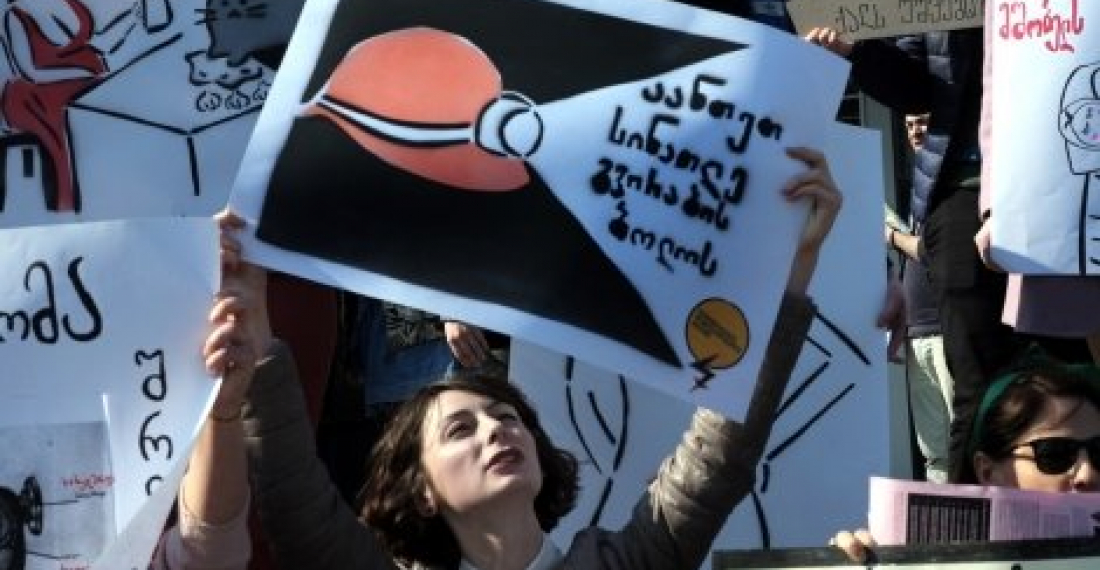
photo: On 8 March, International Women's day, a demonstration in Tbilisi organised by an independent feminist group asked for "More Women in Parliament".