Updated at 1800 CET (2100 Tbilisi)
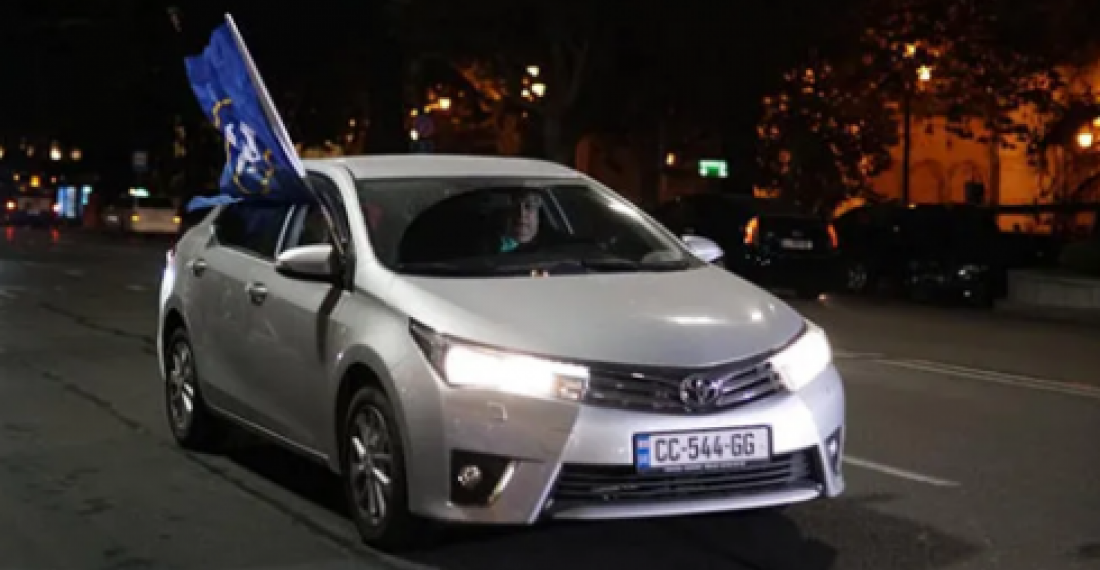
The ruling Georgian Dream party has claimed victory in today's parliamentary election, based on exit polls, most of which indicate that it will emerge as the largest party in the new parliament. But there is still some uncertainty if it will be able to secure enough seats to govern on its own. The largest opposition party in the poll was Mikheil Saakashvili's United National Movement, though again the exit polls differ a lot as to what percentage of votes the party got, although most put it around 30%. All the other parties got less than 5%. But we want to emphasis these are exit polls - and in Georgia they do not always reflect the reality. (Picture shows GD supporters in a carcade on Rustaveli Avenue - picture courtesy of Interpress News, Tbilisi)
Updated at 1730 CET (2030 Tbilisi)
Both government and opposition appear to be claiming victory in today's parliamentary elections in Georgia based on different exit poll predictions.
Updated at 1715 CET (2015 Tbilisi)
There are some preliminary exit poll results. One is giving the ruling Georgian Dream party a clear win with 52.26%
Updated at 1700 CET (2000 Tbilisi)
Polls are now closed in Georgia's parliamentary elections to choose 150 members of the new parliament.
During the day polling was largely peaceful, with some isolated incidents in Gldani, Bolnisi and Marneuli amongst others. But as closing time approached tensions became higher close to polling stations. Many opposition leaders have announced that they have won the election, although it is not clear on what information thiese assessments are based. It is likely to be a tense few hours until the results become known.
Updated at 1530 CET (1830 Tbilisi)
Tension is reported to be high near many polling stations in Georgia as the last voters make it to the polling stations before they close at 2000.
According to figures from the Georgian Central Elections Commission voter turnout so far (up to 1700 local time) was 45.77%.
1 million 607 530 voters had voted up to that point.
Updated at 1415 CET (1715 Tbilisi)
The Central Elections Commission has now released the number of voters as of 1500 Tbilisi Time 1,279,947 voters, representing 36.45% of the total number of voters had voted
The highest voter turnout was reported in the Racha-Lechkhumi-Kvemo Svaneti region, where 49.5% of voters cast their ballots as of 15:00, while the lowest voter turnout was reported in the Kvemo Kartli region - 33.9%. Tbilisi came in second to the last, with 34.2% voter turnout.
In comparison, in the 2016 parliamentary elections, voter turnout up to 1500 was 34.79%. Polls will close at 20.00 local time
Updated at 1400 CET (1700 Tbilisi)
As voting continues in the Georgian elections, the issue of international election observation has been under consideration after the European Parliament decided not to send an observation mission, and even more significantly ODIHR, the leading European election observation body decided not to deploy the planned five hundred short term observers, both because of the pandemic.
However a number of other parliamentary assemblies, such as the NATO PA, the OSCE PA and PACE have sent small missions. These are joined today by an EU led effort involving the EU Delegation, as well as Missions from the member states, Switzerland and Norway. Called the European Diplomatic Watch the seventy teams mobilised will monitor about one thousand polling stations. They will join thousands of domestic observers, who have been busy all day monitoring the process.
You can read more: Commentary: Weak international observation of the Georgian elections may have consequences
Updated at 1200 CET (1500 Tbilisi)
We now have the figures for polling until Midday local time (1200) - that is after four hours of voting.According to the Central Elections Commission voter turnout in the whole territory of Georgia was 19.41%. According to CEC spokeswoman Ana Mikeladze, 681,583 voters have cast their ballots so far.
"The highest activity is in Racha-Lechkhumi and Svaneti - 28.3% and the lowest rate in Adjara - 17.9%," said Ana Mikeladze.
Several political parties and domestic observation groups are reporting violations of procedure in various locations across the country, including carousel voting. The reports are being investigated
Updated at 1000 CET (1300 Tbilisi)
Voting has been brisk throughout the morning in Georgia's parliamentary elections being held today. Some small incidents were reported in Marneuli District and other parts of the Kvemo Kartli Region to the south of Tbilisi which has a large Azerbaijani speaking population. Some issues were also reported in Gldani District in Tbilisi, which is an opposition stronghold. This picture from a screengrab from TV Mtvari shows a fist fight in a polling station in Marneuli where a voter was alleged to have voted without an ID card.

The leader of the ruling Georgian Dream party, Bidhzina Ivanishvili voted this morning in Tbilisi. He said he was voting for a free future and for democracy. (picture screengrab from TV Maestro)

Voting in Tbilisi was reported to be brisque. Picture shows voters wearing masks because of coronavirus rules, entering polling station no 79 in Tbilisi's Saburtalo District on 31 October 2020 (Picture by George Simonishvili for commonspace.eu)

_________________________________________________________________________________________________________________________________________
Georgians are voting today (Saturday 31 October) to elect a new 150 member parliament: 120 elected by proportional representation, and 30 by a majoritarian electoral system.
48 parties and 2 election blocs are contesting the elections.
The consolidated voter list includes 3,526,023 voters, including 14,170 registered abroad.
The elections will be monitored by 80,819 representatives of political parties and candidates, 46981 representatives of 132 local observers and 910 observers of 5 election administrations, 20 embassies and 23 international organizations. 5 971 representatives of 118 media organizations will cover the election process.
Polling stations opened at 07:00 and will close at 20:00. The procedures to be carried out at the polling stations before the voting started at 07:00, and the direct voting procedure started at 08:00. The polling station will be closed at 20:00. (Georgian time is CET +3).
The election campaign was overshadowed by the Covid-19 pandemic . Most of the international attention has also been elsewhere in the Caucasus where a war is raging between Armenia and Azerbaijan.
source: commonspace.eu