European Leaders Unveil New Security Measures and Air Defence Initiatives for Ukraine

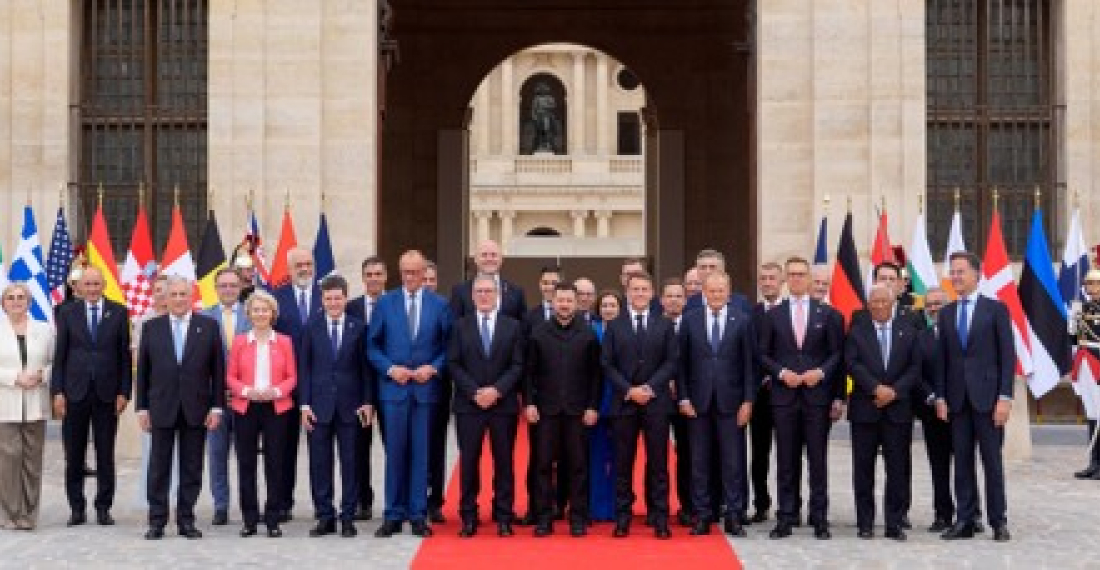
European leaders meeting in Paris on Monday (July 13) renewed their support for Ukraine by announcing new security initiatives, expanded military assistance and closer defence cooperation designed to strengthen Kyiv’s ability to defend itself against continued Russian attacks. Around 20 heads of state and government attended the meeting of the “Coalition of the Willing,” including French President Emmanuel Macron, Ukrainian President Volodymyr Zelensky, German Chancellor Friedrich Merz, British Prime Minister Keir Starmer and NATO Secretary General Mark Rutte.

The summit focused on increasing pressure on Russia while reinforcing long-term security guarantees for Ukraine. Participants reaffirmed their intention to support Kyiv “more quickly and more strongly” and said the measures were aimed at strengthening Ukraine’s position and encouraging Russia to engage in negotiations.

A central announcement concerned the Multinational Force for Ukraine (MNF-U), which is intended to provide reassurance and military support after a credible ceasefire comes into effect. According to the joint communiqué, the force would help regenerate Ukraine’s armed forces and contribute to security on Ukrainian territory once hostilities have stopped. Macron said multinational exercises would take place in neighbouring countries “in the coming months” to validate deployment plans and demonstrate that participating nations were prepared to operate jointly on land, at sea and in the air.

The meeting also resulted in the launch of a new anti-ballistic missile coalition bringing together Ukraine and nine European countries. Describing the initiative as “purely defensive,” participating governments said they would combine their defence industries, research capabilities and operational expertise to develop a shared European capacity to counter ballistic missile threats. The coalition will support the Freya project, a missile defence programme led by the Ukrainian company Fire Point that aims to provide a lower-cost alternative to existing systems such as the US Patriot interceptor and the Franco-Italian Aster missile. Macron said the project would combine the technological capabilities of participating countries and defence companies to accelerate protection for Ukraine.

Zelensky welcomed the announcement, describing the meeting as “a historic day for all of us.” He said Ukraine and its partners could jointly develop an anti-ballistic missile within twelve months and move towards affordable mass production. Strengthening air defence has remained one of Kyiv’s principal requests as Russia continues to launch frequent ballistic and hypersonic missile attacks against Ukrainian cities.

France also announced a significant expansion of its military assistance. Macron said Paris would supply Ukraine with 16 Rafale fighter aircraft, with the first expected to enter service in 2028–2029. France will also provide an initial batch of next-generation SAMP/T air-defence batteries, additional radar systems and support licensed production inside Ukraine of AASM guided bombs, Aster 30 surface-to-air missiles and Scalp cruise missiles. These measures are intended to strengthen Ukraine’s domestic defence industry while improving its ability to intercept aerial threats.

NATO Secretary General Mark Rutte participated in both the Coalition of the Willing meeting and the gathering of the Anti-Ballistic Missile Coalition. He stressed that continued support for Ukraine remained one of NATO’s highest priorities and recalled that alliance members had reaffirmed their “unwavering support” for Ukraine’s sovereignty and territorial integrity at last week's NATO Summit in Ankara. Rutte urged allies to continue supplying air and missile defence systems following recent Russian strikes on Kyiv and to deepen cooperation with Ukraine’s defence industry. He also noted that NATO members had pledged €70 billion in military equipment, assistance and training for Ukraine in 2026, with at least the same level of support planned for 2027.


Source: commonspace.eu with TF1 INFO (Paris), NATO (Brussels) and agencies
  

Related articles

Editor's choice
News
Russia puts pressure on Armenia ahead of Putin-Pashinyan meeting in Bishkek next week

Russia puts pressure on Armenia ahead of Putin-Pashinyan meeting in Bishkek next week

Russian president, Vladimir Putin, and Armenian prime minister, Nikol Pashinyan are expected to meet in Bishkek next week on the margins of the Shanghai Cooperation Organisation. Russian presidential aide Yury Ushakov confirmed this according to the Russian agency, TASS. “We will have a conversation with Armenian Prime Minister Nikol Pashinyan. Our leaders have already spoken following the elections held in Armenia, so it is fairly clear what the conversation will be about,” Ushakov said. He added that, among other issues, the leaders will discuss Yerevan’s aspiration to join the EU and its cooperation with the Eurasian Economic Union. “We continue to insist that Armenia cannot aspire to EU membership while at the same time receiving enormous benefits from its cooperation within the Eurasian Economic Union. This issue must somehow be resolved. And the President and the Prime Minister will undoubtedly discuss it,” Ushakov said. The meeting comes as Russia continues to put unprecedented pressure on Armenia. Using very undiplomatic language, Russian Foreign Ministry spokesperson, Maria Zakharova, on Friday (28 August), called on Pashinyan to stop shifting responsibility for Armenia's problems onto Russia and the CSTO. In 2022, the Armenian Prime Minister personally refused the deployment of the organization's mission, opting instead for Western mediation in Prague, where he officially recognized Karabakh as part of Azerbaijan, recalled the official representative of the Russian Ministry of Foreign Affairs. Yerevan's attempts to blame Moscow, the church, or its own citizens for the consequences of its own decisions are shameless and contradict historical facts, Zakharova emphasized. "Everyone is to blame in your view. Only you are not to blame." "Nikol Vovayevich, elections in your country have ended. You can stop hanging noodles on the ears of your people. Gather your courage and tell the truth at least once, as it actually happened," wrote Russian Foreign Ministry spokesperson Maria Zakharova, addressing Nikol Pashinyan’s statements yesterday. The five-year program of the Armenian government released this week, only speaks of releations with Russia as a "partnership" and omits the previously used term "strategic alliance". Pashinyan told the Armenian parliament this week, "The events of September 2022 took place right before your eyes. A strategic partnership should mean a strategic partnership. If we write 'strategic partnership' in the document now, you will ask why Russia and the CSTO did not fulfill their security obligations in September 2022. What else do I need to tell you?"

Popular

Editor's choice
Interview
Thursday Interview: Murad Muradov

Thursday Interview: Murad Muradov

Today, commonspace.eu starts a new regular weekly series. THURSDAY INTERVIEW, conducted by Lauri Nikulainen, will host  persons who are thinkers, opinion shapers, and implementors in their countries and spheres. We start the series with an interview with Murad Muradov, a leading person in Azerbaijan's think tank community. He is also the first co-chair of the Action Committee for a new Armenian-Azerbaijani Dialogue. Last September he made history by being the first Azerbaijani civil society activist to visit Armenia after the 44 day war, and the start of the peace process. Speaking about this visit Murad Muradov said: "My experience was largely positive. My negative expectations luckily didn’t play out. The discussions were respectful, the panel format bringing together experts from Armenia, Azerbaijan, and Turkey was particularly valuable during the NATO Rose-Roth Seminar in Yerevan, and media coverage, while varied in tone, remained largely constructive. Some media outlets though attempted to represent me as more of a government mouthpiece than an independent expert, which was totally misleading.  Overall, I see these initiatives as important steps in rebuilding trust and normalising professional engagement. The fact that soon a larger Azerbaijani civil society visits to Armenia followed, reinforces the sense that this process is moving in the right direction." (click the image to read the interview in full)