Kazakhstan's new ruling Adilet Party has taken a decisive lead in early exit polls, with more than 70% of the vote, in the country's early elections for its unicameral parliament, which could give it roughly 105 of the 145 seats in the new legislative chamber.
Five parties are projected to enter Kazakhstan’s new 145-member Kurultai, according to early exit polls. Parties needed at least 5% of the vote to win seats in the new legislature.
The election was Kazakhstan’s first parliamentary vote under the new Constitution, which replaced the bicameral Parliament with a single-chamber Kurultai.
The three exit polls put Adilet’s support between 70.7% and 72.3%, positioning the party for a commanding majority in the new 145-member unicameral Parliament, the Kurultai.
In other words, the poll projects around 109 seats for Adilet in Kurultai, giving the party a dominant majority.The Adilet Party merged with Amanat in 2022. Amanat, formerly Nur Otan, traces its roots to the 1999 campaign backing ex-President Nazarbayev. Copyright: Press service of the Adilet Party
The newly established Adilet Party, formed in April, absorbed Amanat, the country’s largest political party, ahead of the election.
Amanat has been the ruling party in Kazakhstan for almost 30 years. Formerly named Nur Otan, the party was created in 1999 from the electoral campaign headquarters,
The Adilet Party is now the country's most influential political force. It supports the new Constitution and nominated the largest number of candidates - 186.
The chair of the leading Adilet Party, Aibek Dadеbay, thanked voters after the first exit poll results were released.
"During the election campaign, we visited all regions and met with thousands of people across the country. At every meeting, we heard directly about the issues that matter to people, as well as their views and suggestions. Every opinion matters to us. All the proposals we received will be taken into account in our future work," he said.
Under the new electoral system, voters chose from seven political parties contesting the election. Unlike under the previous system, independent candidates could not run, with all Kurultai seats contested through party lists.
Who were the other parties competing in Kazakhstan’s first Kurultai election?
A total of seven political parties took part in the election, putting forward 545 candidates.
The first exit poll, conducted by the Kazakhstan Institute of Public Development, put Auyl at 6.2%, Respublica at 5.2%, Ak Zhol at 5.1% and the Nationwide Social Democratic Party at 5%. The People’s Party of Kazakhstan received 2.8%, while Baitaq got 0.9%.
The poll projects 12 seats for for Auyl, 9 for Respublica, 8 for the Nationwide Social Democratic Party and 7 for Ak Zhol. The People’s Party of Kazakhstan and Baitaq are not projected to win seats in the new Kurultai, exit polls show.
The Aq Zhol Democratic Party fielded 63 candidates. Founded in 2002, it advocates political and economic reforms, supports entrepreneurship and private business, and calls for strengthening the role of Parliament.
The Respublica Party, established in January 2023, nominated 75 candidates. The party focuses primarily on entrepreneurship, business and economic development.
The People’s Party of Kazakhstan fielded 72 candidates. Its platform centres on social policy, protection of workers and support for vulnerable groups.
The Auyl Party nominated 69 candidates. Founded in 2000, it has a clear political niche in the agricultural sector.
The Baitaq Green Party fielded 47 candidates. Founded in September 2022, it focuses on environmental protection and green development.
The Nationwide Social Democratic Party nominated 33 candidates. Founded in 2006, it entered Parliament for the first time in 2023.
Assessing the preliminary results, Indira Aubakirova, Head of the Institute of Legislation and Legal Information, said Adilet had used all available platforms effectively, making its lead over the other parties very expected.
"The People’s Party of Kazakhstan, to my surprise, received around 3%. There could be several factors behind this. Firstly, the new generation is entering political life, and it no longer shares these views. At the same time, the natural decline of the older population is also having an impact, meaning that there are fewer," she said.
Among the main contenders were Aq Zhol and Respublica, two parties that have traditionally focused on the interests of entrepreneurs and the business community.
"It would seem that Aq Zhol has such a rich background. It has been on the political scene since 2002. But Respublica is a much younger party, launched in 2023, and it positioned itself very correctly and built its election campaign in a very competent way."
A new vice president
On election day, President Tokayev also made several important statements about the country’s political future, including the appointment of Kazakhstan’s first vice president.
The position of vice president, like the new Kurultai, was introduced under the new Constitution.
Asked by journalists at a polling station when the country would learn the name of the new vice president, Tokayev said he would officially announce the appointment within seven to ten days.
Tokayev also said he plans to launch the Qazaqstan Khalyq Kenesi Secretariat or Kazakhstan People’s Council. The new body is intended to strengthen and develop work previously carried out by the Assembly of the People of Kazakhstan.
"I am confident that the work of the Kazakhstan People’s Council will be productive. The country should turn into a major construction site. Large construction projects will be implemented in every regional centre, district and city. Polyclinics, children’s rehabilitation centres and other social facilities will be built," said Tokayev.
The president’s comments came as Kazakhstan has already been accelerating construction and infrastructure projects across the country.
For example, just days before the election, several strategically important infrastructure projects were opened.
The Parliamentary elections come as Kazakhstan seeks to strengthen its role in Central Asia. For Kazakhstan, this is closely linked to its ambitions to expand trade, attract investment and develop transport routes between Asia and Europe, including the Middle Corridor and oil export routes.
Will Tokayev seek another presidential term?
One of the most closely watched questions on election day concerned Tokayev’s own political future.
Asked whether he would continue his presidential term and seek another election, Tokayev said he could give a more specific answer at a later stage.
"The Constitutional Court made such a decision. It is lawful, of course, and I have the legal right to be re-elected in accordance with the law," Tokayev said.
"But as for the upcoming election, whether I will run or not, and in which year, it is premature to speculate on that at this point."
The question is significant because the new Constitution changed the rules governing the presidency.
Tokayev’s current term remains the focus of political attention, while the constitutional changes have opened a new debate about the country’s political future.
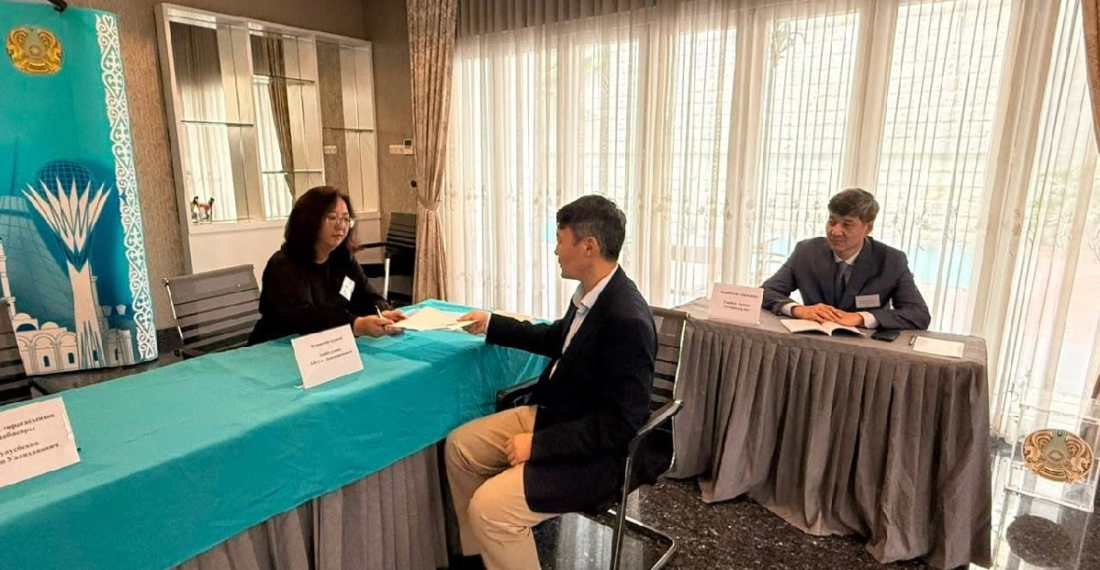
A total of 777 international observers followed the voting process.
Source: commonspace.eu with EURONEWS