


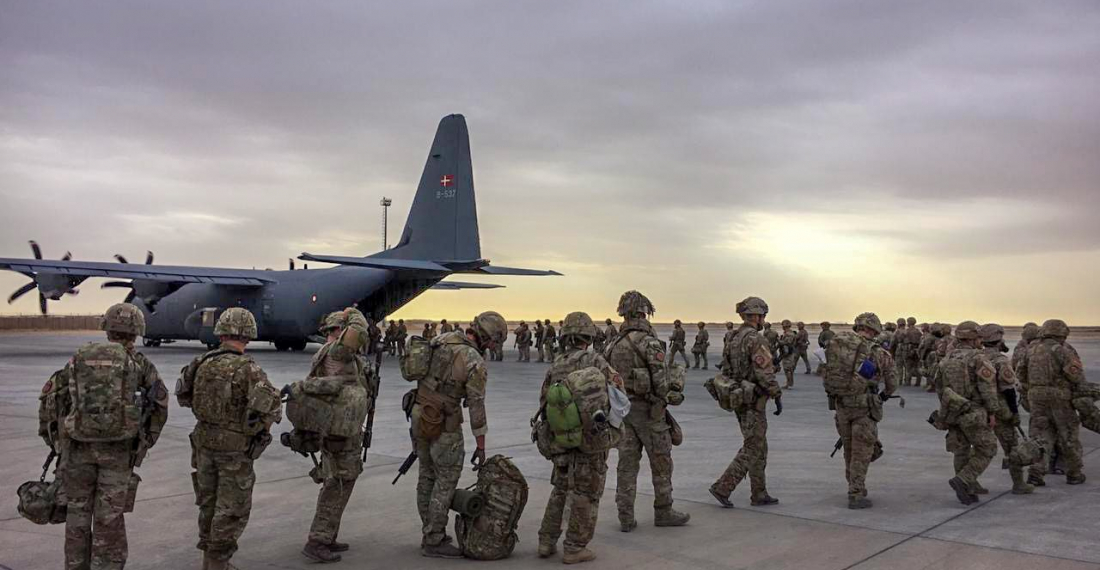
Danish forces deploying to the Sahel sail straight into a political storm between Mali and Paris

A detachment of ninety Danish special forces personnel who arrived in Mali to re-enforce Operation Barkhane, a regional effort aimed at combating the spread of jihadists forces in the Sahel, has become victim to on-going tensions between the military government in Mali and Paris.

The Malian government has requested the repatriation of the Danish soldiers back to their country, even though they had just arrived as reinforcements in the framework of operation Barkhane - an EU supported initiative aimed at re-enforcing the capability of countries in the Sahel in combating ongoing jihadist violence through the joint Task Force Takuba. Bamako denounced the way the Danish contingent had been deployed, but according to the newspaper Le Monde, this unexpected development is the result of a conflict between Paris and the Malian regime.

On 24 January, the ruling military junta denounced the recent deployment of elite Danish troops in Mali. According to the Malian authorities this reinforcement organised by France was co-ordinated by France  without the "consent" of the Malian government, and that this violates the terms of the "additional protocol" which is part of the existing agreements between France and Mali.

All countries joining Task Force Takuba must indeed be "invited, approved and authorised by the government of Mali".  Denmark insists that it has been invited to deploy the detachment. A letter from 2019 containing the Malian invitation was made public by the Danish government.

According to Signe Marie Cold-Ravnkilde, a researcher at the Danish Institute for International Studies, the Malians “want to make it clear that they are the ones who decide in Mali, and to tell France that it cannot just invite foreign forces onto their territory”.  

According to Malians, the modalities of deployment of Task Force Takuba, as stipulated in the terms of an agreement signed between France and Mali in 2013 in the framework of Operation Barkhane, gives too much leeway to the Europeans.

Last month (December 2021), when the Malian government asked for the revision of the defence agreements with France, the Malians demanded that for each new country joining the military coalition, a bilateral agreement be signed sperate from the one that established Operation Barkhane.

For some time France has been trying to involve the EU and EU member states in the anti jihadist efforts in the Sahel, and Task Force Takuba is supposed to be an expression of a new commitment by the EU to engage militarily with the problems of the region. The incident with the Danish forces puts this into question, with considerable political implications.
Sources : CommonSpace.eu, Le Monde (Île-de-France), and other media outlets
Picture : Danish special forces deploying to Mali sailed straight into the middle of a political storm, The Copenhagen Post

Related articles

Editor's choice
News
European leaders set out their plan for Ukraine

European leaders set out their plan for Ukraine

The leaders of Germany, Denmark, Finland, France, Italy, Netherlands, Norway, Poland, Sweden, and United Kingdom, together with the President of the European Council, and the President of the European Commission, o  Monday (15 December) issued a statement, outlining their plan for Ukraine. In their statement, Chancellor Merz, Prime Minister Frederiksen, President Stubb, President Macron, Prime Minister Meloni, Prime Minister Schoof, Prime Minister Støre, Prime Minister Tusk, Prime Minister Kristersson, Prime Minister Starmer, as well as President Costa and President von der Leyen spoke about "Peace for Ukraine". The Leaders welcomed significant progress on President Trump’s efforts to secure a just and lasting peace in Ukraine. They also welcomed the close work between President Zelenskyy’s and President Trump’s teams as well as European teams over the recent days and weeks. They agreed to work together with President Trump and President Zelenskyy to get to a lasting peace which preserves Ukrainian sovereignty and European security. Leaders appreciated the strong convergence between the United States, Ukraine and Europe. Leaders agreed that ensuring the security, sovereignty, and prosperity of Ukraine was integral for wider Euro-Atlantic security. They were clear that Ukraine and its people deserved a prosperous, independent, and sovereign future, free from fear of future Russian aggression. Both the US and European leaders committed to work together to provide robust security guarantees and economic recovery support measures for Ukraine in the context of an agreement on ending the war. This would include commitments to: Provide sustained and significant support to Ukraine to build its armed forces, which should remain at a peacetime level of 800,000 to be able to deter conflict and defend Ukraine’s territory. A European-led ‘multinational force Ukraine’ made up from contributions from willing nations within the framework of the Coalition of the Willing and supported by the US. It will assist in the regeneration of Ukraine’s forces, in securing Ukraine’s skies, and in supporting safer seas, including through operating inside Ukraine. (Click the image to read the statement in full).

Popular

