Changes in the Azerbaijan Presidential administration

The Presidential Administration has over the last two decades been a source of stability and stagnation. One new appointee says that the changes "are aimed at ensuring dynamism, flexibility and optimality in the activity of the country's supreme executive body in accordance with the new situation and challenges".

The Presidential Administration is arguably the most important institution of Azerbaijan. In a presidential republic, tightly controlled from the centre, the Presidential Administration has been the source of ideology, policy and guidance since Heidar Aliyev came to power in 1994, overshadowing both the Cabinet of Ministers and the Parliament. Its head, Ramiz Mehdiyev, an octogenerian of the old school, has been its head ever since, an anchor of stability and stagnation.

Change is in the air however, and this week has probably seen more changes happening in the august body, than seen in the previous two decades. First came the announcement of various structural changes. Departments were abolished, new ones created. Some advisors and heads of departments were unceremoniously retired, and some new faces appeared. It will take some time before the dust settles, and the true extent of these changes understood. Apart from the structural and personnel changes however, another factor has now appeared. The presidential administration encompasses the teams of both the President, Ilham Aliyev, and the 1st Vice president, Mehraban Aliyeva. This has had an impact on the order of precedence within the presidential administration.

According to the official notice of the new composition of the presidential administration, it now looks like this:

Head of the Administration of the President of the Republic of Azerbaijan Ramiz Mehdiyev

Assistant to the President of the Republic of Azerbaijan Jamila Abbasova

Head of the Secretariat of the First Vice-President of the Republic of Azerbaijan Altay Hasanov

Assistant to the President for Agrarian Policy Issues, Department Head Azer Amiraslanov

Assistant to the President for Territorial and Organizational Issues, Department Head Zeynal Naghdaliyev

Assistant to the President for Work with Law Enforcement Bodies and Military Issues, Department Head Fuad Alasgarov

Assistant to the President for Foreign Policy Issues, Department Head Novruz Mammadov

Assistant to the President for Public and Political Issues, Department Head Ali Hasanov

Assistant to the President for Economic Issues, Department Head Ali Asadov

Assistant to the President for Economic Policy and Industry Issues, Department Head Natig Amirov

Assistant to the President for Multinational Relations, Multiculturalism and Religious Issues, Department Head

Head of the Secretariat of the President, Assistant to the President Dilara Seyidzade

Press Secretary of the President Azer Gasimov

Chief of the Protocol Service of the President Elchin Baghirov

Head of the Department of Civil Service and Human Resources Issues Talat Majidov

Head of the Department of State Control Eldar Nuriyev

Head of the Department of Youth Policy and Sport Issues Yusuf Mammadaliyev

Head of the Department of Humanitarian Policy Issues

Head of the Department of Legislation and Legal Expertise Shahin Aliyev

Head of the Department for Work with Documents and Citizens' Requests Suleyman Ismayilov

Head of the Department of Strategic Research and Planning Saadat Yusifova

There has been little comment from public officials about the changes. However one of the new appointees has been quick to comment. His position is unique because he holds a dual role - as head of the recently created post of Department of Youth Policy and Sports Issue, and also Assistant to 1st Vice president Mehraban Aliyeva. 

Yusuf Mammadaliyev was born on January 23, 1979 in Baku. He received his education in Azerbaijan and in 1997 joined the Foreign Service, where he held several diplomatic positions.

From January 2014 he continued his activity as an expert at the Heydar Aliyev Foundation and executive director of the Public Association İDEA.

The Azerbaijan News Agency APA interviewed Mammadaliev about his appointment. He said:

"First of all, I would like to note that the structural changes carried out under the order of the president are aimed at ensuring dynamism, flexibility and optimality in the activity of the country's supreme executive body in accordance with the new situation and challenges. Strong presidential institution is undoubtedly a necessary term for stable and sustainable governance. As you know, those appointed as assistants to the president have many years of management experience. The establishment of the Department of Youth Policy and Sport Issues under Administration of the President of the Republic of Azerbaijan is aimed at successful implementation of the reforms set up by the president and more effective fulfillment of tasks. I want once again to express my gratitude to Mr. President and state that I would do my best to justify his confidence."

Asked about his dual appointment, Yusuf Mammadaliev told APA

"Today Azerbaijan is passing through an important stage of reforms. Following the referendum held on September 26, 2016, purposeful measures have been implemented in Azerbaijan for formation of efficient and flexible governance mechanism, strengthening vertical of executive power and executive discipline and improving the economic management mechanism to ensure the effectiveness and consistency of economic reforms. The creation of the post of the first vice-president and Mrs. Mehriban Aliyeva's appointment as the first vice-president are an important part of these reforms. Mehriban Aliyeva is obviously serving the state and public both as a public figure and President of the Heydar Aliyev Foundation. Her historical and disinterested services are welcomed by every citizen of Azerbaijan, foreign governments and agencies. Thus, I comprehend important obligations and responsibilities of the post of the assistant to the first vice-president."


source commonspace.eu with APA, baku and agencies

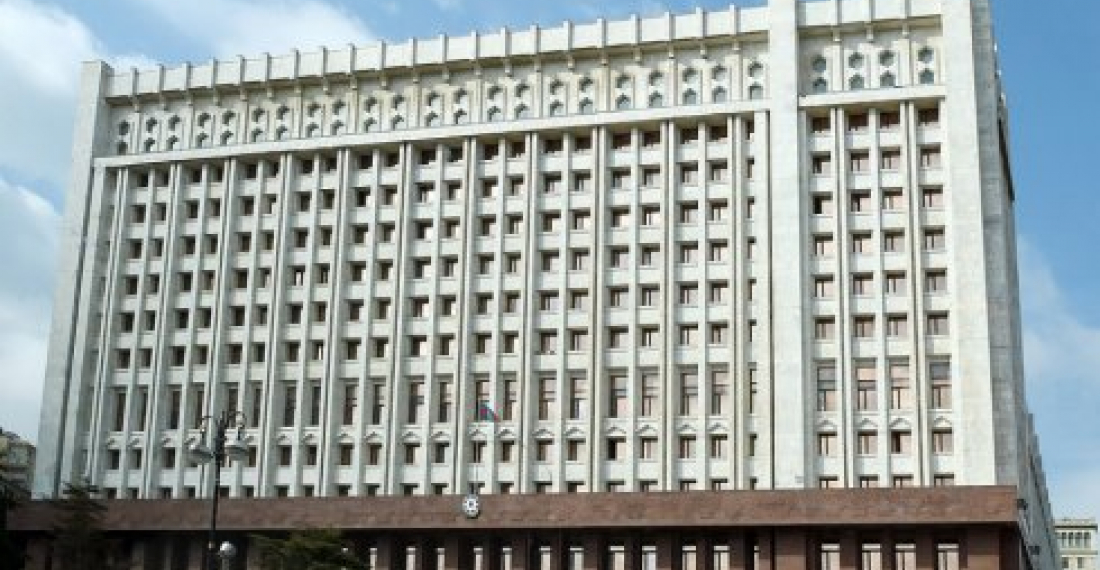
photo: The building of the presidential Administration of Azerbaijan in Baku
Related articles

Editor's choice
News
Russia adds pressure on Armenia ahead of key elections; recalls Ambassador in Yerevan for consultations

Russia adds pressure on Armenia ahead of key elections; recalls Ambassador in Yerevan for consultations

Ahead of key parliamentary elections,scheduled to be held in Armenia on Sunday, 7 June, Russia continues to attempt to put pressure on the Armenian Government led by prime minister Nikol Pashinyan. On 30 May, Russia recalled its Ambassador to Yerevan for consultations. A terse statement, published on the website of the Russian Foreign Ministry, said, "The Ambassador of the Russian Federation to the Republic of Armenia , S.P. Kopyrkin, has been summoned to Moscow for consultations in connection with the steps taken by the Armenian leadership to move closer to the European Union, which are detrimental to cooperation within the EAEU." This followed a statement issued the day before, by the leaders of the Eurasian Economic Union (EAEU) that challenges the Armenian trajectory towards approximating to the European Union. Vladimir Putin is undertood to have personally pushed the other four EAEU leaders to issue the statement, which said: "Taking into account the significant risks to the economic security of the member states of the Eurasian Economic Union (hereinafter referred to as the Union) arising in connection with the preparation of the Republic of Armenia for accession to the European Union, as well as the need to prevent the associated damage to the member states of the Union: decided that the members of the Eurasian Intergovernmental Council from the Republic of Belarus, the Republic of Kazakhstan, the Kyrgyz Republic and the Russian Federation will report at the next meeting of the Supreme Eurasian Economic Council in December 2026 on the possible consequences of the suspension of the Treaty on the Eurasian Economic Union with respect to the Republic of Armenia. We share the position on the need to hold a national referendum in the Republic of Armenia as soon as possible on joining the European Union or continuing to be part of the Eurasian Economic Union."
Editor's choice
News
The leaders of the states of the Eurasian Economic Union issued a tough statement warning fellow-member state Armenia of the consequences of its desire to join the European Union.

The leaders of the states of the Eurasian Economic Union issued a tough statement warning fellow-member state Armenia of the consequences of its desire to join the European Union.

The leaders of the states of the Eurasian Economic Union (EEAS) issued a tough statement warning fellow-member state Armenia of the consequences of its desire to join the European Union. The stark, sharply worded,  warning, comes days before crucial parliamentary elections in Armenia, scheduled for 7 June. The full statement said, “We, the Presidents of the Republic of Belarus, the Republic of Kazakhstan, the Kyrgyz Republic and the Russian Federation, Taking into account the actions of the Republic of Armenia aimed at joining the European Union, including the approval in 2025 by the National Assembly of the Republic of Armenia and the signing by the President of the Republic of Armenia of the Law of the Republic of Armenia "On the Start of the Process of Accession of the Republic of Armenia to the European Union", as well as the confirmation by the European Union of the European aspirations of the Government of the Republic of Armenia, expressed in the joint declaration following the first Armenia-European Union summit, adopted on 5 May 2026, Taking into account the significant risks to the economic security of the member states of the Eurasian Economic Union (hereinafter referred to as the Union) arising in connection with the preparation of the Republic of Armenia for accession to the European Union, as well as the need to prevent the associated damage to the member states of the Union: decided that the members of the Eurasian Intergovernmental Council from the Republic of Belarus, the Republic of Kazakhstan, the Kyrgyz Republic and the Russian Federation will report at the next meeting of the Supreme Eurasian Economic Council in December 2026 on the possible consequences of the suspension of the Treaty on the Eurasian Economic Union with respect to the Republic of Armenia. We share the position on the need to hold a national referendum in the Republic of Armenia as soon as possible on joining the European Union or continuing to be part of the Eurasian Economic Union. Astana, May 29, 2026” A meeting of the Supreme Eurasian Economic Council was held in Astana, Kazakhstan, on May 29, 2026. The meeting of the Supreme Eurasian Economic Council in a restricted format was attended by Russian President Vladimir Putin, Belarusian President Alexander Lukashenko , Kazakh President Kassym-Jomart Tokayev , Kyrgyz President Sadyr Japarov , Armenian Deputy Prime Minister Mher Grigoryan, and Chairman of the Board of the Eurasian Economic Commission Bakytzhan Sagintayev. From the Russian side, the meeting was also attended by Deputy Prime Minister and member of the Council of the Eurasian Economic Commission Alexey Overchuk and Presidential Aide Yury Ushakov . The heads of delegations from EAEU observer states, including President of Uzbekistan Shavkat Mirziyoyev , Vice President of Cuba Salvador Valdés Mesa, Minister of Industry, Mines, and Trade of Iran Mohammad Atabak, and CIS Secretary General Sergei Lebedev, joined the expanded meeting . Following the meeting of the Supreme Eurasian Economic Council, a number of documents were signed .

Popular

Editor's choice
Interview
Thursday Interview: Murad Muradov

Thursday Interview: Murad Muradov

Today, commonspace.eu starts a new regular weekly series. THURSDAY INTERVIEW, conducted by Lauri Nikulainen, will host  persons who are thinkers, opinion shapers, and implementors in their countries and spheres. We start the series with an interview with Murad Muradov, a leading person in Azerbaijan's think tank community. He is also the first co-chair of the Action Committee for a new Armenian-Azerbaijani Dialogue. Last September he made history by being the first Azerbaijani civil society activist to visit Armenia after the 44 day war, and the start of the peace process. Speaking about this visit Murad Muradov said: "My experience was largely positive. My negative expectations luckily didn’t play out. The discussions were respectful, the panel format bringing together experts from Armenia, Azerbaijan, and Turkey was particularly valuable during the NATO Rose-Roth Seminar in Yerevan, and media coverage, while varied in tone, remained largely constructive. Some media outlets though attempted to represent me as more of a government mouthpiece than an independent expert, which was totally misleading.  Overall, I see these initiatives as important steps in rebuilding trust and normalising professional engagement. The fact that soon a larger Azerbaijani civil society visits to Armenia followed, reinforces the sense that this process is moving in the right direction." (click the image to read the interview in full)