Burkina Faso's president calls for "restraint" as anger mounts amidst increasing attacks

The president of Burkina Faso, Roch Marc Christian Kaboré, has called on his compatriots for "restraint", asking them "not to take actions that jeopardise our unity and our common future" amidst protests over increasing extremist violence in the country.

Since the beginning of the jihadist insurgency in 2015, Burkina Faso has suffered innumerable inhumane attacks on its population. One of the latest tragedies occurred in the north-eastern village of Solhan on the night of 4-5 May, where at least 132 civilians lost their lives in an attack. On 29 June, the Burkinabè chief prosecutor, Émile Zerbo, stated that two suspected jihadists accused of playing a key role in the attack – including the "head of a terrorist base" –  had been arrested and indicted for "offences related to terrorism".

Three weeks after the massacre, the Burkinabè population remains in shock, and faced with multiple terrorist attacks in recent months, anger is mounting in the country. On 12 June, several thousand people took to the streets in Dori, the capital of Burkina Faso's Sahel region, to denounce the government’s “inaction”.

Other demonstrations took place on 26 June following new attacks in the country, with several thousand gathering once again – this time in the cities of Kaya and Titao, where the premises of a provincial high commission were ransacked.

The Burkinabè opposition has been particularly active during this wave of anger and protest. It recently announced a series of marches on 3 and 4 July across the country, "to protest against the deterioration of the security situation and demand strong measures". Taking advantage of this mounting anger, the leader of the opposition demanded the resignation of both the prime minister and the minister of defence of Burkina Faso during a press conference on 25 June, declaring that “the government does not have a strategy to combat insecurity”.

Security forces are also seen to share this discontent, concerned that the government does not provide adequate equipment whilst sending troops on high-risk itineraries and missions. On 21 June, at least 11 police officers were left dead after an ambush on a relief mission in north-central Burkina Faso. "The men do not have the right equipment, they lack weapons, ammunition and armoured vehicles, they have to take big risks when they move from the capital by road", denounced Siyalé Moussa Palm, the secretary general of UNAPOL, Burkina Faso's police union.

A final group said to feel particularly disillusioned is the VDP (“Volunteers for the Defence of the Homeland”) – a civilian defence force created in December 2019, recruited and trained by the army to fight terrorism. According to local sources, their post in Solhan was the first target of the attackers on the night of the 4-5 May massacre. “Many have been killed, they are poorly equipped and not all have been trained. We alert the security forces, but they do not come”, denounced a spokesperson for the march in Titao, according to Le Monde.

About a hundred “terrorists” were neutralised in June during a joint operation between the armies of Burkina Faso and Niger at the border of the two countries, according to a statement. Nonetheless, the population – which is the main victim of jihadist violence – are not reassured, aware of the complete absence of security forces in 30% of the territory. Local sources report that when they are present, they are slow to intervene due to difficult access and mined routes. The Solhan massacre is cited as a perfect illustration of this issue as it reportedly took seven hours for security forces, located 14km away from the village, to arrive at the scene of the massacre after being alerted.

On Sunday evening (27 June), in a message to the nation, the president of Burkina Faso, Roch Marc Christian Kaboré, addressed the population's mounting anger. He called for “restraint” and asked political parties and civil society organisations to “suspend” these demonstrations “in order to not to create the bed of our disunity, in the face of the common enemy”. But it appears that more and more Burkinabès are questioning the capacity of the authorities to cope with the security crisis, which in six years has already claimed several thousand lives and forced more than a million people to flee their homes.
 

source: commonspace.eu with France24 (Île-de-France), Le Monde (Paris) and agencies.
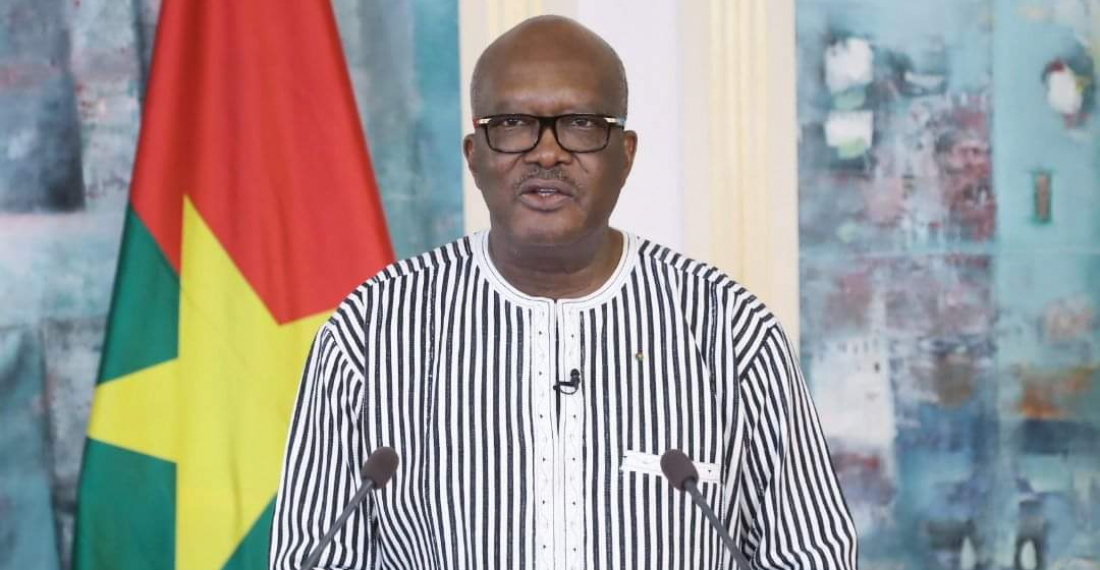
photo: President Roch Marc Christian Kaboré during his message to the nation in Ouagadougou, 27 June 2021; @presidencebf (Twitter)

Related articles

Editor's choice
News
Women emerge favourite to lead United Nations from next year, after straw-poll of UN Security Council members

Women emerge favourite to lead United Nations from next year, after straw-poll of UN Security Council members

​ Two women have emerged as favourite to lead the United Nations as Secretary-General from 1 January 2027, when the term of the present incumbent, Antonio Gutteres, expires. A straw poll of the members of the UN Security Council, held on Thursday, 30 July showed that of the seven candidates, Rebecca Grynspan of Costa Rica and Carolyn Rodriguez-Birkett of Guyana received ten and nine positive endorsements respectively, by the 15 members UN Security Council Although the poll and its result are supposed to be secret, the result leaked within minutes, and was carried on world media outlets, such as Reuters. The result was as follows   Michelle Bachelet 6 encourage 5  discourage   4 no opinion María Fernanda Espinosa 5 2 8 Rafael Grossi 7 2 6 Rebeca Grynspan 10 1 4 Olara Otunnu 2 5 8 Carolyn Rodrigues-Birkett 9 2 4 Macky Sall 6 7 2   Article 97 of the UN Charter states that the “Secretary-General shall be appointed by the General Assembly upon the recommendation of the Security Council”. Straw polls are informal ballots used to determine the viability of Secretary-General candidates.  The seven current candidates are: Michelle Bachelet Jeria (Chile), who was nominated by Brazil, Chile, and Mexico on 2 February, with Chile withdrawing its nomination on 24 March; María Fernanda Espinosa Garcés (Ecuador), who was nominated by Antigua and Barbuda on 11 May; Rafael Mariano Grossi (Argentina), who was nominated by Argentina on 26 November 2025; Rebeca Grynspan Mayufis (Costa Rica), who was nominated by Costa Rica on 3 March; Olara Otunnu (Uganda), who was nominated by Uganda on 24 July; Carolyn Rodrigues Birkett (Guyana), who was nominated by Guyana on 15 June; and Macky Sall (Senegal), who was nominated by Burundi on 2 March. At Thursday's straw poll, there was no difference between the ballots presented to the five permanent members (P5) and the ten elected members (E10). Council members received one ballot per candidate, containing the candidate’s name followed by three options: “encouraged”, “discouraged”, and “no opinion expressed”.   It is ofcourse early days, and the straw poll is just an informal indication of the mood of the UN Security Council, but the strong showwing by the two womencandidates may be an indication that for the first time, the head of the UN can be a women. (click image to read more) ​

Popular

Editor's choice
Interview
Thursday Interview: Murad Muradov

Thursday Interview: Murad Muradov

Today, commonspace.eu starts a new regular weekly series. THURSDAY INTERVIEW, conducted by Lauri Nikulainen, will host  persons who are thinkers, opinion shapers, and implementors in their countries and spheres. We start the series with an interview with Murad Muradov, a leading person in Azerbaijan's think tank community. He is also the first co-chair of the Action Committee for a new Armenian-Azerbaijani Dialogue. Last September he made history by being the first Azerbaijani civil society activist to visit Armenia after the 44 day war, and the start of the peace process. Speaking about this visit Murad Muradov said: "My experience was largely positive. My negative expectations luckily didn’t play out. The discussions were respectful, the panel format bringing together experts from Armenia, Azerbaijan, and Turkey was particularly valuable during the NATO Rose-Roth Seminar in Yerevan, and media coverage, while varied in tone, remained largely constructive. Some media outlets though attempted to represent me as more of a government mouthpiece than an independent expert, which was totally misleading.  Overall, I see these initiatives as important steps in rebuilding trust and normalising professional engagement. The fact that soon a larger Azerbaijani civil society visits to Armenia followed, reinforces the sense that this process is moving in the right direction." (click the image to read the interview in full)