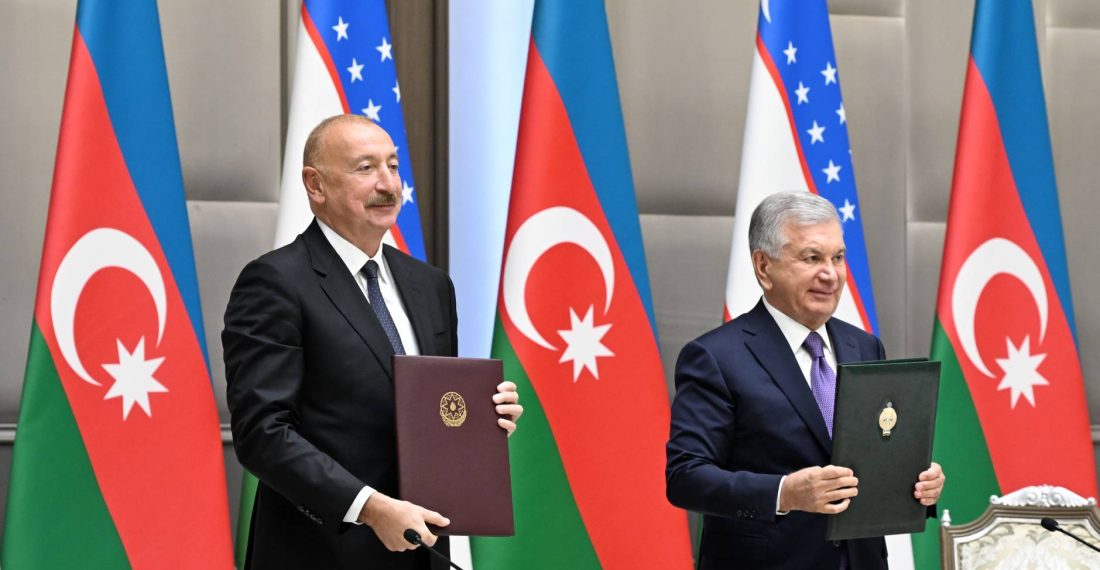
Azerbaijan and Uzbekistan have signed a "Treaty of Eternal Friendship", at the end of a State Visit of Azerbaijani President, Ilham Aliyev, to Tashkent.
On August 23, a ceremony for the signing and exchange of documents between Azerbaijan and Uzbekistan was held in Tashkent with the participation of President of the Republic of Azerbaijan Ilham Aliyev and President of the Republic of Uzbekistan Shavkat Mirziyoyev. The Treaty marks a high point in relations between the two countries, as a confidant Azerbaijan widen its relations with Central Asia and its countries, whilst Uzbekistan seeks to consolidate new routes to the wider world.
President of the Republic of Azerbaijan Ilham Aliyev and President of the Republic of Uzbekistan Shavkat Mirziyoyev signed the “Treaty on Eternal Friendship between the Republic of Azerbaijan and the Republic of Uzbekistan” and the “Decision of the Third Meeting of the Supreme Interstate Council of the Republic of Azerbaijan and the Republic of Uzbekistan”.
President Mirzozayev said,
''The current state visit of the President of Azerbaijan to Uzbekistan is, without exaggeration, of historic significance. We have spoken about this several times today, because everything we sign and every agreement we reach represents a historic milestone in bilateral cooperation. Today, we signed the Treaty on Eternal Friendship. Just imagine the level to which our relations have reached between our regions, businesses, governments and parliaments. This is not simply a document; it reflects our shared commitment to deepening cooperation, expanding opportunities for interaction and building a common future.''
Ambassador Extraordinary and Plenipotentiary of Azerbaijan to Uzbekistan Rashad Mammadov and Chairman of the Customs Committee under the Ministry of Economy and Finance of the Republic of Uzbekistan Akmalkhuja Mavlonov exchanged the "Memorandum on exchange of experience and cooperation in the field of Cynology between the State Customs Committee of the Republic of Azerbaijan and the Customs Committee under the Ministry of Economy and Finance of the Republic of Uzbekistan".
Ambassador Extraordinary and Plenipotentiary of Azerbaijan to Uzbekistan Rashad Mammadov and Chairman of the Tourism Committee of Uzbekistan Abdulaziz Akkulov exchanged the "Agreement between the Government of the Republic of Azerbaijan and the Government of the Republic of Uzbekistan on Cooperation in the Field of Tourism".
Minister of Culture of Azerbaijan Adil Karimli and Minister of Culture of Uzbekistan Ozodbek Nazarbekov exchanged the "Agreement between the Government of the Republic of Azerbaijan and the Government of the Republic of Uzbekistan" on Cooperation in the Field of Culture.
Minister of Economy of Azerbaijan Mikayil Jabbarov and Minister of Investment, Industry and Trade of Uzbekistan Laziz Kudratov exchanged the “Program on Increasing Trade Turnover between the Republic of Azerbaijan and the Republic of Uzbekistan to 1 billion US dollars by 2030” and the “Practical Action Plan for the Implementation of Projects between the Republic of Azerbaijan and the Republic of Uzbekistan (Roadmap) in the Field of Investment and Trade.”
Minister of Foreign Affairs of Azerbaijan Jeyhun Bayramov and Minister of Foreign Affairs of Uzbekistan Bakhtiyor Saidov exchanged the “Agreement between the Government of the Republic of Azerbaijan and the Government of the Republic of Uzbekistan on Cooperation in the Field of Pension Provision”, the “Cooperation Program between the Ministry of Foreign Affairs of the Republic of Azerbaijan and the Ministry of Foreign Affairs of the Republic of Uzbekistan for 2027-2028”, the “Cooperation Program between the State Agency for Public Service and Social Innovations under the President of the Republic of Azerbaijan and the Ministry of Justice of the Republic of Uzbekistan for 2027-2028”, as well as the “Protocol on the Establishment of Sister-City Relations between the City of Khankendi (Republic of Azerbaijan) and the City of Urgench (Republic of Uzbekistan)”, the “Protocol on the Establishment of Sister-City Relations between the City of Nakhchivan (Republic of Azerbaijan) and the City of Urgench (Republic of Uzbekistan)”, and the “Protocol on the Establishment of Sister-City Relations between the City of Lachin (Republic of Azerbaijan) and the City of Bukhara (Republic of Uzbekistan).”
source: commonspace.eu with president.az (Baku)
photo: President Aliyev of Azerbaijan and president Mirzizoyev of Uzbekista signed a "Treaty of Eternal Friendship" between the two countries, on 23 August 2026.