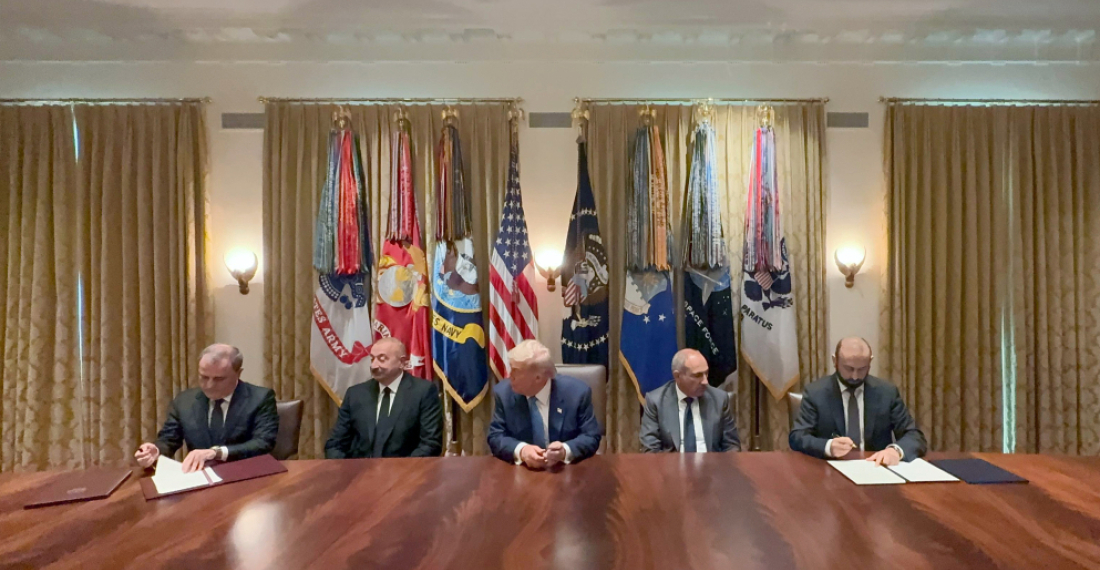
The agreement between Armenia and Azerbaijan, initialed at the White House in Washington DC on Friday, 8 August 2025 has been published.
The website of the Armenian Foreign said that, by mutual consent, the initialed agreement "On the establishment of peace and interstate relations between the Republic of Armenia and the Republic of Azerbaijan" is hereby published.
Here is the full text:
Agreement on the establishment of peace and interstate relations between the Republic of Armenia and the Republic of Azerbaijan
The Republic of Armenia and the Republic of Azerbaijan (hereinafter referred to as the Parties),
Recognizing the urgent need to establish a just, comprehensive and lasting peace in the region,
Seeking to contribute to the achievement of this goal through the establishment of interstate relations,
Guided by the Charter of the United Nations, the Declaration on Principles of International Law concerning Friendly Relations and Co-operation among States in Accordance with the Charter of the United Nations (1970), the Final Act of the Helsinki Conference on Security and Co-operation in Europe (1975) and the Almaty Declaration of 21 December 1991, and aiming to develop relations on the basis of the norms and principles enshrined in the aforementioned documents,
Expressing their mutual desire to establish good neighborly relations between them,
have agreed to establish peace and interstate relations between themselves on the following basis:
ARTICLE I
Affirming that the borders between the former Soviet Socialist Republics of the USSR have become the international borders of the respective independent states and have been recognized as such by the international community, the Parties recognize and will respect each other's sovereignty, territorial integrity, inviolability of international borders and political independence.
ARTICLE II
In full compliance with Article I, the Parties confirm that they have no territorial claims against each other and will not make such claims in the future.
The Parties shall not take any action, including the planning, preparation, encouragement and support of such actions, which aims at the dismemberment or impairment, in whole or in part, of the territorial integrity or political unity of the other Party.
ARTICLE III
The Parties shall refrain in their mutual relations from the threat or use of force against the territorial integrity or political independence of any Party or in any other manner inconsistent with the Charter of the United Nations. They shall not permit any third party to use their respective territories against the other Party for the use of force inconsistent with the Charter of the United Nations.
ARTICLE IV
The Parties will refrain from interfering in each other's internal affairs.
ARTICLE V
Within _____ days after the exchange of notifications by both Parties that their internal procedures for ratification of this Agreement have been completed, the Parties shall establish diplomatic relations with each other in accordance with the provisions of the Vienna Conventions on Diplomatic and Consular Relations (1961 and 1963, respectively).
ARTICLE VI
In full compliance with their obligations under Article I of this Agreement, the Parties shall conduct negotiations in good faith between the relevant border commissions, in accordance with the regulations agreed upon by the Commissions, with a view to concluding an agreement on the delimitation and demarcation of the state border between the Parties.
ARTICLE VII
The Parties will not deploy any third party forces along their common border. The Parties, pending the demarcation of their mutual border and subsequent demarcation, will implement mutually agreed security and confidence-building measures, including in the military sphere, to ensure security and stability in the border areas.
ARTICLE VIII
The Parties condemn and will combat intolerance, racial hatred and discrimination, separatism, violent extremism and terrorism in all their manifestations, each within the framework of its jurisdiction, and will ensure the implementation of international obligations applicable to them.
ARTICLE IX
The Parties undertake to address the cases of missing persons and enforced disappearances in armed conflict involving both Parties, including by exchanging, directly or, where appropriate, in cooperation with relevant international organizations, all available information on such persons. The Parties hereby recognize the importance of establishing the fate of such persons, including the search for and, where appropriate, the return of their remains, and of ensuring justice for such persons through proper investigation, as a means of reconciliation and confidence-building. Appropriate arrangements in this regard will be negotiated and agreed in detail in a separate agreement.
ARTICLE X
The Parties may conclude agreements in various areas of mutual interest, including economic, transit and transport, environmental, humanitarian and cultural cooperation.
ARTICLE XI
This Agreement shall not limit the rights and obligations of the Parties under international law and treaties concluded by each Party with other Member States of the United Nations. Each Party shall ensure that no international agreements in force between it and any third party shall impair the performance of its obligations under this Agreement.
ARTICLE XII
The Parties shall be guided in their bilateral relations by international law and this Agreement. Neither Party may invoke the provisions of its domestic law as justification for failure to comply with this Agreement.
The Parties, in accordance with the Vienna Convention on the Law of Treaties (1969), shall refrain from any action that would defeat the object and purpose of this Agreement until its entry into force.
ARTICLE XIII
The Parties shall ensure the full implementation of this Agreement and shall establish a bilateral Commission to monitor the implementation of this Agreement. The Commission shall operate on the basis of regulations to be agreed upon by the Parties.
ARTICLE XIV
Without prejudice to the rights and obligations assumed by the Parties under international law and other treaties binding on them in their mutual relations, the Parties shall endeavour to resolve any dispute concerning the interpretation or application of this Agreement through direct consultations, including within the framework of the Commission referred to in Article XIII. If such consultations do not produce a result acceptable to both Parties within a period of six months, the Parties shall seek other means of peaceful settlement of the dispute.
ARTICLE XV
Without prejudice to Article XIV, within one month after the entry into force of this Agreement, the Parties shall withdraw, cancel or otherwise resolve any and all interstate claims, complaints, appeals, objections, proceedings and disputes filed in any legal forum relating to issues existing between the Parties prior to the signing of this Agreement, and shall not initiate such claims, complaints, appeals, objections, proceedings and shall not be involved in any way in any claims, complaints, appeals, objections, proceedings filed by any third party against the other Party.
The Parties shall not in any way carry out, encourage or engage in hostile actions against each other in the diplomatic, informational or other spheres that are contrary to this Agreement and shall hold regular consultations to this end.
ARTICLE XVI
This Agreement shall enter into force upon the exchange of instruments of notification of the completion of the internal procedures required by the national legislation of the Parties. This Agreement shall be registered in accordance with Article 102 of the Charter of the United Nations.
ARTICLE XVII
This Agreement is concluded in Armenian, Azerbaijani and English, all three texts being equally authentic. In the event of any dispute as to the meaning of any provision of any of the equally authentic texts, the English text shall prevail.
Date, place
source: commonspace.eu with the website of the Armenian Foreign Ministry, Yerevan