


NATO-RUSSIA COUNCIL AGREES WORKPLAN FOR 2012

NATO and Russia have agreed to deepen the co-operation between them in future years and approved their work plan for 2012. The decisions were taken by the 29 Chiefs of Defence Staff of NATO countries and Russia meeting in the format of the NATO-Russia Council in Brussels yesterday.

NATO and Russia currently focus on six agreed areas of cooperation: Logistics, Combating Terrorism, Search and Rescue at Sea, Counter Piracy, Military Academic Exchanges and Theatre Missile Defence/ Missile Defence.

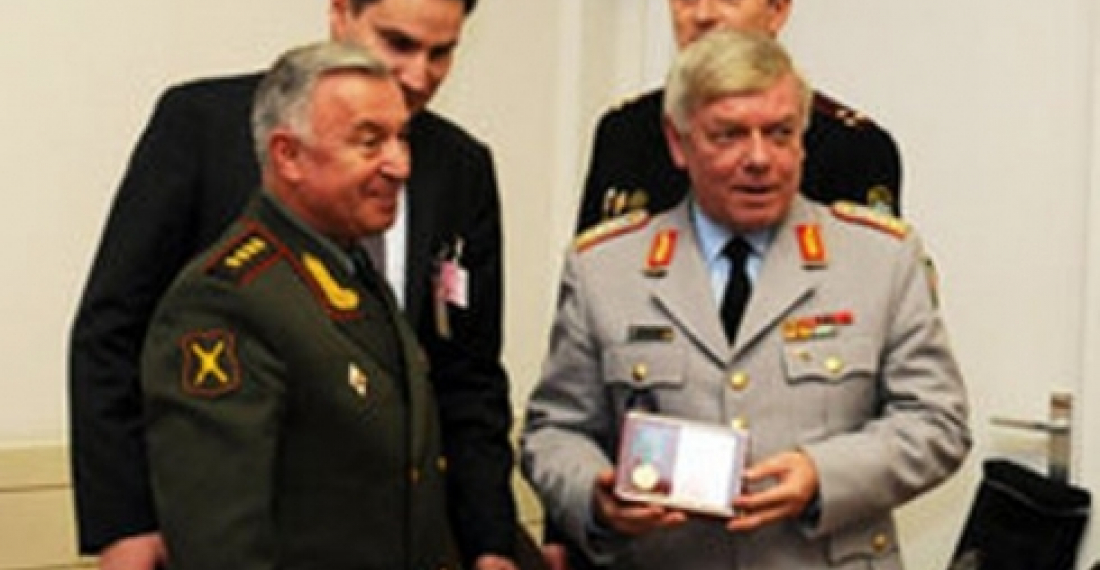
After the meeting, the Chief of the Russian Defence Staff, General Nikolay E Makarov handed medals to a number of NATO senior officers. Speaking at the ceremony Makarov said that "our cooperation with NATO is expanding, in particular, in the spheres of fighting against sea piracy and terrorism." Makarov praised the NATO officers for making the Russia-NATO co-operation real.

The NATO-Russia Council was established at the NATO-Russia Summit in Rome on 28 May 2002. In accordance with the Rome declaration, NATO member states and Russia work as equal partners in areas of common interest in the framework of the NRC, which provides a mechanism for consultation consensus-building, cooperation, joint decision and joint action on a wide spectrum of security issues in the Euro-Atlantic region. The members of the NRC, acting in their national capacities and in a manner consistent with their respective collective commitments and obligations, take joint decisions and bear equal responsibility, individually and jointly for their implementation.

Since the NRC's establishment, it has evolved into a productive mechanism for consultation, consensus-building, cooperation, joint decision and joint action. As an example, more than 25 working groups and committees have been created to develop cooperation on terrorism, proliferation, peacekeeping, theatre missile defence, airspace management, civil emergencies, defence reform, logistics, scientific cooperation for peace and security.

source: commonspace.eu with Itar-Tass and www.nato.int

picture: General Nikolai Makarov, Chief og the Russian General Staff presenting a medal to Lieutenant General Jürgen Bornemann, NATO Director General of the International Military Staff following a meeting of the NATO-Russia Council at NATO Headquarters in brussels on 18 January 2012 (picture courtesy of NATO)
Related articles

Editor's choice
News
Borrell tells the European Parliament that the situation in Afghanistan was critical, but the EU will remain engaged

Borrell tells the European Parliament that the situation in Afghanistan was critical, but the EU will remain engaged

Borrell underlined that the European Union will make every effort to support the peace process and to remain a committed partner to the Afghan people. "Of course, we will have to take into account the evolving situation, but disengagement is not an option.  We are clear on that: there is no alternative to a negotiated political settlement, through inclusive peace talks.
Editor's choice
News
Pope's visit to Türkiye and Lebanon has a strong ecumenical character, and places interreligious dialogue at its centre

Pope's visit to Türkiye and Lebanon has a strong ecumenical character, and places interreligious dialogue at its centre

Pope Leo XIV has begun the first overseas trip of his pontificate, a six-day visit to Türkiye and Lebanon, which started yesterday (27 November) and ends on Tuesday (2 December). According to Vatican Radio, the visit "carries a strong ecumenical character and places interreligious dialogue at its centre. It will also be a moment of closeness to Christian communities and local populations across the region".   During nearly a week in the region, Pope Leo XIV will meet civil and religious authorities, visit mosques and ancient churches, pray at Beirut’s port in memory of the victims of the 2020 explosion, and hold private meetings with Presidents Recep Tayyip Erdoğan and Joseph Aoun.   A highlight of the visit will be a visit to Nicaea, where the Pope will mark the anniversary of the Council of Nicaea. Christians of many traditions recognise the Council of Nicaea as a foundation of shared faith. One of the most anticipated moments will be the Pope’s encounter with Lebanese youth in Bkerké, at the Maronite Patriarchate, a meeting expected to carry strong messages of hope in the Jubilee Year. A central event will be the ecumenical celebration in İznik, where the Pope and Ecumenical Patriarch Bartholomew will walk together toward the ruins of the Basilica of St Neophytos. The prayer, held before icons of Christ and the Council, will conclude with the lighting of a candle—a symbolic gesture of unity. The journey will also highlight interreligious engagement.   Memorable moments are expected throughout the trip: a wreath at Atatürk’s mausoleum, prayer inside the Blue Mosque, Mass at Istanbul’s Volkswagen Arena, the planting of a cedar at the presidential palace in Beirut, and prayer at the tomb of St Charbel in Lebanon. The Vatican said that "Pope Leo XIV’s pilgrimage to Türkiye and Lebanon aims to offer a voice of peace, unity, and hope at the heart of the Middle East."

Popular

Editor's choice
News
Pope's visit to Türkiye and Lebanon has a strong ecumenical character, and places interreligious dialogue at its centre

Pope's visit to Türkiye and Lebanon has a strong ecumenical character, and places interreligious dialogue at its centre

Pope Leo XIV has begun the first overseas trip of his pontificate, a six-day visit to Türkiye and Lebanon, which started yesterday (27 November) and ends on Tuesday (2 December). According to Vatican Radio, the visit "carries a strong ecumenical character and places interreligious dialogue at its centre. It will also be a moment of closeness to Christian communities and local populations across the region".   During nearly a week in the region, Pope Leo XIV will meet civil and religious authorities, visit mosques and ancient churches, pray at Beirut’s port in memory of the victims of the 2020 explosion, and hold private meetings with Presidents Recep Tayyip Erdoğan and Joseph Aoun.   A highlight of the visit will be a visit to Nicaea, where the Pope will mark the anniversary of the Council of Nicaea. Christians of many traditions recognise the Council of Nicaea as a foundation of shared faith. One of the most anticipated moments will be the Pope’s encounter with Lebanese youth in Bkerké, at the Maronite Patriarchate, a meeting expected to carry strong messages of hope in the Jubilee Year. A central event will be the ecumenical celebration in İznik, where the Pope and Ecumenical Patriarch Bartholomew will walk together toward the ruins of the Basilica of St Neophytos. The prayer, held before icons of Christ and the Council, will conclude with the lighting of a candle—a symbolic gesture of unity. The journey will also highlight interreligious engagement.   Memorable moments are expected throughout the trip: a wreath at Atatürk’s mausoleum, prayer inside the Blue Mosque, Mass at Istanbul’s Volkswagen Arena, the planting of a cedar at the presidential palace in Beirut, and prayer at the tomb of St Charbel in Lebanon. The Vatican said that "Pope Leo XIV’s pilgrimage to Türkiye and Lebanon aims to offer a voice of peace, unity, and hope at the heart of the Middle East."

