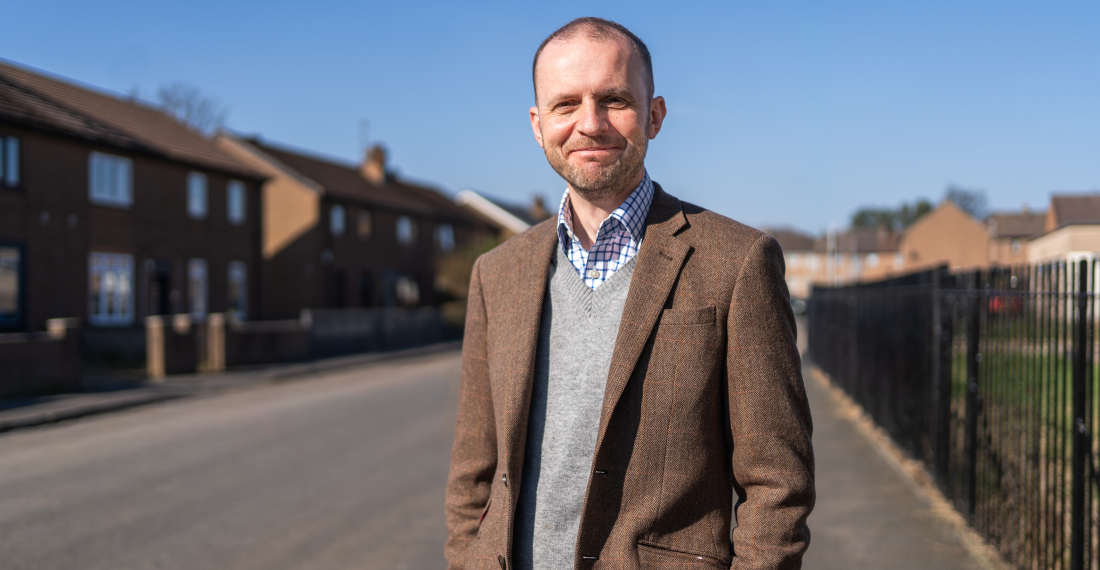
Stephen Gethins was elected as Member of the Scottish Parliament for Dundee City East in the 2026 election, after previously serving as Westminster MP for North East Fife and, later until this month, for Arbroath and Broughty Ferry. He has also worked extensively in international affairs, including on peace-building, arms control and democratisation in the South Caucasus and the Balkans, and was appointed Professor of Practice in International Relations at the University of St Andrews in 2019.
Following the Scottish Parliament election on 7 May 2026, commonspace.eu spoke to the newly elected Scottish National Party MSP (Member of the Scottish Parliament) about Scotland’s relationship with Europe, the security implications of Brexit, and the challenges facing democratic societies at a time of war, disinformation, and geopolitical instability.
“The UK is a significant security actor, there’s no question about it. Europe becomes weaker with the UK sitting outside. But on balance, the UK is the one that is much weaker, because it stands isolated and alone at a time when the rest of democratic Europe is pulling so much closer together.
Brexit benefits nobody. It might benefit the criminal individuals in the Kremlin, but it does not benefit the citizens of the UK, the citizens of Scotland, or, quite bluntly, the citizens of the rest of Europe.”
Read the full interview below:
Congratulations on your recent election success. Could you begin by telling our audience how you first got involved in politics and which issues initially drove you to campaign?
I first got involved in politics as a student. Politics in a democratic society is the way that you seek to make change, or society a better place, or the thing that we all aspire to: to leave the world slightly better off than we found it.
I’ve also always been really interested in international affairs and international politics. From an early time, I was an enthusiast for the European institutions. I saw that as a way forward to build peace, stability and well-being across our shared continent. That view hasn’t changed. In fact, that view has only strengthened over the years.
I remember visiting the European Parliament, one of my earliest political involvements, when I was about 17. I visited Strasbourg, got the bus all the way from Perth in Scotland to Strasbourg. That’s a long journey, but it was a good one, with the other school kids.
And I’m also a believer in Scotland being an independent country. The UK is a multinational state. The United Kingdom, the clue’s in the name, and we have a form of union. But for me, that's an 18th-century form of union. The European treaties provide, in my opinion, a more modern and up-to-date way for nations to interact and to become more cohesive in Europe. And certainly, democratic Europe needs to pull closer together.
You’ve worked for many years in international affairs, security and conflict, including democratisation and peace-building in the Western Balkans and South Caucasus. How has that international experience, in your opinion, shaped the way that you approach local politics today?
Well, crucially, all politics is local politics. I’m still a professor of international relations at the University of St Andrews, where I still do work at our School of International Relations, a fantastic school with some wonderful colleagues.
One of the things I do most years is one of the first-year lectures, which is an introduction to foreign policy and practice. One of the things I always say to the new first years coming in, and I think that this is a really valuable lesson if you’re in first year, or if you’ve been a Member of the European Parliament or another parliament for decades, is that all politics is local.
And the biggest driver in international affairs and international policy is domestic politics. Now, what’s the biggest driver in our politics at the moment? The cost-of-living crisis. That’s particularly acute in the UK, sitting outside the European Union, but it’s also something acute all over.
So we have an international crisis in the Straits of Hormuz, in the Persian Gulf. What’s the biggest consequence of that for my constituents? Well, they’re paying a lot more to heat their homes, for their energy costs, or for their transport costs.
We have a war in Ukraine with profound consequences, not just for the cost of living, but for the way in which we live our lives, and for the democracy that we take for granted itself.
All politics is local. But all politics is also international. We do not live in a vacuum. We live in an interconnected world, and nowhere is that more acute than in Europe. As somebody who’s lived and worked in the South Caucasus, I see what happens there as profoundly consequential for my own part of the world, for my own constituents. And the war in Ukraine is one of the most important issues that faces any democratic politician in Europe today.
Do you sometimes find it difficult to translate these macro issues into policy, or something actionable locally?
That’s the job of a politician. Look, the job of politics is to seek to advance an argument to make society better. And fundamentally, the electorate decides. Unfortunately, the electorate never gets it wrong. Sometimes that’s good and you win, sometimes that’s not so good, but the electorate doesn’t get it wrong. So it’s my job to make my argument, and make it relevant.
I think right now, with the crisis in the Persian Gulf, and also people seeing Russia bombing European cities day in, day out in Ukraine, it’s not a terribly difficult argument to make about the importance and the way in which we are interconnected.
People can see the crisis in Iran, and then leave their homes to go and fill up their car and be paying more money to fill up their car. These are directly consequential.
Or we can have that debate about whether or not the UK should be in the European Union. People go and do their shopping and see that their food prices have gone up, or that their kids don’t have the same opportunities as they did pre-Brexit.
So it’s about making it relevant and making your argument. And also, I think there’s a job in politics to say what you’re for. That’s really important. I think too often, we slide into managerialism. I see that in the debate over the European Union in the UK at the moment. Say what you’re for. I’m for rejoining the European Union. Other colleagues would be against that. Let’s have a debate and discussion, and let’s let people decide fundamentally what they think.
In practical terms, where do you think Scotland could make the greatest contribution to European security and democratic resilience?
I was listening to an interview by Kaja Kallas, the High Representative, earlier today. She was quoting Spaak, one of the founders of the EU, the Belgian politician Paul-Henri Spaak. She said, “there are only two types of countries in Europe: the small countries and those who haven't realized that they are small countries. And that is so true.”
I think the war in Ukraine and our security situation has underlined this like never before. A number of years ago, I worked in the EU, and there was always talk about us being a security alliance. That was true then. It’s really true now. The EU is a security actor.
That goes in a number of ways. Our food and drink security and our energy security are pivotal. I’ll talk about hard security in a moment, but let’s take those areas. If you cannot feed your population, if you don’t have your energy supplies, then you are insecure, and your populations are insecure, and it leads to destabilisation and insecurity.
Scotland is a net exporter of both food and drink, and energy. We are a hydrocarbons producer. I think we were the biggest hydrocarbons producer in the EU, and we’re also one of the most significant producers of renewable energy in Europe as well.
So, first of all, rejoining that single market and rejoining that more cohesive energy market makes sense. It makes sense for my constituents because there are jobs, investment, and greater security. But actually, if we talk in terms of European solidarity, there’s also that greater investment across the whole of Europe in terms of our contribution.
I think that is often overlooked in terms of security, but that’s where Scotland in particular has got a big contribution to make. I think the UK does as well.
Now, harder security. The UK is a significant security actor, there’s no question about it. Europe becomes weaker with the UK sitting outside. But on balance, the UK is the one that is much weaker, because it stands isolated and alone at a time when the rest of democratic Europe is pulling so much closer together.
Brexit benefits nobody. It might benefit the criminal individuals in the Kremlin, but it does not benefit the citizens of the UK, the citizens of Scotland, or, quite bluntly, the citizens of the rest of Europe.
So, that security side of it has become really important. I saw SAFE, the defence procurement mechanism, as a really serious pan-European mechanism. The Canadians have joined, the UK hasn’t. That’s disgraceful.
More broadly than that, sitting outside alone and isolated weakens the UK significantly at a time when we can’t afford it. To go back to Kallas quoting Spaak, I think in Scotland we’ve always got the sense that the pooling and sharing of sovereignty is something that European states need to do.
I would remind any of your readers that there’s no right way up to look at a globe. At different points of our history — I’ve written a book on this, actually, Nation to Nation: Scotland's Place in the World — Scotland has had a union with Ireland, as we do at the moment with England and Wales. We’ve also had unions with Norway, we’ve had common citizenship with France and Denmark, and these networks of alliances, because it is something that is vibrant and consistently changing across Europe.
There’s no right way up to look at a globe. If I look at our near-neighbours in the Nordic states, who are pooling together in terms of their own security infrastructure, for me, that provides a really good model of how we take things forward. Brexit was a bad idea 10 years ago. It’s a dangerous idea now.
I’m from Finland, so I’m very familiar with the Nordic security alliances. You would imagine something similar for Scotland, essentially, would be beneficial?
Absolutely. You guys provide a really valuable model for the whole of Europe. I’ve watched Finland. Finns are deeply, deeply impressive. Now, look, we won’t copy everything the Finns do, but I think there are incredibly valuable lessons from the way in which Finland conducts itself and has built its society.
You have warned in recent years about the threat of Russia, especially hybrid threats, disinformation, cyber threats, attacks on infrastructure, such as undersea cables. How serious do you think these threats are for the integrity of security and elections in the UK, Scotland, and across Europe?
There’s a deep threat, and we know this. Until about last week, I was chair of the all-party group at Westminster on Russia. There is a huge threat to our democracy. Democracy is fragile. We know that.
There’s a threat from disinformation, from polarisation. There’s also that harder threat from security cables and other means of threatening us.
What’s interesting is, the closer you get to the Russian border, the more seriously that threat is taken. I think we need to start listening to our neighbours with a lot more first-hand experience.
I think security policy used to be driven by Paris, Berlin, London, et cetera. It’s being driven by Helsinki, Tallinn, Vilnius, Warsaw, Bucharest, Prague, and crucially, led in Kyiv.
We’ve got a lot to learn, and a lot of catching up to do. I’m sitting talking to you, and I represent an area on the east coast of Scotland, facing Denmark and Norway, our next neighbours over.
We know that there’s Russian activity just off the coast, just a short distance from where I sit now, in the High North. Scotland’s High North is a crucial part of not just the UK infrastructure, but actually European security infrastructure.
We need to take those responsibilities really seriously. But I think there’s a lot of catching up that needs to be done, certainly in the UK and elsewhere, and we’ve got a lot of learning to do from our European partners who have been a bit more ahead of the game on this.
Thank you. Do you have any final comments, or anything else you would like to say to our audience?
No, but just because I’m speaking to a pan-European audience at the moment, I’ll just go back to this. We’re focused internationally. Let me just talk a little bit about our domestic politics.
The United Kingdom is, in its name, a treaty of union, just like you have a treaty of union in the rest of Europe. The definition of sovereignty is different under Scots law from English law, for example. We don’t have this definition of parliamentary sovereignty.
I know that when people are discussing the idea of secession, that it’s a difficult question, and I don’t make any judgement about other parts of Europe. But Ireland has already shown us that Ireland has now got a more grown-up relationship with the rest of the UK and with the rest of Europe than it has at any moment in its history.
Ireland was part of the kingdom, but Scotland was also part of that multi-crown system, that multinational state. It strikes me that the UK has gone through a decade of political mess since it left the EU.
But our friends and neighbours in the Baltic states, the Nordic states, and elsewhere show that there’s a model within our immediate neighbourhood, a better model. Once you achieve that better model, you can contribute more effectively to our broader democratic continent as well.
Stephen Gethins SNP | Facebook
Stephen Gethins (@StephenGethins) / X
Nation to Nation; Scotland’s Place in the World, Luath Press