


In 2022, Russian forces advanced towards Kyiv from Belarus. Bucha, only a 30-minute drive from the capital, became the site of mass atrocities, including summary executions, torture chambers, and the deliberate hunting of civilians. Ukrainian officials described this as “a plan of terror against the population.”
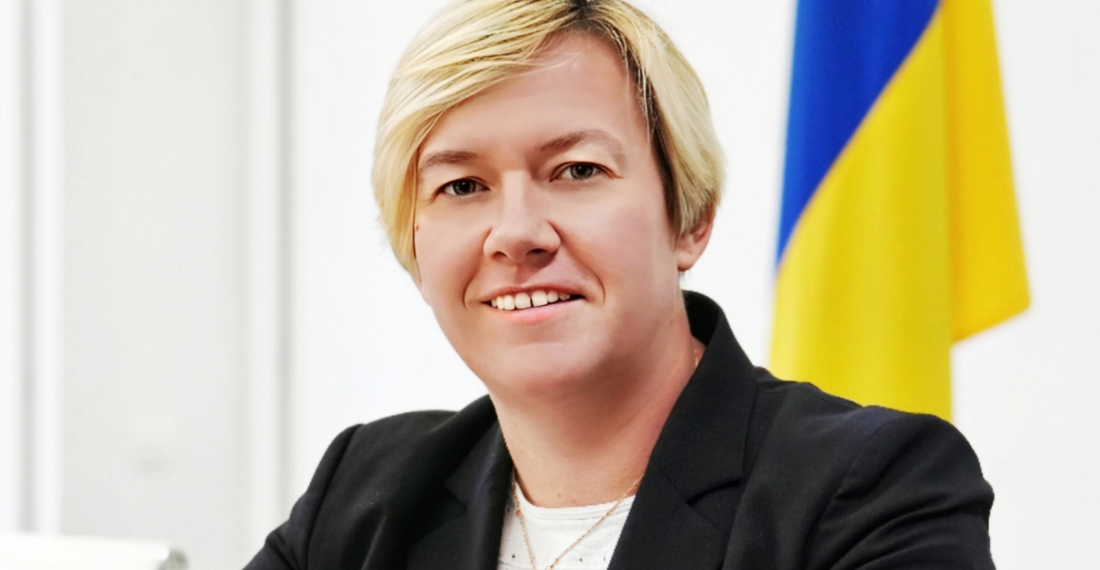
This week, commonspace.eu welcomes Mykhailyna Skoryk-Shkarivska, who served on Bucha’s city council during the invasion and was later appointed deputy mayor to support the city’s recovery. Mykhailyna shares the story of how a suburb of Kyiv grieved, became a global symbol of Russian atrocity, and ultimately rebuilt.
"We saw this scale of killing first in Bucha, and we showed it to the world because it required global attention and serious punishment. Not only domestic court cases, but international justice.”
“We needed to transform a place of tragedy into a place for living again. A smart, liveable city."
Read the full text of our conversation with Mykhailyna below:
Before local government, you spent 20 years working as a journalist. You were working in Bucha’s City Council when Russia invaded, and later returned as deputy mayor to lead the recovery after occupation. Can you tell us about your background and how it’s inspired the work you’re doing today?
I was trained as a journalist and when I began my career, Ukraine was a post-Soviet country without a free media. At the same time, the country was undergoing major reforms in local and state governance, and we were creating our own currency after our economy transitioned out of the Soviet system. It was a period of profound transformation, and I worked as a journalist throughout it.
After 20 years in journalism, I came to see decentralised reform as the final step in transforming Ukraine into a European state. This excited me and led me to focus on local governance. That is how I left the media and began working in local governance in Bucha.
No one expected Russia to invade Ukraine around the time I joined the City Council, and it just so happened that I was on staff when Russian soldiers occupied Bucha. In that moment, my media experience and international contacts, including friends in Warsaw, Brussels, France, the United States, and the United Kingdom, became critically important.
I relied on these connections when I returned to occupied Bucha. Even while evacuated and outside of the community, I understood that the war crimes had to be documented openly and shared with the world. They could not be hidden. These crimes changed everything, including relationships between those who remained in Bucha and relatives elsewhere, even in Russia. After the mass killings carried out by the Russian army in our community, many of those relationships came to an end.
So you used your connections as a journalist to shine a spotlight on your city?
Part of my media background included consultancy work for companies such as CBS and CBC, both of which were later expelled by Putin during the war. I also maintained close connections with field teams from Reuters, NBC, and The New York Times in Ukraine, among many others.
After the full-scale invasion, we understood how foreign media operated in Ukraine and remained fully open to them. We organized events, responded to all of their requests, and provided comments. Initially, this involved standard commentary, but after the war crimes committed by the Russian army in Bucha, we opened an information office near the site where investigators and forensic teams were working with casualties. We then established a media centre and held press conferences for international teams. When we had to bury victims who had been killed but not yet identified by relatives, we did so publicly to demonstrate that these were not isolated incidents but evidence of mass killing.
This was a large-scale massacre of civilians. We recognized that it required special coverage and had to be shown exactly for what it was, without hiding any parts of the tragedy. We pursued this approach with the full support of my colleagues in the City Council. We invited photographers and opened the city completely to the media from around the world.
In comparison, places such as Hostomel or Borodianka did not engage with the media in the same way, and their tragedies became more private and less visible. For example, in Hostomel, Russian officers killed the mayor, yet this story is not as widely known as it might have been if the community had worked more actively with the media.
At the same time, similar crimes occurred elsewhere, including in Mariupol and, more recently, in villages in the Sumy region, where civilians were killed simply for being Ukrainian. We first saw this scale of killing in Bucha, and we showed it to the world because it demanded global attention and serious punishment. Not only through domestic court cases, but also international justice.
Bucha has become a world symbol of Russian atrocities, but you’ve also spoken to your high hopes for the city’s future. How do you see Bucha’s legacy moving forward?
At the beginning, we knew it was important to show the truth of what had happened. However, after a year, we realised that for people returning and trying to rebuild their lives, these stories were extremely difficult to carry. We understood that we needed to transform a place of tragedy into a place for living again. A smart, liveable city. Many people saw Bucha only as a site for memorials, but it is very difficult to live in a memorial. As a result, we decided to focus on success through rapid rebuilding and recovery, which became the municipality’s central strategy.
Even with fast reconstruction, the memory of what occurred remains. Today, however, Bucha looks like a typical Ukrainian city, though to truly understand this, one needs to visit in person. From the outside, many people still hesitate to come because of the city’s past. Publicity surrounding the war crimes continues to shape Bucha’s image, creating another challenge for local residents. To address this, we are working on initiatives that promote Bucha as a peaceful and forward-looking community once again.
In 2022, Bucha was nearly empty. Infrastructure had been destroyed, and there were almost no children left in the city. The first priority was restoring infrastructure, which was accomplished within two months. We then rebuilt schools to encourage families to return, with reconstruction efforts focusing heavily on education and social facilities. We also established a centre for psychological and social support that offers free therapy and group sessions to help residents process trauma.
At the same time, we collaborated with donors and international partners, emphasizing that while Bucha required long-term support, it also aspired to become a model of rapid recovery and democratic rebuilding. This is not a single achievement but an ongoing process that continues to bring us closer to the future we envisioned years ago.
Could you describe your oganization’s current work, the Institute for Sustainable Development of Communities (ISDC)?
The Institute for Sustainable Development of Communities began at Bucha’s project office when we recognized the need for outsourced project teams. We trained staff, established international departments, and strengthened our ability to manage complex projects. The outsourced team focused on areas where the City Council lacked sufficient resources, including psychological support, infrastructure, and recovery planning. In the summer of 2023, I joined the project office full time.
Our goal was not only to support Bucha but also to share its recovery experience with neighbouring communities such as Hostomel and Borodianka, promoting the region as one capable of rapid rebuilding. Today, much of our work centres on negotiations with international partners and engagement with the media. The emergency phase has ended, and partners now expect more strategic, long-term thinking.
We built expert teams to support communities over the next five to ten years, particularly in the context of European integration. Organizations like ours can offer participative approaches that help Ukrainian municipalities adapt to EU standards at the local level.
You're interested in connecting Ukrainian and European cities through partnerships. What could that actually look like – and what would both sides get out of it? What do European partners most need to understand most now about supporting local governance in Ukraine?
We see huge potential in building these relationships. Connecting at the local level creates understanding faster and more effectively than formal arrangements at the national level. Bucha, for example, had strong ties with Palanga in Lithuania, which was instrumental in 2022, and we learned from them how to attract EU funding. We also developed relationships with Bergisch Gladbach in Germany, focusing on horizontal, people-to-people connections rather than only official ties. These partnerships led to practical projects, including improvements to public transport and knowledge exchange on infrastructure, blackout management, and bomb shelter planning. We now recommend this approach to other Ukrainian communities, as friendship between towns and villages is the most effective way to foster mutual understanding. These partnerships create an expertise in crisis management that can be shared with EU partners, which is difficult to find anywhere else.
These relationships are human-centred and create genuine, lasting partnerships. In terms of EU integration, Ukraine has made significant progress, but local-level changes are critical, such as waste management, certification, and construction standards. Integration is a step-by-step process that requires participation across the country, not just national legislation. We can learn from countries like Poland, Romania, and the Baltic states, adapting their experience to the Ukrainian context.
Thank you for your insights. One final question: You are doing very challenging work under difficult circumstances. What keeps you going?
What drives me every day is simple: we live here. We could leave Ukraine, but we choose to maintain our identity, protect our families, and improve life despite the war. Every sign of normal life our families, community, friends motivates us. From the war, we have learned that to survive, people must fight and live at the same time, continuing everyday life even under extraordinary circumstances. That’s how nations have survived over the centuries. Even during conflict, people kept cooking borsch and mashed potatoes, tending to daily life, and celebrating the small moments. This is very understandable to people in the EU because we continue to normally, despite facing the greatest threat we have ever experienced.
Follow Mykhailyna on Facebook and LinkedIn
Follow the ISDC on Facebook and LinkedIn



