
Karabakh: The big debate
Commonspace.eu today publishes the 9th in a series of twenty interviews with key personalities from Nagorno-Karabakh. The interviews give a vivid, even if sombre picture, of the attitude of Armenians and Azerbaijanis from Karabakh whose lives have been deeply affected by the conflict, and whose destiny will be at the heart of any future conflict settlement. Those interviewed sometimes use harsh language. Their opinion is almost inevitably controversial, as are sometimes their biographical notes. However it is through listening to these opinions that a path through the labyrinth that is the Karabakh conflict can be found. A full editorial policy of commonspace.eu is available at the About Us section. The next interview in the series will be with Arif Aliev, a veteran and invalid from the Karabakh conflict.
Interview with Sergey Ghazaryan

|
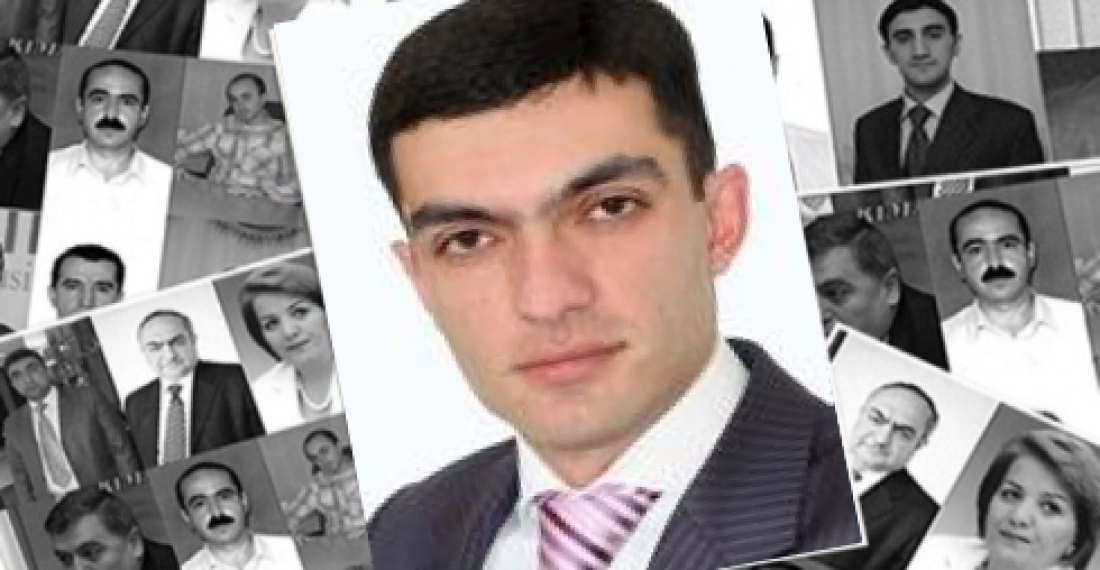
Sergey Ghazaryan was born in 1979, in Stepanakert. From 1998-2003 he studied at the Moscow State Institute of Foreign Affairs (MGIMO). Since 2007 he has held several different leading positions in the NKR Government, including in the Ministry of Foreign Affairs, Ministry of Urban Development and the Chief of Staff of Government of NKR. He was elected to the NKR National Assembly in May 2010. Ghazaryan is now the Deputy Chairman of the NKR National Assembly Foreign Affairs Standing Committee. Biographical notes are provided by the interviewees themselves. |
Can you summarize your overall position on the Karabakh conflict and the conflict resolution process:
First of all, NKR should be engaged in all the peace process. Without this, any viable and lasting peace is impossible. Next - the peace process and negotiations should consider not only norms and principles of international law, but also the historical aspects of the conflicts, as without this a full-range settlement is impossible.
If a solution is found only based upon political expediency, again, a viable and lasting peace will be impossible. History and the roots of the conflict are also very much important. The country that started the war of aggression should be named. Without the consideration of the will of the NK people, a solution is impossible, despite any pressure from the international community, no matter what scenario will be chosen. 70 years of Soviet rule in Nagorno-Karabakh have proven that a nation can stand the situation for some time, but it will take the first opportunity to defend its rights.
In the long term do you want to see Nagorno-Karabakh (a) as an independent state; (b) as part of Armenia (c) as part of Azerbaijan; (d) none of the above but in as yet undefined status. Comment on your choice:
We have already made our choice and voted for independence. For this very moment I think that the best scenario for the international community is to recognize our independence and the statehood, as it is also in line with all the relevant norms and principles of international law, as well as the effective Soviet legislation of the time (before 1991).
Regarding what will be next - I strongly believe that will depend on the will of two Armenian statehoods - whether they would wish to re-unite or stay as two independent states. This is a matter of sovereign and free choice for the future.
I firmly exclude the other scenarios, so need not to comment further.
What is your biggest objection/concern to Nagorno-Karabakh being part of Azerbaijan?
First - history has shown that we are not able to live inside the Azeri statehood. The primary reasons being policies of suppressions, ethnic cleansings, racism, xenophobia and a policy of assimilation against Armenians inside that country. After 1988, when Azerbaijan started the war against our people, I guess the last opportunities to live in a single state faded away.
Second - during all these years and up to now on a state (government) level, Azerbaijan propagates anti-Armenianism. The consequences of this policy is, for instance, the inhumane killing of a sleeping Armenian soldier, Gurgen Margarian, by Azeri army officer Ramil Safarov in 2004 in Hungary during the NATO courses. For the record, later proved by the court, Margarian was hacked to death with an axe and a knife while sleeping. The Azeri officer became a national hero in Azerbaijan. Can you imagine it? The same policy is now being run by the incumbent authorities. Another example of anti-Armenianism - a sportsman says that he is better to lose the championship and finish last than to lose against an Armenian and come second. Most notably, this is clearly supported by the government. Isn't this weird for 21st century? A young artists group goes to the United States for some concerts and they, Azeris, say that "we will use them in our information-propaganda war against Armenians". Think to yourself - where are the youth affairs and the culture and where is the propaganda war? I am a pessimist here, and I think these policies will go ahead for many years still to come and this will breach the peace process.
Third - all these territories have always been Armenian, and they cannot be artificially transferred into Azerbaijan any time in the future. The strong-hand Soviet rule of 70 years, with all its suppression mechanisms of militia etc., seemingly controlled the situation, but as soon as the system showed signs of breach, the situation went out of control and the people began the process of claiming independence on their historic lands.
Are you satisfied with the policy of the de facto Nagorno-Karabakh Republic authorities towards the conflict and its resolution?
First and foremost - the authorities are not only de facto, but they are also de jure. The sole fact that somebody doesn't recognize this situation, doesn't necessarily mean that they are right in their adopted position. We are, thanks to God, well aware of international law, our rights and universal rules for all states, and we know very well how and why we are entitled to call ourselves a state and build our sustainable statehood.
To your main point regarding the NKR authorities' policies towards the peace process - "politics is the art of the possible". Our authorities have underlined on various occasions that without meaningful NKR participation to the peace process with full powers, no final option for a peaceful settlement can be adopted and implemented. All in all, we are not against the current negotiations - let them meet, discuss what they discuss, we don't object to this, maybe even they will be able to produce some positive scenario and even take some steps towards this - we don't object to it. We only welcome this. However, meanwhile we clearly acknowledge ownership of our rights and our country, and we will stand firmly for it. This was clearly obvious in 1997-98 when Levon Ter-Petrossian (first president of Armenia) began discussing the two variants of settlement - the "package" and "phased" solutions, when NKR clearly expressed its position. Now I can't exclude the possibility that any such variant which will not be in line with Artsakh's interests (I mean, not "exclude" outright, as far as I positively exclude any solution which will not be in line with the Artsakh position), will be rejected from Stepanakert. On the other hand, I am sure that Armenia, which is currently representing us at the talks, is well aware of this. I mean, the Rep. of Armenia, I guess, now only tried to make the positions of the two sides - Azerbaijan and NKR - a bit closer, to bridge their positions. The leadership of Armenia has also noted many times that NKR should also be brought back to the table as a full party.
Were you directly involved in armed hostilities between 1989-94?
I was under-age to take an active part in this, but the entire world should be pretty sure that all the inhabitants of Nagorno-Karabakh took active part in the War of Independence by the sole virtue of living here. Even the capital of NKR - Stepanakert - was bombarded on a daily basis during those years, and all the people therefore - from elderly to a child - have taken part in the war daily. God forbid, if the aggression of Azerbaijan will again take place - all the Armenians are conscious enough to engage in another war. We see no alternative to this, if the enemy will renew its aggression. I am sure that the new generation will give new heroes who will protect their right to live on their own lands.
How do you evaluate the work of the OSCE Minsk Process?
The very fact that the Minsk Group operates and takes some steps is good news. However meanwhile there are evident truths of their failings. The mediation job is really very difficult, but can't they really identify the guilty?! Isn't it evident that one of the sides is guilty in this situation? The Armenian side has deliberately called for a pull back of the snipers, while Azerbaijan fiercely rejects it. Why don't the mediators point this out and assign blame to the exact side which rejected this? Also the subversions on the border - during the last two years these attempts have enormously risen in numbers, while the co-Chairs do nothing to bring the wrong side to account, the wrong side that breaches the peace is not brought to responsibility. With the absence of such a mechanism - absence of responsibility - it's really very hard to speak of the effectiveness of any job.
Meanwhile regarding the recent trip of the Field Assessment Mission that visited some regions of NKR recently - in the follow-up report they argue that on those territories some Armenian refugees (from Azerbaijan) are living in very poor conditions. However the report doesn't speak of the very reason which pushed them to refuge. Do you think that they switched their prosperous life in Sumgayit and Baku to this poor existence in those territories by their own will?! The only country of the region which doesn't get any humanitarian aid from abroad is the Nagorno-Karabakh Republic. We saw how the whole world spent hundreds of thousands of dollars to organize democratic elections in Kosovo. We see how Russia invests money in Abkhazia or South Ossetia. All we do here in NKR is based on our own resources, and mostly on the assistance of Armenia and the Diaspora. Meanwhile, we have reached greater success and results in comparison to the other entities I listed above. This needs to be appreciated by the international community.
Do you have a publicly expressed a position on the Madrid Principles?
You know, no matter what the label is of any box which may lead us towards a final settlement, only once the package is presented to us, we will express our position on whether we agree with it or not. We have argued this on many occasions, including through the statements of our President Bako Sahakyan. The latter has recently once again underlined that "the independence of NKR is not a matter of trade".
Do you think it is important/appropriate that the de facto authorities of the Nagorno-Karabakh republic be part of the peace process facilitated by the Minsk Group? If yes should they be there instead of the Armenian Government?
Once above I have already expressed my dismay at your term of "de facto authorities". I hope you will translate that in your final edit, so I will not need to repeat it once more here.
The best scenario will be that the negotiations are held solely between NKR and Azerbaijan, since the conflict itself started and continued between our two countries. We don't invite other countries which were either way engaged in the hostilities to take part in this peaceful process, right? We are well aware that the Islamic world was engaged - namely Turkey - but this doesn't mean that they should take part in the process directly. The direct sides of the conflict are NKR and Azerbaijan, which is well illustrated in relevant UN Security Council and OSCE documents of the time. This is the most optimal and effective pattern of peace talks, as we see it in Stepanakert.
Regarding NKR participation in the talks of the Minsk Group, I believe that only the inclusion of NKR in the talks will make them effective. I see no other way to move forward sustainably.
Sometimes the possibility is mentioned that the territories around Nagorno-Karabakh under Armenian control since 1994 should be returned to Azerbaijan as part of an interim peace arrangement, leaving the issue of the status of Nagorno-Karabakh to a later date. Do you have an opinion on this issue?
I have already noted above that the historical aspects of the conflict should not be forgotten. Regarding "those territories" - they are all Armenian territories. We remember how these lands have been transferred into Soviet Azerbaijan, and we know what has happened to Armenian heritage and Armenians themselves living in those lands. We know how these lands have been actively inhabited by Azerbaijanis, and what the conditions of Armenians living there was at the time of Soviet rule.
We have our churches there - holy things cannot be traded. If the European nations, for example, regard their freedom and liberty as absolute rights and values, in the same way our values are legitimate. Regarding our religion and language, we are firm on them, and we will never surrender them. I will repeat - holy things cannot be traded in.
Regarding a certain "transitional period", you know if you live with a neighbor like Azerbaijan you can't give guarantees on your national security as Azerbaijan breaches all the papers it signs. I can bring numerous examples of recent history to illustrate this. Besides, the world knows many examples when documents just remained as priceless papers with the signatures on them invaluable. The same applies in this situation. No one now speaks of the Agreement on Measures of Strengthening the Ceasefire Regime of 1995, right? Why?
I have mentioned earlier my own attitude towards "these lands" clearly.
What is your opinion with regards to the role of Turkey, Russia, Iran, the United States, the European Union or any other country or international organisation, or the international community in general, with regards to the Karabakh conflict and its settlement:
You know, in this particular region, as well as all over the world, the clash of great power politics is the usual business for international relations. The Armenian world in this mosaic tries its best to fulfill its own national interests.
This issue is really a big one and one can hardly explain himself concerning all the states. In a very nutshell, I would say that we need to consider all the engaged states, and consider their policies in trying to manage our way to sustainability and prosperity. That is all I have to say here.
How do you evaluate the role of informal, NGO-level contributions to the peace process? Do you believe that informal contacts have a useful role to play prior to or after a formal agreement?
I clearly understand that a dialogue between NKR and Azerbaijan, between our societies, between the intselligentsia might be a useful tool. However I must confess that we can't see this readiness and any opportunity, any openness in Azerbaijan. On a civil society level all the activities are managed and well controlled by the government. All the activists in Azerbaijan report their business to "the relevant" state agencies, also controlled by Aliyev regime. If anyone of them uses the wording of the "Nagorno-Karabakh Republic" he will be severely punished. I have witnessed this many times myself in international venues. In such an atmosphere we can't talk of any move-forward.
However, some steps of confidence building must be implemented to secure a development of this peace process.
Do you have a position on the desirability or not of free movement of Armenians and Azeris between their two countries before a final peace agreement?
Many people who don't know Artsakh, they have a different perspective, but the very moment they visit Artsakh, they change in 180 degrees. The same is true for Azeris visiting NKR. Their preconceived stereotype that in Stepanakert or in Shushi live only those who hate Azerbaijan and the Azeri nation - is not true. We are quite a normal nation.
Future contacts of our two nations, which will only be positive, should be discussed between our two governments so a way out may be found.
During my student years in Moscow I offered my Azeri colleagues in class a chance to visit NKR, taking whole responsibility of their security there. I offered them to visit any point on the NKR map and to see where the Armenian or Azeri history of NKR begins. They rejected the offer. I also insisted many times that they invite me to Baku, Kirovabad or elsewhere. I used to say, "Invite me to Baku, and I will show you where the Armenian history of Baku starts from". Unfortunately, they rejected both offers. Again however, in any question, if we seek effective results, without the meaningful participation of NKR in the talks any progress is impossible. I am 100% sure on this.
Do you think that Armenian and Azerbaijanis will ever be able to live together peacefully in Karabakh again in the future?
In the same way Armenians and Azeris will be able to live in Azerbaijan, they will also be able to do here.
What is your opinion on the issue of return of refugees/IDPs to Nagorno-Karabakh
This is indeed a very complex and very difficult issue. There are too many nuances here. First - we must take into account the will of those people themselves. Many Armenian refugees from Azerbaijan, who have witnessed the Sumgayit or Baku massacres, will hardly be able to fight their fears and return to live in Azerbaijan. If an agreement will be reached at the peace process, taking into account other important aspects and if from the Azeri side, those who lived here in NKR, may, of course, go back to their homes and live according to the effective Constitution and laws of NKR - e.g. the law of citizenship and others. However there should also be guaranteed equal opportunities of return for Armenian refugees to Azerbaijan, and later all relevant issues may be solved according to domestic legislation.
(c) commonspace.eu
Read previous interviews in this series: