A seventh consecutive night of attacks by United States forces on targets across Iran has left 10,000 people without water after a desalination plant was hit, with Iran retaliating by launching another wave of drones and missiles at US-allied Gulf states, according to the Qatari Channel Al Jazeera.
Hamzeh Pour, chief executive of the Hormozgan Water and Wastewater Company, was quoted by the Tasnim news agency on Saturday as saying that a seawater pumping station and a power transformer at the Bunji desalination plant in Jask in southern Iran were “completely destroyed”, depriving 20 villages of water.
Iran’s retaliation also targeted civilian infrast ructure, a war crime under international humanitarian law.
In the early hours of Saturday, Kuwait announced the closure of its airspace and said two power and water desalination plants were hit by Iranian attacks. Several Kuwaiti firefighters were wounded while responding to a fire sparked by the strikes, the country’s firefighting force said.
Air raid sirens also sounded repeatedly in Bahrain, where authorities urged residents to seek shelter.
In Jordan, authorities said they intercepted 10 Iranian ballistic missiles.
Iran’s Islamic Revolutionary Guard Corps (IRGC) said its naval forces had targeted a US military fuel pier at Kuwait’s al-Ahmadi port and a US warplane assembly site at Bahrain’s Sheikh Isa Air Base. The IRGC also said it attacked a US base in Azraq in Jordan, claiming to have destroyed two American fighter jets.
The Iranian attacks came after the US military’s Central Command, or CENTCOM, announced it had carried another wave of overnight strikes targeting “surveillance sites, military logistics infrastructure, underground weapons storage, and maritime capabilities” in Iran.
US President Donald Trump declared at the NATO summit in Ankara 10 days ago that a memorandum of understanding signed in mid-June by Washington and Tehran was "over", following Iranian attacks on tankers near the Strait of Hormuz. He reimposed a naval blockade on Iranian ports and revoked a waiver of sanctions on Iranian oil exports.
Iran insists that under the interim peace deal agreed with the US, it has the right to control maritime traffic in the Strait of Hormuz and dictate which routes ships should take when transiting the narrow waterway – a vital channel for global energy exports.
source: commonspace.eu with Al Jazeera (Doha) and agencies
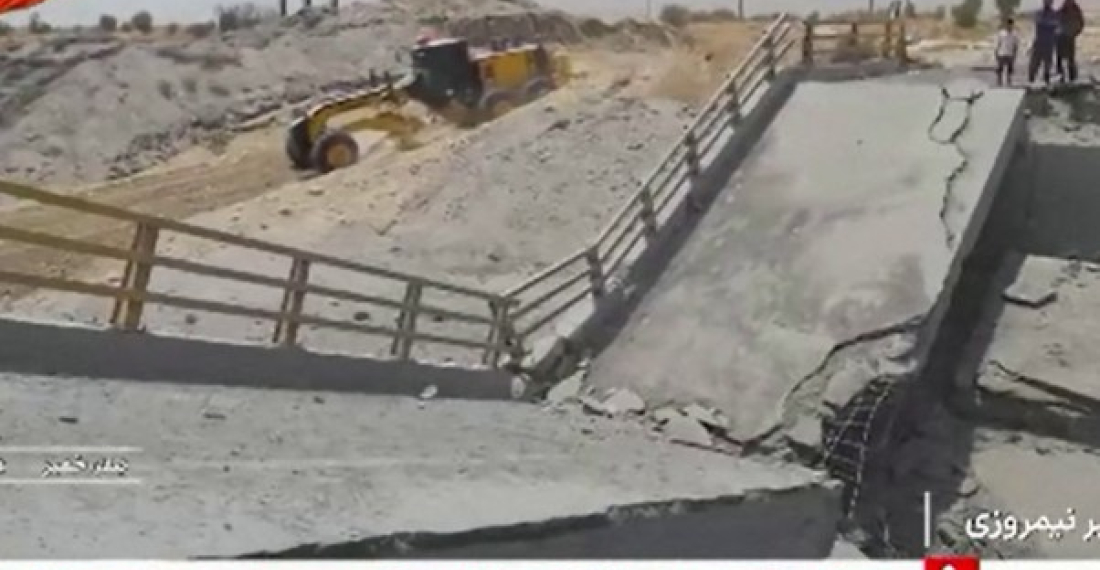
photo: This screengrab taken from video footage broadcast by Iran's IRINN state television network on July 17, 2026, shows what the network says is the aftermath of overnight US strikes on a bridge in Bandar Khamir county, near the Strait of Hormuz (AFP/ al Jazeera)