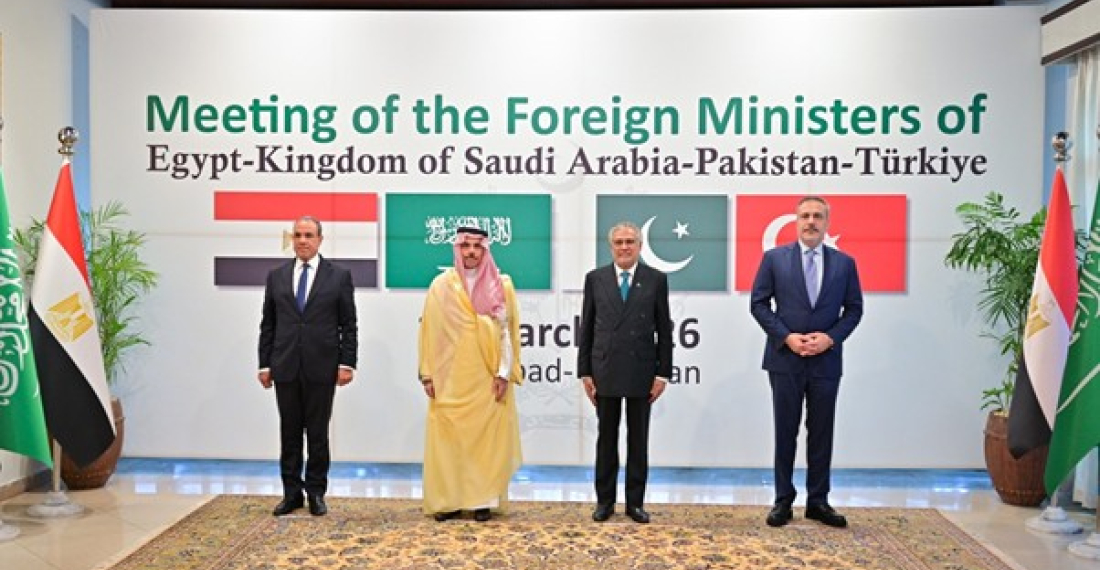
The Foreign Ministers of Türkiye, Egypt, Saudi Arabia and Pakistan met for the second time this month in the new quadrilateral format. The aim of the meeting was primarily to support Pakistan's efforts to initiate US-Iran talks. The first meeting was held in Riyadh on March 19.
Pakistani Deputy Prime Minister and Foreign Minister Ishaq Dar on Sunday (29 March) said both the United States and Iran had expressed confidence in Pakistan to facilitate talks aimed at ending the ongoing United States-Israeli war on Iran, following “very productive consultations” among Pakistan, Saudi Arabia, Türkiye and Egypt amid the rapidly escalating Middle East conflict.
Speaking in a televised address after the high-level quadrilateral meeting in Islamabad, attended by the foreign ministers of Saudi Arabia, Türkiye and Egypt, Dar described the consultations as “candid, constructive and focused on exploring pathways to de-escalation.”
Dar said the four foreign ministers held an in-depth discussion on the evolving regional situation and deliberated on “possible ways to bring an early and permanent end to the war in the region.”
He noted that all participants expressed deep concern over the devastating human and economic toll of the conflict. “We agreed that this war is not in favour of anyone and would only lead to death and destruction. The unity of the Muslim Ummah in these challenging times is of utmost importance,” he added.
Dar said he also briefed the visiting ministers on the prospects of potential US-Iran talks in Islamabad. “The visiting foreign ministers expressed their fullest support to this initiative,” he said, adding that the participants reaffirmed unity to contain the situation, reduce risks of further military escalation, and create conditions for structured negotiations.
“The foreign ministers advocated dialogue and diplomacy as the only viable pathway to prevent conflict and promote regional peace and harmony. They also called for upholding the principles of the United Nations Charter, including respect for sovereignty and territorial integrity of all states,” he said.
He further said the four countries agreed to strengthen mutual cooperation and decided to constitute a committee comprising senior officials from their respective foreign ministries to work out modalities for future coordination through consensus.
Highlighting Pakistan’s diplomatic outreach, Dar said the country had remained actively engaged with regional and global partners under the leadership of Prime Minister Shehbaz Sharif to help bring the conflict to an end. He underscored Pakistan’s “very important relationship” with the United States, noting that Islamabad had maintained close engagement with US leadership as part of its de-escalation efforts. “Pakistan is very happy that both Iran and the US have expressed their confidence in Pakistan to facilitate the talks,” he said.
“Pakistan will be honoured to host and facilitate meaningful talks between the two sides in the coming days for a comprehensive and lasting settlement of the ongoing conflict,” he added.
Dar also revealed that he had held a detailed telephonic conversation with Chinese Foreign Minister Wang Yi, who conveyed Beijing’s full support for Pakistan’s initiative. He added that the Secretary-General of the United Nations had also expressed full backing for Islamabad’s peace efforts.
“I have also held several telephone conversations with my counterparts from different countries around the world. They have all extended their full support and confidence in our efforts,” Dar said, adding that there was broad international appreciation for Pakistan’s diplomatic initiative.
He stressed that Pakistan would continue its efforts with sincerity and commitment, while calling for prayers and global support to ensure the success of its peace initiative aimed at achieving a permanent end to the conflict.
The quadrilateral mechanism is increasingly being viewed as a key diplomatic track complementing broader international efforts to end the conflict. It aims to consolidate regional support for de-escalation, align positions ahead of any potential US-Iran negotiations, and facilitate dialogue among stakeholders.
Although neither Washington nor Tehran participated in the meeting, it is widely seen as a preparatory step toward a broader diplomatic opening.
source: commonsopace.eu with agencies