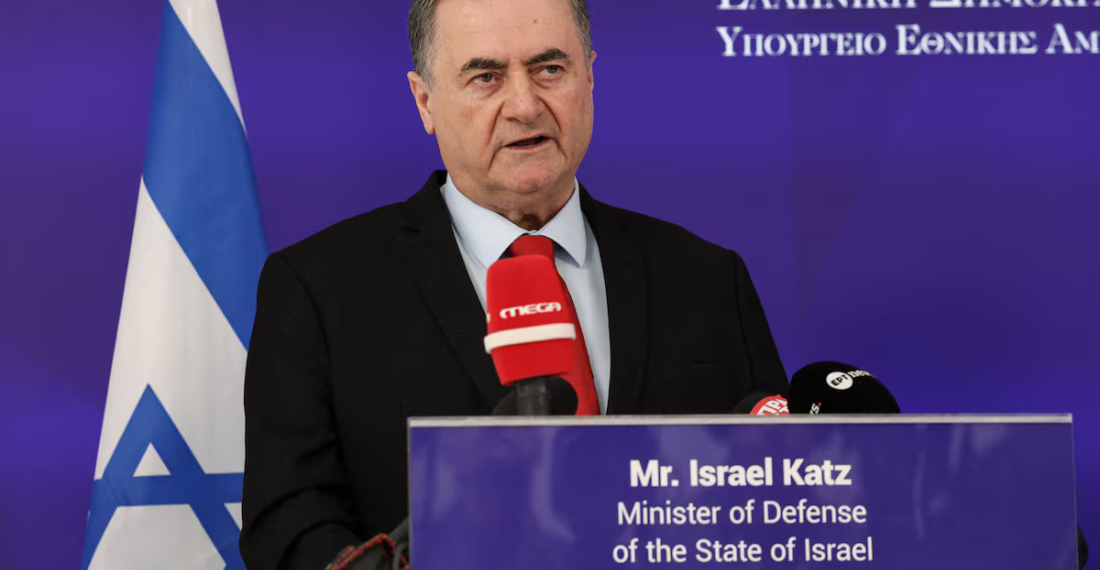
Israel seeks to destroy "all houses in villages near the Lebanese border"

Israel's Minister of Defense, Isreal Katz, said on Tuesday (31 March) that all homes in Lebanese villages near the border will be destroyed, and 600,000 people who fled ​the south will not be allowed home until northern Israel is 'secure'. Isreal is aiming to establish a 'buffer zone' in southern Lebanon, and intends to maintain control over a swathe of territory up to the Litani River after their war with Iran-backed Hezbollah ends. 

Israel launched an offensive against Hezbollah on 2 March, displacing more than 1.2 million people. Hezbollah opened fire in support of Tehran on 2 March. The Israeli military (IDF) earlier ​this month ordered residents to leave swathes of the south, the Hezbollah-controlled southern suburbs of Beirut, and the group's political heartlands in eastern Lebanon.

"At the end of the operation, the IDF will establish a security zone inside Lebanon — a line of defence against anti-tank missiles — and ​will maintain security control over the entire area up to the Litani River, including the remaining Litani bridges," Katz ​said in a statement.


Israeli forces would eliminate Hezbollah's elite Radwan fighters who infiltrated the south and destroy all weapons, he said. Displaced residents ‌would not ⁠be allowed to return south of the Litani "until the safety and security of residents of northern Israel is guaranteed", he added.


"All houses in villages near the Lebanese border will be destroyed, in accordance with the model used in Rafah and Beit Hanoun in Gaza, in order to permanently remove the threats near the border to northern residents," he said.

Source: commonspace.eu with Reuters
Related articles

Popular

Editor's choice
Interview
Thursday Interview: Murad Muradov

Thursday Interview: Murad Muradov

Today, commonspace.eu starts a new regular weekly series. THURSDAY INTERVIEW, conducted by Lauri Nikulainen, will host  persons who are thinkers, opinion shapers, and implementors in their countries and spheres. We start the series with an interview with Murad Muradov, a leading person in Azerbaijan's think tank community. He is also the first co-chair of the Action Committee for a new Armenian-Azerbaijani Dialogue. Last September he made history by being the first Azerbaijani civil society activist to visit Armenia after the 44 day war, and the start of the peace process. Speaking about this visit Murad Muradov said: "My experience was largely positive. My negative expectations luckily didn’t play out. The discussions were respectful, the panel format bringing together experts from Armenia, Azerbaijan, and Turkey was particularly valuable during the NATO Rose-Roth Seminar in Yerevan, and media coverage, while varied in tone, remained largely constructive. Some media outlets though attempted to represent me as more of a government mouthpiece than an independent expert, which was totally misleading.  Overall, I see these initiatives as important steps in rebuilding trust and normalising professional engagement. The fact that soon a larger Azerbaijani civil society visits to Armenia followed, reinforces the sense that this process is moving in the right direction." (click the image to read the interview in full)