


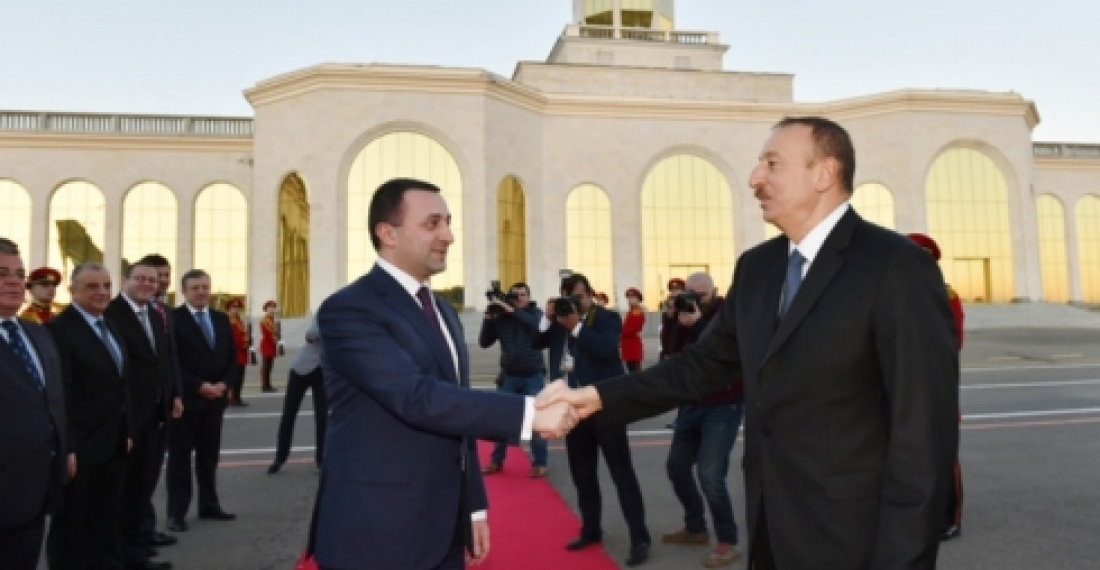
Georgia-Azerbaijan partnership is a bedrock for region’s future.

This is a commentary prepared by the editorial team of commonspace.eu.

The visit of President Ilham Aliev to Georgia on 5-6 November marks a high point in relations between the two countries. It reaffirmed the deep friendship between the two neighbouring nations. The governments of the two countries describe the relationship between them as "strategic". This term is often overused in diplomacy, but on this occasion it aptly describes a relationship that is helping to define the future of the South Caucasus.

In Tbilisi, President Aliev met with President Giorgi Marghvalishvili, Prime Minister Irakli Gharibashvili, and Parliamentary Speaker Davit Usupashvili. He also met Catholicos Patriarch Ilia II and former Prime Minister Bidhzina Ivanishvili - a recognition of the important role that these two personalities play in Georgia's public life.

On the occasion of the visit, President Marghvelashvili and President Aliev issued a joint declaration in which they stated that "the two countries hereby proclaim that they continue to strengthen the present level of strategic partnership aimed at elevating their relations by deepening and broadening cooperation in fields of mutual interest, both in the bilateral and international fora". The declaration goes on to list four key areas where this co-operation and partnership will focus on, namely (a) political; (b) economy and trade; (c) defence and security; and (d) Science, education and culture.

The two countries already have two decades and more of experience of working together as independent sovereign states. The Baku-Tbilisi-Ceyhan pipeline is a living symbol of how that co-operation can be of benefit to both countries. It was the first of many ambitious projects that were subsequently implemented together, or are in the process of being so. Azerbaijan and Georgia also co-operate closely with Turkey in both a bilateral and multilateral format.

Regional co-operation is the basis on which the future of the South Caucasus needs to be built. The Georgia-Azerbaijan strategic co-operation is rightly seen as the bedrock for future co-operation, and indeed for the future prosperity of the region and its people. The wider geo-political context in which this co-operation is developing is however not simple.

The last paragraph of the declaration agreed in Tbilisi on 5 November states, "The strategic partnership between the two countries is not directed against any other State or group of States, and does not infringe upon their rights or commitments under bilateral or multilateral international agreements in force to which they are Parties". Georgia, whilst very keen to develop its strategic partnership with Azerbaijan, also wants to maintain its good relations with Armenia. It was perhaps a coincidence, or perhaps not, that Armenian President Serzh Sargsyan visited Georgia a few days before President Aliev (see commonspace.eu commentary on the visit here). Georgia rightly needs to balance the relationship with its two neighbours, and if possible contribute towards a rapproachment between them. On its part Azerbaijan does not want its special relationship with Georgia to upset Russia. It similarly could play a role in maintaining lines of communication open between the Georgian and the Russian leaderships.

There are also issues in relations between Georgia and Azerbaijan that the two sides need to manage properly. These range from border demarcation to the issues related to the large population of Azerbaijani ethnicity in Georgia. The two sides will do well to give proper attention to these matters and to ensure that problems are dealt with in a timely fashion and not allowed to fester. The two countries also have different governance models and foreign policy orientations. Only by basing their relationship on mutual respect will they be able to ensure that these differences will not become an obstacle in their relationship.

On the whole however, it is possible to say that the visit of President Aliev to Georgia this week has been a huge success, and opens new horizons not only for bilateral co-operation between the two countries, but also for regional co-operation - an essential ingredient for peace and prosperity in the Caucasus.

source: This commentary was prepared by the editorial team of commonspace.eu.

photo: President Aliev of Azerbaijan with Prime Minister Gharibashvili of Georgia in Tbilisi on Friday, 6 November 2015. (picture courtesy of the press service of the president of Azerbaijan).


Related articles

Editor's choice
News
Council of Europe launches new International Claims Commission for Ukraine

Council of Europe launches new International Claims Commission for Ukraine

Thirty-four countries and the European Union have signed a new convention establishing an International Claims Commission for Ukraine at a diplomatic conference co-hosted by the 46-nation Council of Europe and the Netherlands in the Hague. The diplomatic conference was attended by leaders and high-level representatives from over 50 states, including the President of Ukraine, Volodymyr Zelenskyy, the President of the Republic of Moldova, Maia Sandu, and the Prime Minister of the Netherlands, Dick Schoof.  “Today marks a major step forward in ensuring accountability for Ukraine. The International Claims Commission represents justice and hope for tens of thousands of victims—our determination that those who have suffered will not be forgotten. I call for quick ratifications so we can get the commission rapidly up and running for the people of Ukraine,” said Council of Europe Secretary General Alain Berset. Ukrainian President Volodymyr Zelenskyy said: “We expect that every mechanism for compensation from the Register of Damage and Claims Commission to the actual payments – will start working and receive strong and sufficient international support, so that people can truly feel that any kind of damage caused by the war can be compensated. This war, and Russia’s responsibility for it, MUST become a clear example – so that others learn not to choose aggression.” “Accountability is about creating the conditions for peace that endures. And therefore, accountability is a condition of security – today and for the future. But accountability is not only about Ukraine. And it is not only about one aggressor and one victim. Accountability is about Europe. About every country in Europe. It is about whether Europe, as a whole, is willing to defend its peace,” said Maia Sandu, President of the Republic of Moldova, which currently holds the Presidency of the Council of Europe’s Committee of Ministers. The Prime Minister of the Netherlands, Dick Schoof, said: “Every day Russia is deliberately bombarding homes, destroying businesses and damaging infrastructure in Ukraine. Russia must compensate Ukraine for the damage caused. That is why we have launched the International Claims Commission for Ukraine and we are honoured to host it.” The International Claims Commission will be the second part of a comprehensive compensation mechanism related to Russia’s war of aggression, building on the existing Register of Damage for Ukraine. The claims commission will be established within the framework of the Council of Europe and will also be open to other countries. The Register of Damage for Ukraine, created in 2023, collects and records compensation claims submitted by individuals, organisations and public bodies in Ukraine. Forty-four states and the European Union have so far joined the Register, which has already received 86,000 claims. The International Claims Commission will review, assess and decide upon claims submitted to the Register of Damage for Ukraine and determine the amount of compensation, if any, which is due in each case. The convention establishing the commission will enter into force once it has been ratified by 25 signatories, as long as sufficient funds have been secured to support its initial work.

Popular

Editor's choice
News
Council of Europe launches new International Claims Commission for Ukraine

Council of Europe launches new International Claims Commission for Ukraine

Thirty-four countries and the European Union have signed a new convention establishing an International Claims Commission for Ukraine at a diplomatic conference co-hosted by the 46-nation Council of Europe and the Netherlands in the Hague. The diplomatic conference was attended by leaders and high-level representatives from over 50 states, including the President of Ukraine, Volodymyr Zelenskyy, the President of the Republic of Moldova, Maia Sandu, and the Prime Minister of the Netherlands, Dick Schoof.  “Today marks a major step forward in ensuring accountability for Ukraine. The International Claims Commission represents justice and hope for tens of thousands of victims—our determination that those who have suffered will not be forgotten. I call for quick ratifications so we can get the commission rapidly up and running for the people of Ukraine,” said Council of Europe Secretary General Alain Berset. Ukrainian President Volodymyr Zelenskyy said: “We expect that every mechanism for compensation from the Register of Damage and Claims Commission to the actual payments – will start working and receive strong and sufficient international support, so that people can truly feel that any kind of damage caused by the war can be compensated. This war, and Russia’s responsibility for it, MUST become a clear example – so that others learn not to choose aggression.” “Accountability is about creating the conditions for peace that endures. And therefore, accountability is a condition of security – today and for the future. But accountability is not only about Ukraine. And it is not only about one aggressor and one victim. Accountability is about Europe. About every country in Europe. It is about whether Europe, as a whole, is willing to defend its peace,” said Maia Sandu, President of the Republic of Moldova, which currently holds the Presidency of the Council of Europe’s Committee of Ministers. The Prime Minister of the Netherlands, Dick Schoof, said: “Every day Russia is deliberately bombarding homes, destroying businesses and damaging infrastructure in Ukraine. Russia must compensate Ukraine for the damage caused. That is why we have launched the International Claims Commission for Ukraine and we are honoured to host it.” The International Claims Commission will be the second part of a comprehensive compensation mechanism related to Russia’s war of aggression, building on the existing Register of Damage for Ukraine. The claims commission will be established within the framework of the Council of Europe and will also be open to other countries. The Register of Damage for Ukraine, created in 2023, collects and records compensation claims submitted by individuals, organisations and public bodies in Ukraine. Forty-four states and the European Union have so far joined the Register, which has already received 86,000 claims. The International Claims Commission will review, assess and decide upon claims submitted to the Register of Damage for Ukraine and determine the amount of compensation, if any, which is due in each case. The convention establishing the commission will enter into force once it has been ratified by 25 signatories, as long as sufficient funds have been secured to support its initial work.

