


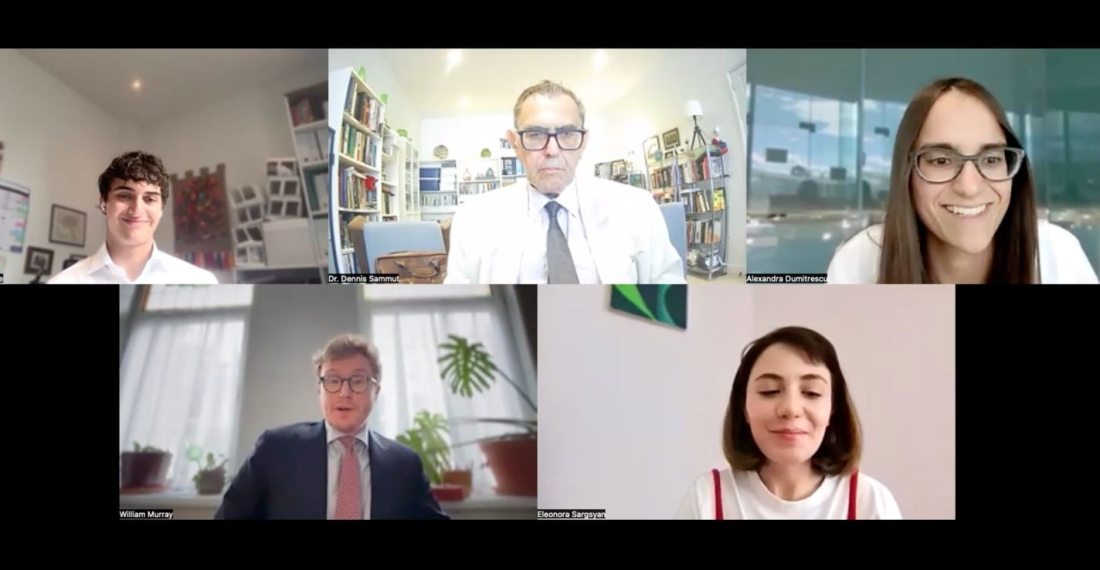
On Thursday (11 June), LINKS Europe held a webinar on the results of the Armenian Parliamentary elections and the role of social media and media during the election period, both in Armenian media and Russian media.
The panel was formed by Eleonora Sargsyan, from Armenian Progressive Youth; Dennis Sammut, Director of LINKS Europe; Santiago Ferbel-Azcarate, Senior Research Assistant at LINKS Europe; and Will Murray, founder of Vigeat Europa. The panel was chaired by Alexandra Dumirescu, international coordinator at LINKS Europe.
Ms. Sargsyan offered the audience an overall assessment of the election results and the overall political mood in the country. She explained that the key outcome of Armenia's 2026 parliamentary elections was a renewed mandate for continuity. Despite war, displacement, the loss of Nagorno-Karabakh, and significant foreign interference, a large part of Armenian society once again backed the political force most closely associated with peace, normalisation with Azerbaijan and Türkiye, and a more diversified foreign policy. She cautioned against interpreting the result as unconditional support for the government, noting that many voters remain critical of Prime Minister Pashinyan. Nevertheless, she argued that the result reflected a clear societal preference for peace, stability, sovereignty, and continuity rather than a return to previous political models.
Drawing on her work with youth in Armenia, she highlighted youth polarisation as one of the most pressing challenges facing the country. Contrary to common assumptions, she argued that younger generations are not necessarily more supportive of peace and are often among the strongest critics of the government's peace agenda. Having grown up in an environment shaped by conflict and escalation, many young Armenians have no lived experience of peaceful coexistence with Azerbaijanis and therefore view peace as abstract, uncertain, or even threatening. She warned that young people are particularly susceptible to foreign influence and narratives framed around patriotism and traditional values, and argued that youth engagement must go beyond electoral participation to include media literacy, critical thinking, and spaces where young people can process the fears and traumas created by years of conflict and instability.
She welcomed the assessment of the international electoral observation mission on the free and fair conduct of the elections, and she stressed that Armenia now needs to invest more in media literacy, critical thinking, and social cohesion. In her view, the election result should be respected as a genuine expression of public will, but it should not be romanticised, since it emerged in a highly polarised environment and against a backdrop of substantial foreign pressure.
Dr Sammut described the 2026 parliamentary elections as a good election that strengthened Armenia's democratic process and produced a clear result. Yet he identified three issues that require serious attention. First, Russia interfered in the election in ways that were both overt and covert, using pressure, threats, and influence operations to sway voters towards pro-Russian opposition forces. Second, parts of the campaign became trapped in arguments about Armenia's geopolitical orientation, obscuring the everyday concerns that matter most to many voters. Third, the election showed that Armenian society remains divided over the peace agreement with Azerbaijan and the wider normalisation process with its neighbours. Whilst the result gives Prime Minister Nikol Pashinyan the legitimacy to continue pursuing peace, it also demonstrates that a substantial part of society remains unconvinced.
Dr Sammut argued that the next government must now focus on narrowing these divisions. Much responsibility lies with Pashinyan, who has transformed Armenia in ways few thought possible, but whose leadership must also evolve. What worked after 2018 will not necessarily work now. Armenia needs stronger institutions, a more inclusive government, and greater attention to the consequences of political decisions. It is no longer time to cut corners. If Armenia is to deal with the challenges ahead, not least continued pressure from Russia, it must rely less on personalities and more on resilient and inclusive institutions capable of carrying the country forward.
The webinar moved on to two presentations. Mr Ferbel-Azcarate shared a presentation titled 'Social media usage and Armenia's 2026 election'. This was followed by a presentation on how the Russian media discussed the Armenian elections by Will Murray from Vigeat Europa.
During the Q&A session, the panel discussed in detail how Moscow influenced the Armenian Elections and how Pashinyan’s government will be affected by the lack of a constitutional majority. In addition, the importance of media literacy was addressed as a way forward in combating misinformation.
Source: This briefing was prepared by the editorial team of LINKS Europe Foundation



