As Georgia and Russia prepared to mark the 5th anniversary of the August 2008 war commonspace.eu special correspondent Joseph d'Urso joined a patrol of the European Union Monitoring Mission (EUMM), and watched the Russians construct a new fence that is fast becoming a symbol of suffering and separation in the heart of the Caucasus. He also talked to local people directly affected by the conflict.
The village of Ditsi lies just on the Georgian side of the administrative boundary line (ABL) between Tbilisi administered territory (TAT) and the autonomous region of South Ossetia. The area was devastated by the brutal war of August 2008, which left many dead, wounded or displaced.
Our Swedish patrol leader holds a bulky GPS unit as his weapon - EUMM is a completely unarmed civilian mission - and we are suddenly told to stop. 'The ABL is here. You can see the Russian surveillance cameras in the distance. If you go further, it is at your own risk.' The Georgian police do not mark or patrol the ABL; to do so would be to acknowledge its legitimacy.
Most of the eccentrically zigzagging 350km ABL is not marked in any way. It takes an intricate cross-referencing of Russian surveillance positions, Ossetian and Georgian settlements as well as modern and Soviet-era maps to determine where Tbilisi-controlled Georgia ends and South Ossetia begins.
In the second phase of the short war in August 2008 Russian forces moved deep into Georgia but Russia swiftly withdrew, after the Sarkozy-brokered cease fire agreement, to the old Soviet administrative borders of South Ossetia and Abkhazia, territories that it now recognises as independent states.
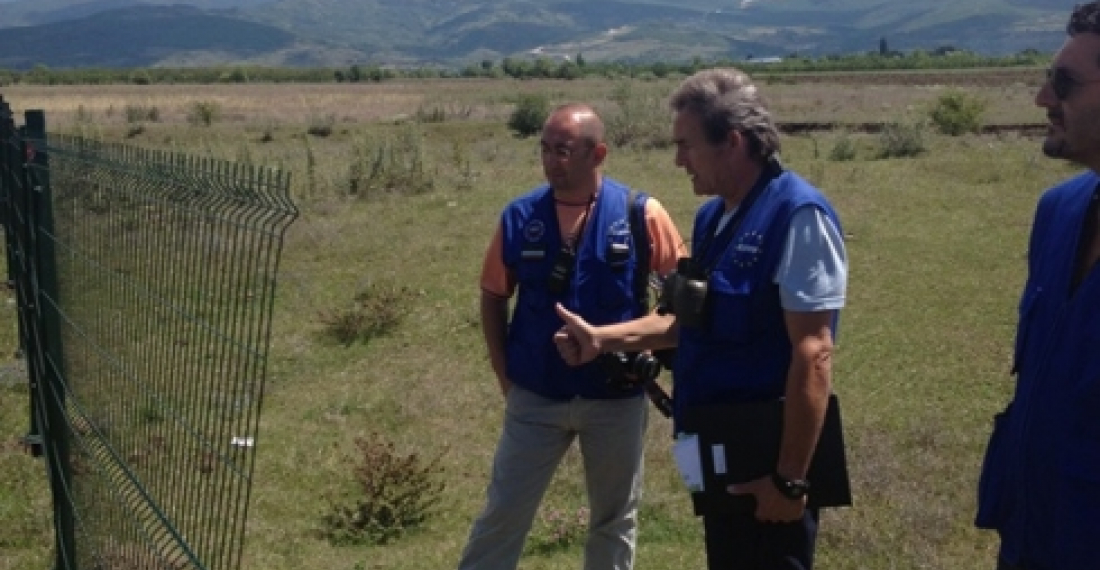
This stalemate manifests itself on the ground. As we patrol a different segment of the boundary line later in the day, we come across three Ossetian villagers constructing a brand new fence along the ABL. They stand around ten metres away. Between us lie only a stony path and some patchy grass, yet as we stand there they are in the process of making this tiny gap physically impassable.
The villagers hammer thick metal poles into the sunbaked turf, fastening thick wire fencing sheets between them. Not once do they look up or acknowledge our presence in the twenty minutes or so we spend watching them. After a while a call is made, and a shiny SUV arrives on the path some fifty metres behind them, sixty metres from us. Russians, one assumes.
When we finally drag ourselves away from this surreal scenario, the fence is a bit longer. So too perhaps is the prospect of South Ossetia returning under Tbilisi's control. As we leave, villagers on the Georgian side of the line stop our vehicle to give us some fresh peaches. Perhaps this group and the Ossetian fence builders were friends, co-workers or neighbours before 2008. Perhaps back then the Ossetians would have walked ten metres towards us and given us peaches too.
The South Ossetian front differs from the Abkhazian one in that there is no obvious physical demarcation. While the Inguri River neatly divides Georgia from its autonomous northwestern neighbour, the border with South Ossetia is far less clear. An estimated 30km of the border is now fenced off, an amount that has been increasing steadily during 2013. There are now thought to be nineteen Russian military bases within South Ossetia, and surveillance cameras on giant poles observe movements along the ABL 24 hours a day.
Later on at the largest internally displaced persons (IDP) camp at Tserovani just north of Tbilisi, I meet Emzari, a man of around fifty years old. He last saw his home in 2008. 'In my district, nine villages, including my own, were completely burned down - I don't know when I will be able to return. If I could go back tomorrow, I would.' His message to EU observers is not to forget about the fate of IDPs in Georgia. Although EUMM continues its daily operations on the boundary line, EU emergency humanitarian aid to IDPs in Georgia has largely ended. Another group of men in Tserovani complain that the $12 a month they receive from the Georgian government is not even enough to enable them to travel to Tbilisi and look for work.
Hostages are still regularly taken along the ABL. Georgian villagers alleged to have strayed on the wrong side of the line have been detained by Ossetian authorities and fined 5,000 roubles, an astronomical sum in this impoverished corner of the Caucasus. The ABL cuts through communities, dividing people from their farms and orchards, even from family and friends. A small Georgian graveyard near Ditsi is especially politically sensitive. Located right on a disputed section of the ABL, the right of villagers to tend to the graves of their loved ones - an important and symbolically powerful tradition in the Caucasus - is in jeopardy. According to EUMM staff, near here each Sunday afternoon a mother climbs a hill to greet her daughter on the other side.
An 81 year-old man, happy to speak anonymously once Georgian police have left the vicinity, complains that life is now worse than under Soviet times when there was freedom of movement and free medical treatment.
The Russian positions in South Ossetia and Abkhazia are more entrenched than ever, making the EU's stated goal of restoring Georgia's 'territorial integrity' seem remote. One could be cynical about the EUMM's lack of muscle in such a militarised region, or about the challenging position that lacking access to the disputed territories puts them in. However unlike in Nagorno-Karabakh or Gaza, both sides, so far, have respected the ceasefire, and there have been very few casualties since it came into force. EUMM also helps facilitate limited communication between parties where no other international organisation is able to do so. EUMM has clearly played a role in securing this uneasy peace.
As an unarmed civilian operation it has managed to build relationships with all parties, though it has at times had difficulty persuading the South Ossetian and Abkhazian authorities that it is genuinely impartial. As EUMM still has no access to either, it relies largely on analysis and anecdotal evidence to comprehend the situation inside the territories.
One source of communication is at regular IPRM (Incident Prevention and Response Mechanism) meetings, where EUMM findings are communicated to Georgian, Russian and Ossetian authorities. Unfortunately the Abkhazians have not participated since an April 2012 when they accused the EUMM's Head of Mission of the time with lack of impartiality. There is also an EUMM facilitated 'hotline', which has helped to negotiate the release of detainees and to defuse tensions when clashes have occurred.
It is impossible to know what the long term solution will be regarding the future status of South Ossetia and Abkhazia. Georgians are divided and fickle about their country's long-term strategic interests, while the diplomatic process, based in Geneva, has yielded no answers.
The conflict is in part a story of posturing elites in Tbilisi and Moscow (and to some extent also in Sukhumi and Tskhinvali), and the subsequent reactions from Brussels and Washington. Yet one must never forget the scale of human tragedy that has been caused by this conflict. Virtually every family in South Ossetia and the surrounding area, be they Georgian or Osset, have witnessed first-hand the horrors of death and deportation, rape and dispossession. The paroxysms of 2008 have been followed by the more mundane tragedies of poverty and unemployment. The contorted and arbitrary boundary line compounds this misery, as does the wearisome passage of time with no solution.
Commonspace.eu correspondent Joseph d'Urso travelled with a patrol of the European Union Monitoring Mission near the Administrative Boundary Line seperating Georgia from the self-declared Republic of South Ossetia on 31 July 2013. He also met Georgian displaced persons in the IDP settlement of Tserovani.
source: commonspace.eu
photo: Members of the EUMM Mission in Georgia inspecting a new fence being constructed by Russian forces on the Ossetian side of the Administrative Boundary Line.