


This editorial first appeared in the 4 April 2023 issue of our newsletter, Central Asia Concise. If you would like to sign up to Central Asia Concise, or any other of our newsletters, click here.
"The exciting changes taking place in Central Asia cannot succeed if they are only a top-down exercise," writes commonspace.eu in this editorial. "Civil society through NGOs and SMEs needs to be galvanised to sustain the reforms and changes and to give them momentum. This will be a test for the Central Asian governments, as much as the journey to political plurality which some of them have now, at least nominally, embarked on."
A story is told of a young Uzbek, who shortly after his country gained independence following the collapse of the Soviet Union in 1991, went to the Governor of his region and told him he wanted to establish a Non-Governmental Organisation (NGO).
The Governor was shocked. “My son”, he told him, “you are from such a good family, why are you against the government?” In Islam Karimov’s Uzbekistan you were either with the Government, or against it. Here, as in the other Central Asian republics, there was no or little space for NGOs.
Unfortunately this attitude prevailed for decades. Civil society in Central Asia was weak and marginalised. A few NGOs managed to survive, with western funding, and often heavily infiltrated by intelligence agencies. Some religious inspired organisations were seen as tools of jihadist forces.
The lack of a proper civil society leaves a hole in Central Asia’s governance and development model. This is becoming more obvious as countries like Kazakhstan and Uzbekistan cautiously implement reforms across all sectors of society and try to regain the time lost over the last three decades. The reforms that the two governments are pushing are positive and they are real. They are also top-down.
The presidential administrations in both countries struggle to get government officials to implement the changes that are necessary. The administrative system remains rooted in old habits, most dating back to Soviet times. In similar situations in other post-Soviet and transition countries, civil society often acted as a counterbalance, supporting reforms, and urging for more. But in Central Asia this demand is weak.
Plurality should be across society
In the last days, the new Kazakh Parliament was sworn in. It is a multi-party parliament, and although not pluralistic in the traditional sense, it allows for different voices. This has the potential to create a new dynamic in the country’s governance system,#. But the lack of civil society means that any positive steps do not get amplified through wider society. Change in this sector is necessary too.
First there needs to be a change of mentality - non-governmental does not mean anti-government. The message needs to come down from the top that NGOs are a necessary thing, and that they should not only be tolerated but encouraged.
Then there is a need to liberalise the regulatory framework, so that organisations are able to form easily, to enable them to work transparently and not to over-burden them with complex financial regulations.
Third, it is necessary to start giving NGOs a voice by seeing them as partners in the reform agenda that is being pursued by Astana and Tashkent.
There will of course be those who will abuse the system, as was seen in other post-Soviet and other transition countries in the past. NGOs can simply become tools of opposition forces with hidden agendas. Even worse, in Central Asia, they can become tools of jihadist forces pushing a confused and distorted version of Islam. These are real risks that governments, working with genuine civil society groups, need to manage and tackle.
SMEs can also play a vital role
Parallel to civil society – some would argue part of it – are the SMEs – small and medium size enterprises. For many countries they are the motor of the economy. In Central Asia this sector is also in a nascent stage. But there are encouraging signs, especially in the high tech sector where young entrepreneurs are trying to break out of the mould of the past. This is a trend that one can see even in the smaller Central Asian republics, such as Tajikistan. This sector also needs to be encouraged through regulatory reforms, financial incentives and through the establishment of innovation hubs.
Central Asia’s western partners, especially the US and the EU, can and should be at the forefront in working with the governments of the region to support these sectors. The approach needs to be intelligent and nuanced, and most importantly, transparent. They too need to remember that non-governmental does not mean anti-government, and that the first obligation of NGOs is to contribute to the wider welfare of society and not to do politics.
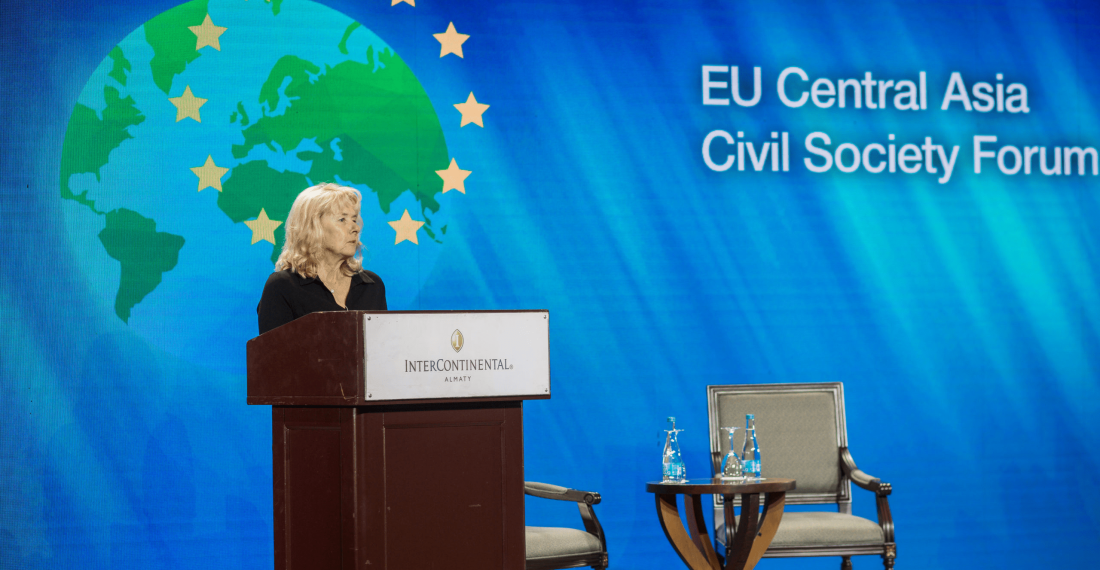
In any case, the 4th EU-Central Asia civil society forum held in Tashkent last month was a positive step, but this initiative needs to be energised and be given a proper focus. Click here to read more.
The exciting changes taking place in Central Asia cannot succeed if they are only a top-down exercise. Civil society through NGOs and SMEs needs to be galvanised to sustain the reforms and changes and to give them momentum. This will be a test for the Central Asian governments, as much as the journey to political plurality which some of them have now, at least nominally, embarked on.



