


Did Armenia say "nyet"?

Azerbaijan has accused Armenia of rejecting a proposal from the international community for the establishment of a working group to start preparing a comprehensive peace agreement.

Azerbaijan's Foreign Minister, Elmar Mammadyarov has accused Armenia of rejecting a proposal to set up a working group to start working on a draft of a comprehensive peace agreement to resolve the Karabakh conflict. Speaking while on an official visit to Tbilisi Mammadyarov said that Azerbaijan has accepted the proposal to establish a working group to prepare a peace agreement,but when the co-Chair took the idea to Yerevan earlier this week the Armenian side rejected the proposal.

Mammadyarov said that the idea of a comprehensive peace agreement was discussed during the summit of the Presidents of Armenia and Azerbaijan with the President of France in Paris last year. He said that the co-Chair of the Minsk Process during their recent visit to the region had suggested the establishment of a working group to develop a peace agreement within six to twelve months, and Azerbaijan had accepted the idea. The co-Chair than took the idea to the Armenian leadership in Yerevan. Mammadyarov was quoted by the Azerbaijani News Agency APA as saying that "the Armenian leadership has refused to this schedule. I've already talked to US Co-Chair, who informed me that the Armenian leadership rejected the proposal...... The co-chairs most likely will determine how to build the work in this direction. We need to start this work, the sooner the better. It is beneficial to all, including Armenia. Azerbaijan has accepted the proposal for establishment of a working group to prepare peace agreement. Now co-chairs will have to decide how to speak with Armenia".

Earlier, the Foreign Minister of Armenia Edward Nalbandian accused Azerbaijan of trying "to bring to naught the results of the negotiation process of several years on elaboration of the Basic Principles of the Nagorno-Karabakh conflict settlement. Baku is attempting to use the fact of the non-resolution of the conflict, through its own fault, tо justify the flagrant violations of human rights and repressions against opponents within the country." "As soon as an agreement on the Basic Principles is reached , and Nagorno-Karabakh approves it, then it will be possible to start by Azerbaijan, Nagorno-Karabakh and Armenia to elaborate a comprehensive peace agreement", Nalbandian was quoted as saying by the website of the Armenian Foreign Ministry.

In a statement issued earlier this month, the leadership of the organisation for Security and Co-operation in Europe (OSCE) stated that "The Minsk Group Co-Chairs, with the full support of the Chairperson-in-Office, are prepared to host an intensified negotiation process that can bring to a peaceful end a conflict that has scarred the region for too long. We strongly urge the sides to find the political will to begin this process immediately without excuses."

source: commonspace.eu with agencies.

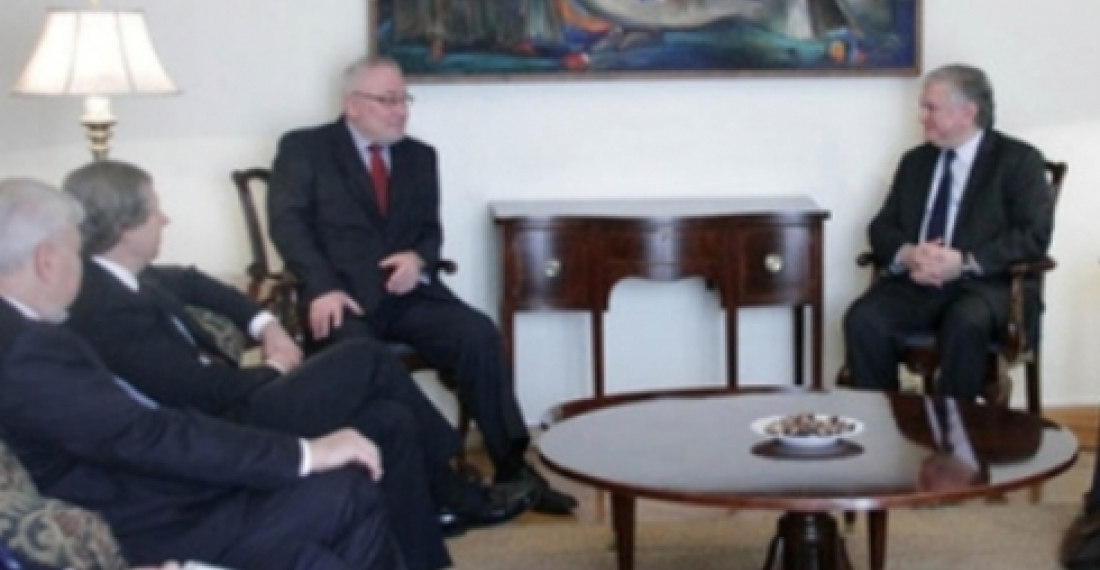
photo: The co-Chair of the OSCE Minsk Process met the Foreign Minister of Armenia Edward Nalbandian in Yerevan on Tuesday, 17 February 2015. (picture courtesy of the Press Service of the Foreign Ministry of Armenia).
Related articles

Editor's choice
News
Key European countries back Denmark in the face of Trump's continuing insistence on taking over Greenland

Key European countries back Denmark in the face of Trump's continuing insistence on taking over Greenland

 Six major European countries have declared their support to Denmark following renewed insistence by the US that it must have control over Greenland. "Greenland belongs to its people, and only Denmark and Greenland can decide on matters concerning their relations," said the leaders of the UK, France, Germany, Italy, Poland, and Spain, in a joint statement, issued on Tuesday (6 January), together with Denmark. On Sunday, Donald Trump said the US "needed" Greenland - a semi-autonomous region of fellow Nato member Denmark - for security reasons. He has refused to rule out the use of force to take control of the territory, and Danish Prime Minister Mette Frederiksen warned on Monday that an attack by the US would spell the end of Nato. The issue of Greenland's future resurfaced in the wake of the US military intervention in Venezuela, during which elite troops went in to seize the country's President Nicolás Maduro and take him to face drugs and weapons charges in New York. Following the raid, Trump said the US would "run" Venezuela for an unspecified period of time. He also said the US was returning to an 1823 policy of US supremacy in its sphere of influence in the Western hemisphere - and he warned a number of countries the US could turn its attention to them. The US military raid in Venezuela has reignited fears that the US may consider using force to secure control of Greenland. A day after the raid, Katie Miller - the wife of one of Trump's senior aides - posted on social media a map of Greenland in the colours of the American flag, alongside the word "SOON". On Monday, her husband Stephen Miller said it was "the formal position of the US government that Greenland should be part of the US". In an interview with CNN, he also said the US "is the power of Nato. For the US to secure the Arctic region, to protect and defend Nato and Nato interests, obviously Greenland should be part of the US." Asked repeatedly whether the US would rule out using force to annex it, Miller responded: "Nobody's going to fight the US over the future of Greenland." Stressing they were as keen as the US in Arctic security, the seven European signatories of Tuesday's joint statement said this must be achieved by Nato allies, including the US "collectively" - whilst "upholding the principles of the UN Charter, including sovereignty, territorial integrity and the inviolability of borders". Greenland's Prime Minister Jens-Frederik Nielsen welcomed the statement and called for "respectful dialogue". "The dialogue must take place with respect for the fact that Greenland's status is rooted in international law and the principle of territorial integrity," Nielsen said. Trump has claimed that making Greenland part of the US would serve American security interests due to its strategic location and its abundance of minerals critical to high-tech sectors. Greenland, which has a population of 57,000 people, has had extensive self-government since 1979, though defence and foreign policy remain in Danish hands. While most Greenlanders favour eventual independence from Denmark, opinion polls show overwhelming opposition to becoming part of the US.

Popular

