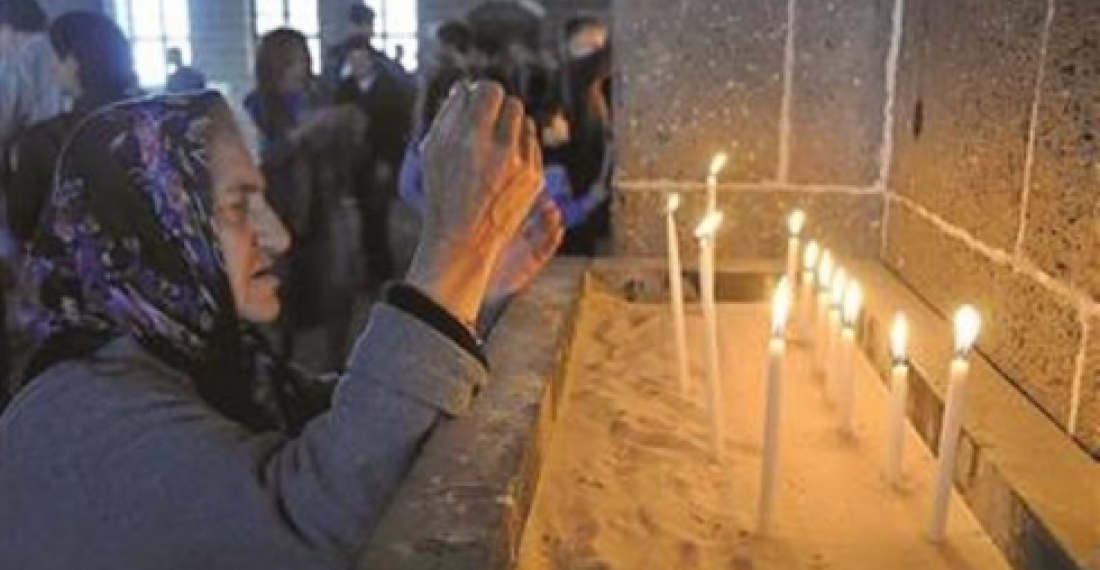
The painful process of healing relations between Armenians and Turks made one small step forward yesterday. In the Turkish city of Diyarbakir the Armenian community has rung the bells of Surp Giragos Armenian Church for the first time in 98 years to celebrate the Easter holiday. A proper mass could not be held due to a lack of priests to take part.
Doğan news agency reported yesterday that the church had been out of service for almost a century now, and was recently restored with a $3.200.000 budget before it was re-opened. The community visited the grounds yesterday, Easter Sunday. The bronze bell, which was built in Russia, was rung for the first time in almost a century. The community failed to conduct a mass for Easter, however, since the Istanbul Patriarchate previously responded to a request to send priests to the church by telling the community that it would take a week for the religious official to arrive in Diyarbakır. As a result, no masses were held at the church, but the community prayed to celebrate the religious holiday nevertheless, before distributing colored eggs and pastries.
On the other hand Armenian and Turkish media over the weekend reported that flights from the Armenian capital Yerevan to the Turkish city of Van, which were due to start this week have been cancelled. It is not clear what the reasons are but it is known that Azerbaijan had protested to Turkey about the launch of the flights. Azerbaijan and Turkey have for the last two decades cut most links with Armenia in response to Armenia's occupation of Azerbaijani territory during the conflict around Nagorno-Karabakh. On Sunday some media outlets speculated that the air links between Yerevan and the Turkish city of Istanbul, one of the few remaining means of communications between Turkey and Armenia were also to be suspended but this information could not be confirmed.
Commonspace.eu political editor said in a comment that "the problem is that the already complex and bitter Turkish-Armenian relations have now got entangled in the equally difficult relations between Armenia and Azerbaijan and all three countries are having difficulties managing this. Armenia, and most of the international community, would prefer to keep the issues seperate, but in reality this is becoming increasingly unrealistic. Expectations that Turkey will take the lead and come up with positive gestures have not always been realised. The toll of the bells of the Armenian church in Diyarbakir gave out a positive sound yesterday, but as has happened often in recent years it has been one small step forward and one small step backward, at a time when what is needed is a determined push forward."
source: commonspace.eu with Hurriyet Daily News
photo: A women lighting a candle at the Armenian Church in Diyarbakir on Easter Day (31 March 2013) where the church bell rang for the first time in ninety eight years. (photo courtesy of Hurriyet Daily news).