


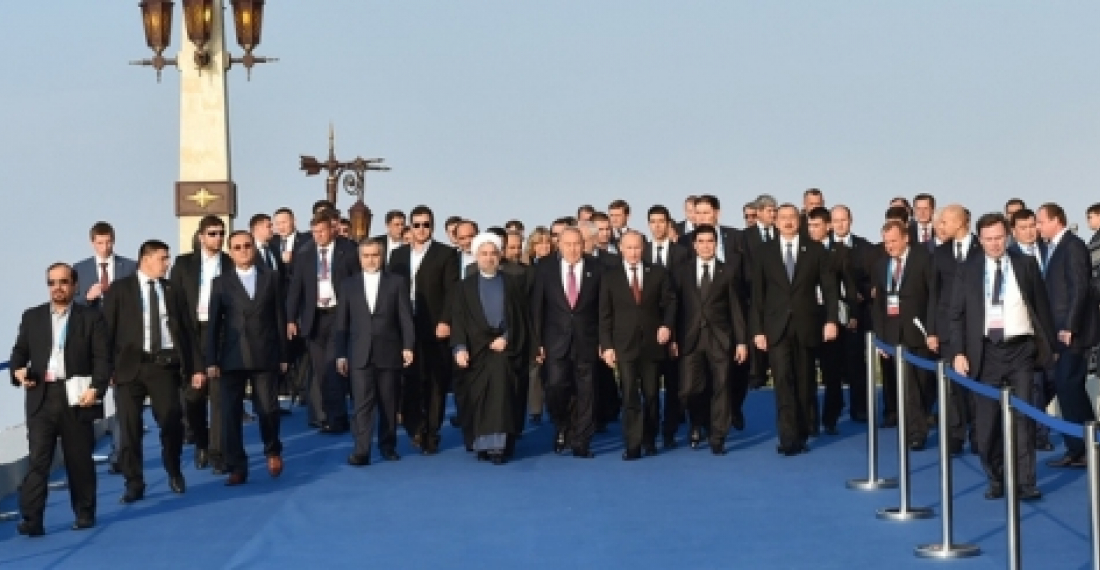
Show of friendship on the shores of the Caspian, but big differences remain. The 4th summit of Caspian leaders was held in Astrakhan.

The 4th summit of the heads of state of the Caspian littoral states took place in the Russian city of Astrakhan on Monday, 29 September. The President of Azerbaijan Ilham Aliyev, the President of Russia, Vladimir Putin,the President of Iran Hassan Rouhani, President of Kazakhstan Nursultan Nazarbayev and President of Turkmenistan Gurbangulu Berdimuhamedov attended the summit.

An agreement on cooperation in hydrometeorology of the Caspian Sea, an agreement on cooperation in warning and liquidating emergencies in the Caspian Sea and an agreement on the preservation and rational use of water biological resources in the Caspian Sea were signed by officials representing the five countries.

A statement was also issued at the end of the meeting.

Speaking at the end of the summit, Russian President Vladimir Putin  saıd that one of the biggest achievements of the meeting was the considerable progress made in preparing the convention on the Caspian's legal status. Putin added that "This was made possible by the fact that we have now agreed on the key principles for our countries' activity in the Caspian". The President said:

"These principles are set out in the political declaration that the five presidents just signed. This declaration will form the future convention's cornerstone. I cannot claim that all issues have been settled completely, but there are far fewer outstanding matters now.

Our experts have received the instruction to step up consultations on the remaining issues to be settled and we have every reason to expect that we will soon have the convention ready for signing and will thus successfully conclude the work that has been going on for 18 years now."

Commonspace.eu political editor said in a comment that whilst the Russians are trying to present this as a breakthrough summit it is clear that considerable differences remain between the position of the different sides. Sending the problems back to officials is not going to narrow the differences since all five countries are very hierarchical and the leaders take all the important decisions anyway. However for the moment it suits all the sides to present an image of harmony. For the smaller countries especially containing the pressure from Russia and Iran is for the moment the highest priority."

source: commonspace.eu

photo: The Leaders of the five Caspian Sea Littoral states at their summit in Astrakhan on Monday. 29, September 2014.
 

Related articles

Editor's choice
News
European leaders set out their plan for Ukraine

European leaders set out their plan for Ukraine

The leaders of Germany, Denmark, Finland, France, Italy, Netherlands, Norway, Poland, Sweden, and United Kingdom, together with the President of the European Council, and the President of the European Commission, o  Monday (15 December) issued a statement, outlining their plan for Ukraine. In their statement, Chancellor Merz, Prime Minister Frederiksen, President Stubb, President Macron, Prime Minister Meloni, Prime Minister Schoof, Prime Minister Støre, Prime Minister Tusk, Prime Minister Kristersson, Prime Minister Starmer, as well as President Costa and President von der Leyen spoke about "Peace for Ukraine". The Leaders welcomed significant progress on President Trump’s efforts to secure a just and lasting peace in Ukraine. They also welcomed the close work between President Zelenskyy’s and President Trump’s teams as well as European teams over the recent days and weeks. They agreed to work together with President Trump and President Zelenskyy to get to a lasting peace which preserves Ukrainian sovereignty and European security. Leaders appreciated the strong convergence between the United States, Ukraine and Europe. Leaders agreed that ensuring the security, sovereignty, and prosperity of Ukraine was integral for wider Euro-Atlantic security. They were clear that Ukraine and its people deserved a prosperous, independent, and sovereign future, free from fear of future Russian aggression. Both the US and European leaders committed to work together to provide robust security guarantees and economic recovery support measures for Ukraine in the context of an agreement on ending the war. This would include commitments to: Provide sustained and significant support to Ukraine to build its armed forces, which should remain at a peacetime level of 800,000 to be able to deter conflict and defend Ukraine’s territory. A European-led ‘multinational force Ukraine’ made up from contributions from willing nations within the framework of the Coalition of the Willing and supported by the US. It will assist in the regeneration of Ukraine’s forces, in securing Ukraine’s skies, and in supporting safer seas, including through operating inside Ukraine. (Click the image to read the statement in full).

Popular

