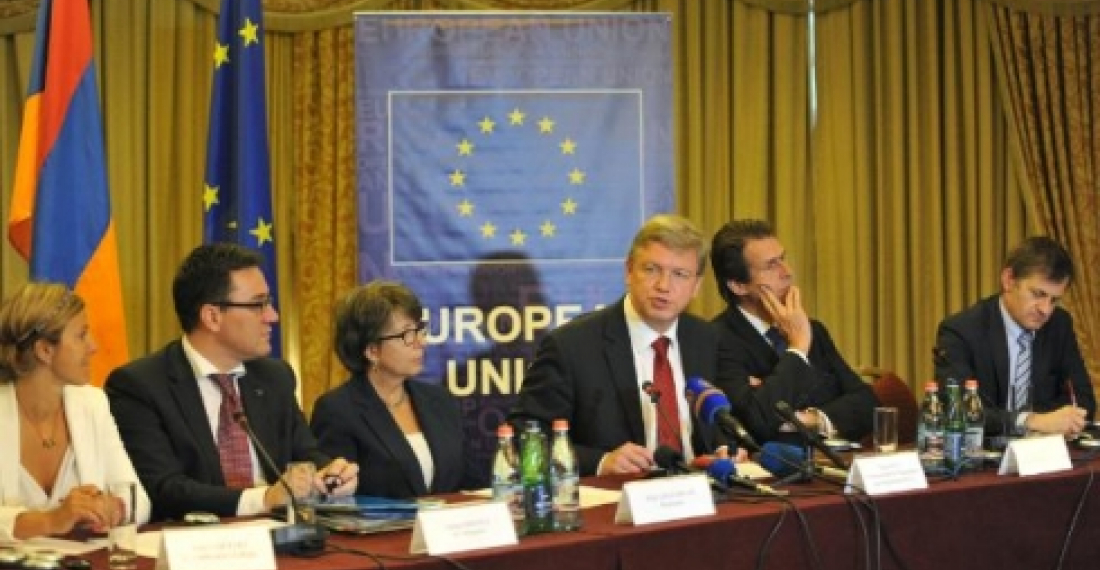
EU Commissioner Stefan Fule was this week in the South Caucasus for meetings with the leadership of Armenia and Georgia and for a range of meetings with other representatives of society in the two countries.
On Wednesday, Fule made a keynote speech to representatives of civil society, students and think tanks at the Marriott Hotel in Yerevan. In his speech Fule reached out to the non governmental representatives and emphasised the important role that they have to play in the development of EU-Armenia relations.
In his speech, Commissioner Fule said,
"We are very close to finalising our Association Agreement, including a Deep and Comprehensive Free Trade Area. I am confident that this will bring concrete benefits and new opportunities to all citizens.
In addition to offering an important trade partnership with the EU - a market with 500 million consumers, the Agreement addresses many concrete issues which affect everyday life. As a result, for example, consumer protection, both in terms of product safety and value for money, or road safety, or air quality are improved. What is more, it will also strengthen the links between the people of Armenia and the people of Europe.
For the European Union, partnerships are not only about economics, business and regulatory frameworks. If we are serious in implementing our commitments, as we should be, our political and trade relations will become much stronger: through the regulatory convergence of our partners with the European Union and the effective sharing of values. Human rights, democracy and fundamental freedoms will be so-called "essential elements" of our new Agreement, in other words the absolute core that both sides must respect and promote.
The Association Agreement, and the Deep and Comprehensive Free Trade Area which it includes, have taken a long time to negotiate. We have worked with our Armenian partners to define a set of reforms which will not only open up new opportunities in terms of market access, mobility and co-operation, but which will allow Armenia to exploit those opportunities with strengthened state institutions, labour market, and infrastructure.
One of the reasons I am so keen that we complete our negotiations is so that we can prepare the Agreement in its final form and share the contents with citizens - I do believe that it will open a new chapter not only in European Union-Armenia relations but also in Armenia's own development.
And we are ready not only to provide financial support of our own, but to encourage other international donors to support reform projects. This can be a foundation for solid medium-term planning, focusing on a common set of goals and under government leadership.
Let me add a couple of words on the broader context of our partnership. As you know, EU-Armenia relations are developed through the Eastern Partnership, that is to say the Eastern dimension of the European Neighbourhood Policy. This policy framework is of great value both to the European Union and also its partners because it is allowing us to bring our relationships to a new level.
In addition to the political aspects of our dialogue with and between our Eastern partners, there is also very practical sectoral cooperation that is underway, in areas ranging from transport to education. In September this year for instance, your beautiful country will host an informal dialogue of Eastern Partnership ministers of education, which Commissioner Vassiliou and I will attend. There we will jointly seek to further enhance opportunities for cooperation between the EU and our partners on higher education.
Ultimately, the Eastern Partnership allows our partners to join forces with the European Union politically and economically. And jointly, the European Union and its partners will be in a better position to face the challenges and opportunities. Needless to say, I see a strong case for participation in a multilateral format of this sort for a country with no access to sea, whose borders with two of its neighbours are currently closed.
Let me also use this opportunity to dispel a myth: The Eastern Partnership, some say, uses a one-size-fits-all-approach leading to uniform relationships in which the individuality of each of the partners gets lost. However, exactly the opposite is true: While we do use a common tool box, including mobility, approximation to European Union standards and values, we work with partners to find tailor-made solutions. Differentiation is a key concept in the Eastern Partnership, and Armenia is no exception."
Fule also took the opportunity to clarify the European Union's attitude to Armenian-Russian relations and said that the EU is not asking for Armenia to lessen its relations with Russia. Speaking about the Nagorno Karabakh conflict Fule added,
"I cannot end today without a word on the conflict. I know this is a painful and difficult subject but it is one that the European Union cannot hide from, either in Baku or here in Yerevan. I urge Armenia to step up efforts with Azerbaijan to reach an agreement on the Madrid Principles, in accordance with the commitments made by the Presidents of Armenia and Azerbaijan within the Minsk Group. We will continue to provide assistance to encourage progress in conflict settlement, and to support related peace-building activities."
Commonspace.eu political editor said in a comment,
"This is probably the last visit of Commissioner Fule to the region ahead of the Eastern Partnership summit in November in Vilnius. This summit will be historic for the South Caucasus Region since it will bring the region closer to the EU, politically and economically, than it has ever been. Building this relationship is not the prerogative of governments only, but civil society has an important role to play too. Fule's message in Armenia was 'We are in this together'. EU's relations with the South Caucasus is entering an interesting new phase. There is much work to be done, but the opportunities from this relationship are many."
During his visit to the South Caucasus Commissioner Fule also visited Georgia.
source: commonspace.eu with the Press Service of the European Union
photo: Commissioner Fule addressing civil society representatives in Yerevan on 10 July 2013. (picture courtesy of the Press Service of the European Union).