


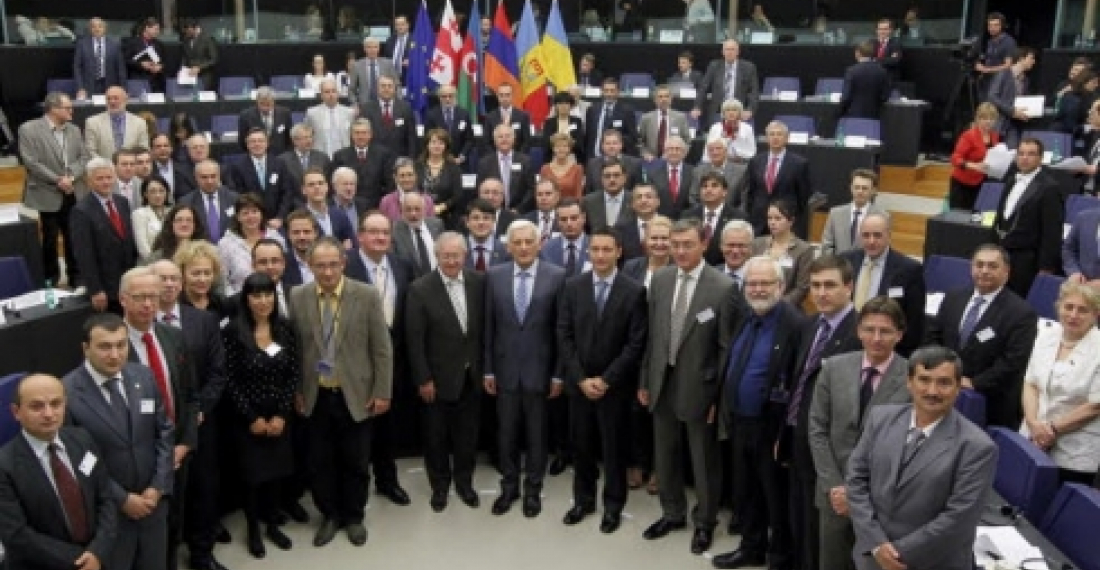
EURONEST 1st session held with "usual problems", but the process must go on.

The President of the European Parliament, Jerzy Buzek officially opened the 1st Session of the EURONEST Parliamentary Assembly in Strasbourg on Thursday. Delegations from Armenia, Azerbaijan, Georgia, Moldova and Ukraine joined colleagues from the European Parliament for the launch of this new Parliamentary framework that connects the European Parliament with the Parliaments of the Eastern Partnership countries.

In his opening address the President of the EP appealed for more co-operations between the five Eastern Partnership countries themselves "It is important that there is greater integration among yourselves - I strongly encourage that you move towards greater mobility of goods, services, capital and people among you".

Buzek added that "greater cooperation will allow us to meet local challenges better - such as regional conflicts where we can serve as objective facilitators and provide peer encouragement to find peaceful resolution. Issues that concern us all - energy security, social and economic problems, the environment, infrastructure - become more manageable when we work together and under common rules".

Despite this appeal observers noted that tensions in the Caucasus region, particularly between Armenia and Azerbaijan, continue to create "usual problems" in the organisation of the work of EURONEST.  The session spent a lot of time discussing the venue of the next meeting after Azerbaijan offered to host it. After "a long discussion" it was decided that the meeting will be held in Baku in May 2012. This decision upsets the Armenian delegation who in the Spring had tried unsuccessfully to host the 1st session in Yerevan coinciding with the 20th anniversary of Armenian independence.

Regardless of these difficulties EURONEST is an important process that is crucial for the future success of the Eastern Partnership and of the European Union's relations with its Eastern Neighbours, and all sides need to remain engaged with it in a positive manner. The process needs to move quickly from discussions on format and procedure to discussions on substance, where there are many things in common and where the Eastern Partner countries can focus on positive asspects that would actually bring benefits to their countries and their people.

source: This commentary was prepared by the commonspace.eu editorial team

photo: Delegations at the 1st Session of EURONEST pose for "family photo" (picture courtesy of the Press Service of the European Parliament).
Related articles

Editor's choice
News
Not quite there yet!

Not quite there yet!

The presidents of Ukraine and the United States were both upbeat after their talks on Sunday (28 December), but clearly there is yet no agreement on how to end the war in Ukraine. Donald Trump and Volodymyr Zelensky said progress had been made during Florida talks but the US president admitted the problem of territory remained "unresolved". While both the US and Ukrainian presidents described the talks as "great", Trump said "one or two very thorny issues" remained outstanding - most notably on the issue of land. Addressing reporters at Mar-a-Lago, Zelensky said they had come to an agreement on "90%" of the 20-point peace plan, while Trump said a security guarantee for Ukraine was "close to 95%" done. Zelensky later said US and Ukrainian teams would meet next week for further talks on issues aimed at ending Russia's nearly four-year war in Ukraine. "We had a substantive conversation on all issues and highly value the progress that the Ukrainian and American teams have made over the past weeks," Zelensky said in a statement on the Telegram messaging app. Russia launched a full-scale invasion of Ukraine in February 2022, and Moscow currently controls about 20% of Ukrainian territory. A proposal to turn the Donbas region in eastern Ukraine, which Russia largely controls, into a demilitarised zone remains "unresolved", Trump said. "Some of that land has been taken," he told reporters after the meeting. "Some of that land is maybe up for grabs, but it may be taken over the next period of a number of months." Moscow currently controls about 75% of the Donetsk region, and some 99% of the neighbouring Luhansk. The regions are collectively known as Donbas. Russia wants Ukraine to pull back from the small part of the territory it still controls in Donbas, while Kyiv has insisted the area could become a free economic zone policed by Ukrainian forces. The US president has repeatedly changed his own position on Ukraine's lost territories, and in September stunned observers by suggesting that Ukraine might be able to take it back. He later reversed course. "[That] is a very tough issue," he said. "One that will get resolved." Security guarantees for Ukraine are "95% done", Trump said, without formally committing to logistical support or troop deployment to help protect Ukraine from future attacks. Trump floated the possibility of trilateral talks between the US, Russia, and Ukraine, saying it could happen "at the right time". Immediately after their bilateral talks, Trump and Zelensky held a one hour meeting with European leaders. European Commission president, Ursula von der Leyen, wrote on X "We had a good hour-long conversation with President Trump and Zelensky. Several European leaders were present and discussed future peace talks. Good progress has been made. Europe stands ready to work with its partners to consolidate this."  

Popular

