|
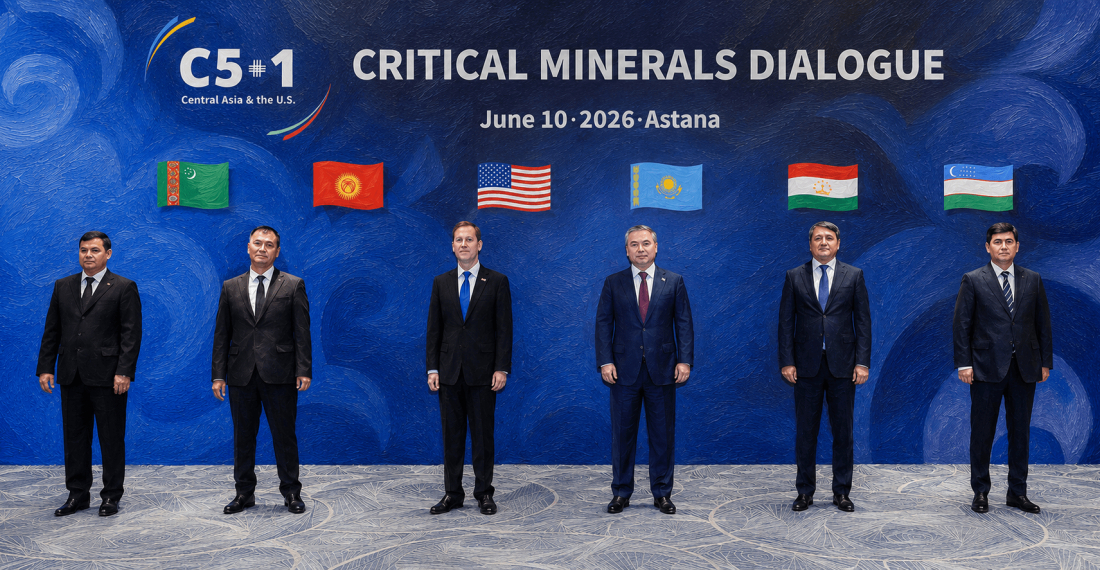
Critical mineral discussions in Astana Kazakhstan hosted a new round of high-level C5+1 critical mineral talks in Astana on Wednesday (10 June). As a reminder, the C5+1 format includes the 5 Central Asian nations, Kazakhstan, Uzbekistan, Tajikistan, Turkmenistan, and Kyrgyzstan, as well as the United States, which makes up the ‘+1’ element. The C5+1 format, along with the recent U.S. intensifying push for critical minerals in Central Asia has been covered extensively in previous newsletters. The talks brought together the U.S. Special Envoy for South and Central Asian Affairs Sergio Gor with several senior officials from the Central Asian nations. These talks did not happen in isolation, as the Astana Mining and Metallurgy Congress and Exhibition (AMM 2026) also took place from 10-11 June. Furthermore, the U.S. Special Envoy also likely attended several bilateral meetings with Central Asian ministers, having reportedly met Kazakh President Kassym-Jomart Tokayev beforehand, and also having discussed a wide range of topics with Kazakh Foreign Minister Yermek Kosherbayev covering foreign investment, innovation, education, artificial intelligence, critical minerals and the implementation of previous agreements reached between President Tokayev and U.S. President Donald Trump. Following the C5+1 critical mineral dialogue, The AMM 2026 took place, bringing together industry, investors, and government representatives. At the AMM 2026 David L. Fogel, Assistant Secretary of Commerce and Director General of the United States and Foreign Commercial Service, made it a point to frame the U.S. support and involvement in critical minerals in the region as part of a broader strategic push to strengthen supply chains in the current global climate of hostility and competition. He also did not shy away from highlighting critical minerals as a top U.S. priority, thereby also making U.S. involvement in Central Asia’s critical mineral production crucial to strengthening the U.S.’ industrial base, national and economic security. Preceding this week’s flurry around critical minerals the C5+1 forum also set its sight on the cultural dimension, as culture ministers from the C5 and the U.S. Under Secretary of State for Public Diplomacy and Public Affairs met in Tashkent. Culture was recently made a priority for cooperation at the C5+1 heads of state meeting in Washington in November 2025. The meeting addressed topics such as joint training for museum staff, film and music exchanges, and workshops for tourism and other cultural exchange opportunities. As was the case with the talks on critical minerals, this meeting took place in the context of a larger series of bilateral meetings as the Under Secretary toured the region. Russia’s recent engagement in Astana This sequence of American activity is contrasted by Russian President Vladimir Putin’s visit to Astana two weeks ago. The presidents of Russia and Kazakhstan discussed and signed an agreement to build a nuclear power plant in Kazakhstan. This power plant would supplement the existing research reactors and overall allow Kazakhstan to better leverage its considerable uranium reserves towards independent energy. Crucially, however, Putin did not arrive alone, staffing the delegation with a slew of high-level officials and technocrats, most notably Elvira Nabiullina, the Governor of the Central Bank of Russia. Nabiullina is known as one of the Kremlin’s most competent and independent officials, having played a large part in so far effectively navigating the Russian economy through the complications of the Ukraine-Russia war. A result of Putin’s visit, which is likely why Nabiullina was there, was an extensive Kazakh Tenge/ Russian Ruble currency swap, as well as a Memorandum of Understanding between the two nation’s central banks. Although underreported, these developments are significant, as they show Kazakhstan’s intention to continue pursuing integration with the neighboring Russian economy. Tokayev’s government while constantly courting the current Trump administration, clearly still prioritizes cooperation with its large and historically entwined neighbor in Russia. Russia for its part, of course also continues to remain engaged with the region, only recently having signed a defence deal with Taliban Afghanistan focusing on repairing existing Russian or older Soviet equipment already used in Afghanistan. The weapons will likely be shipped to Tatarstan in Russia to be repaired before returning back to Afghanistan. However, Zamir Kabulov, Russia’s Special Envoy for Afghanistan, already hinted that the deal may later expand to include future defence contracts. Russia’s rhetoric is centered around aiding Afghanistan against the Islamic State in Khorasan Province (ISKP), responsible for the deadly Crocus City Hall attack in Moscow. Nevertheless, defence agreements between Russia and Afghanistan, are likely to make Central Asian governments uneasy, especially Tajikistan, which has been repeatedly engaged in sporadic clashes along the Afghan border. Ultimately, although Central Asian countries, especially Kazakhstan, are currently able to pursue economic integration, foreign investment, and cultural ties with great powers like the U.S., Russia, and China, as this Russian-Afghan defence pact demonstrates, these powers may still take actions that run counterintuitive to Central Asia’s general stance towards regional issues such as engagement with Taliban Afghanistan. As Central Asia continues to strive towards boosting its economic development and global integration through securing contracts with powerful external forces, Kazakhstan currently emerging as a clear frontrunner, it will also be important for Central Asia to account for other near regional neighbors benefiting from similar arrangements, that may not always align with their own interests. Source: This Briefing was prepared by the editorial team of commonspace.eu for VOL. V ISSUE 9 of Central Asia Concise |
Commentary
Critical mineral discussions in Astana