


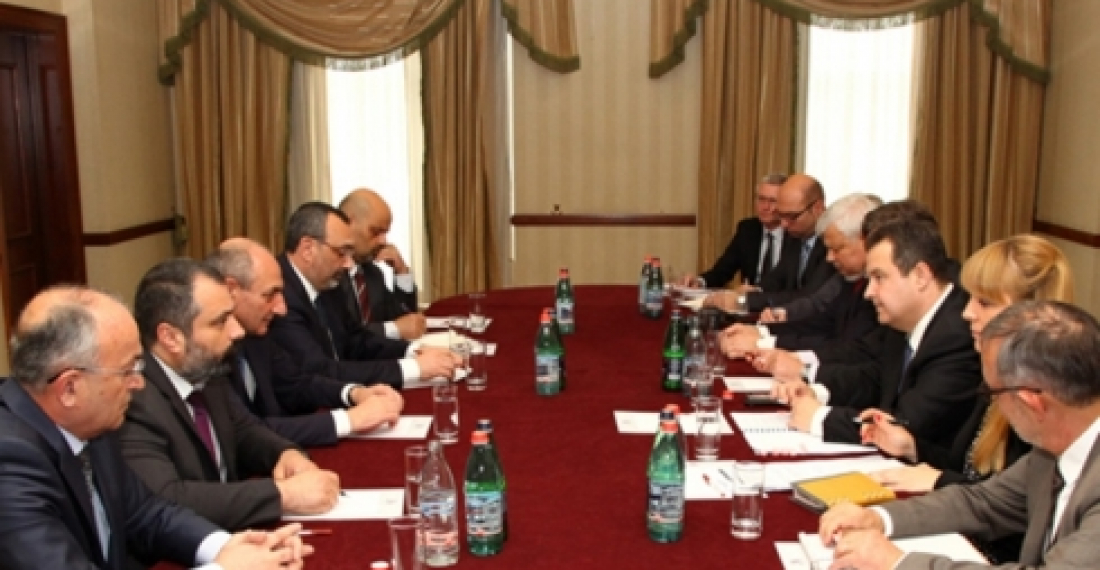
Commentary: Dacic's meeting with Karabakh separatists - an awkward moment.

Commentary by the political editor of commonspace.eu

The Chairman-in-Office of the OSCE, the Foreign Minister of Serbia, Ivica Dacic, has just concluded a three day visit to the South Caucasus. In Baku, Tbilisi and Yerevan the head of the OSCE met with the Presidents of Azerbaijan, Georgia and Armenia and other officials and held a range of other meetings.

An early summer visit by whoever is holding the annual chairmanship of the OSCE to the South Caucasus has now become a ritual. It is an opportunity for the Chairmanship to show its committment to the work of the OSCE in the region and push forward the OSCE agenda. If we are to believe the official statements and what was said in the press conferences during this visit most of the talk was about bilateral relations between Serbia and the three respective countries. This ofcourse would not have been the case in reality. There are many outstanding issues in the region with which the OSCE is engaged, and Dacic's visit helped to put some of them in context.

There was however one meeting during the visit  which must have been particularly awkward for the Serbian Minister. This was the meeting with the President of the self-declared Nagorno-Karabakh Republic, Bako Sahakyan. We can safely say that that meeting was most definetely not about bilateral relations. Serbia does not recognise separatists entitites. Its own experience of Kosovo remains a sore point, despite the fact that it has been putting a brave face on it in its efforts to move forward.

Very little has been said about the meeting between Dacic and the Karabakh separatists. According to the Foreign Minister of the self-declared Nagorno-Karabakh Republic, Karen Mirzoyan, the meeting "was held in a warm and constructive atmosphere".  Mirzoyan told reporters that views were exchanged on the Nagorno-Karabakh negotiations. The meeting agenda also included the situation at the Karabakh-Azerbaijan Line of Contact, and the avenues for reducing tension. Armenian media also quoted Mirzoyan as saying that "the Karabakh party underscored the OSCE activities, which are aimed at the creation of a necessary climate for a progress in the negotiations".

There was however no reference to the meeting with the Karabakh separatists on the website of the Serbian OSCE Chairmanship.

Serbian diplomacy has inherited the mantel of the diplomacy of the Former Yugoslavia, which was considered efficient, eclectic and extremely well networked. The new Serbia is smaller in size, and in many extents in its vision. It does not have grandiose world visions, as Yugoslavia had with the non-aligned movement. Yet it has an important role to play in the area of European security where it is emerging as a country that can communicate well across the many divides that have recently emerged on the continent. It seems that this was the spirit with which Daciic approached his visit to the South Caucasus, and his words were listened to with respect by his interlocateurs.

Serbia's engagement with the problems of the South Caucasus in the first five months of its chairmanship has been cautious - one can say even lethargic. One hopes that Dacic has now returned to Belgrade energised, and that Serbia will use the remaining months of its presidency to push through movement on issues such as the Karabakh conflict and the conflicts in Georgia. There are already increasing expectations of what can be achieved in the Belgrade meeting of OSCE Foreign Ministers next December. The OSCE's existential crisis is not yet over, and events on the ground in Ukraine may still determine the health of the institution in Vienna. But over the last days Dacic would have seen with his own eyes the complexity of the Caucasus region, and would have appreciated better the importance of engaging with this region more intensively in order to resolve some of the difficult challenges that it faces. Dacic, and Serbian diplomacy has seven months to do that. At the end of December, Germany takes over the Chairmanship of the OSCE. At that point we can expect something different in both style and substance, although quite what is as yet not clear.

source: This commentary was prepared by the political editor of commonspace.eu

photo: Serbian Foreign Minister Ivica Dacic, who is currently the Chairman in Office of the OSCE, met in Yerevan on Wednesday, 3 June 2015 with the President of the self-declared Nagorno-Karabakh Republic, Bakop Sahakyan. (picture courtesy of the press office of the NKR President)
 

Related articles

Editor's choice
News
Borrell tells the European Parliament that the situation in Afghanistan was critical, but the EU will remain engaged

Borrell tells the European Parliament that the situation in Afghanistan was critical, but the EU will remain engaged

Borrell underlined that the European Union will make every effort to support the peace process and to remain a committed partner to the Afghan people. "Of course, we will have to take into account the evolving situation, but disengagement is not an option.  We are clear on that: there is no alternative to a negotiated political settlement, through inclusive peace talks.
Editor's choice
News
Germany accuses Russia of cyberattacks and disinformation campaign

Germany accuses Russia of cyberattacks and disinformation campaign

The German government holds Russia responsible for a cyberattack on German air traffic control, and for targeted disinformation campaigns before the last federal election. According to the German Foreign Office in Berlin, the incidents could be clearly attributed to the Russian military intelligence service, the GRU. In response, the Russian ambassador to Berlin was summoned to the Foreign Ministry. "We have been observing a massive increase in threatening hybrid activities by Russia for some time now," a spokesperson for the Foreign Ministry stated. These range from disinformation campaigns and espionage to cyberattacks and sabotage attempts. The aim is to divide society, sow distrust, and undermine confidence in democratic institutions. The spokesperson added that with these actions, Russia is "very concretely threatening our security, not only through its war of aggression against Ukraine, but also here in Germany."  The Foreign Ministry spokesperson explained that the cyberattack on air traffic control in August 2024 was clearly attributed to the hacker collective "APT28," known as "Fancy Bear," and to the responsibility of the Russian military intelligence service, the GRU. Furthermore, it could now be "conclusively stated" that Russia had attempted "to influence and destabilize both the last Federal election and the ongoing internal affairs of the Federal Republic of Germany." There was "absolutely irrefutable evidence" for this". The so-called "Storm 1516" campaign, which has been running since 2024, is allegedly backed by "reliable information" that the Moscow-based think tank "Center for Geopolitical Expertise" is behind it. The Center is also said to be supported by Russian military intelligence. Its primary aim is to influence democratic elections in the West. (Click the image to read more).

Popular

Editor's choice
News
Germany accuses Russia of cyberattacks and disinformation campaign

Germany accuses Russia of cyberattacks and disinformation campaign

The German government holds Russia responsible for a cyberattack on German air traffic control, and for targeted disinformation campaigns before the last federal election. According to the German Foreign Office in Berlin, the incidents could be clearly attributed to the Russian military intelligence service, the GRU. In response, the Russian ambassador to Berlin was summoned to the Foreign Ministry. "We have been observing a massive increase in threatening hybrid activities by Russia for some time now," a spokesperson for the Foreign Ministry stated. These range from disinformation campaigns and espionage to cyberattacks and sabotage attempts. The aim is to divide society, sow distrust, and undermine confidence in democratic institutions. The spokesperson added that with these actions, Russia is "very concretely threatening our security, not only through its war of aggression against Ukraine, but also here in Germany."  The Foreign Ministry spokesperson explained that the cyberattack on air traffic control in August 2024 was clearly attributed to the hacker collective "APT28," known as "Fancy Bear," and to the responsibility of the Russian military intelligence service, the GRU. Furthermore, it could now be "conclusively stated" that Russia had attempted "to influence and destabilize both the last Federal election and the ongoing internal affairs of the Federal Republic of Germany." There was "absolutely irrefutable evidence" for this". The so-called "Storm 1516" campaign, which has been running since 2024, is allegedly backed by "reliable information" that the Moscow-based think tank "Center for Geopolitical Expertise" is behind it. The Center is also said to be supported by Russian military intelligence. Its primary aim is to influence democratic elections in the West. (Click the image to read more).

