Analysis: Special and Strategic Relations - (1) Armenia in the bosom of Mother Russia
Although President Serzh Sargsyan has been in Moscow many times, both since becoming President and before, this week he was there for his first state visit. The event was meant to symbolise the special character of the relationship between Armenia and Russia, a relationship that has been close for a long time, but that has become closer still under President Sargsyan's leadership.

The President told students at Moscow Sate University that the relations between the two countries go beyond that of good neighbours. The Russian President Dimitri Medvedev, also spoke of a "broad ranging alliance" between the two countries, and the visit offered an opportunity for the two sides to sign a number of agreements on a wide range of topics.

Consolidating and developing this relationship has been the cornerstone of President Sargyan's foreign policy, and that of his Foreign Minister, Edward Nalbandian, over the last three years. Whilst the initiative to open up relations with Turkey - an initiative that remains frozen largely not through the fault of Armenia - was also an important objective, this was never meant to be either a substitute to the special relationship with Russia, nor even a counterbalance to it. It was simply an expression of "real politik", which Russia itself supported.

At the heart of the special relationship between Armenia and Russia is Armenia's security. Whichever way you look at the relationship it always comes down to the question of Russia's underwriting of Armenian security. The continued presence of a large Russian base in Armenia, under an agreement which has recently been extended until the middle of this century is justified through this prism. The extent of these security guarantees is not absolutely clear, but all Armenians believe that they are there, and the Russians have never said anything to the contrary.

This makes the special relationship with Russia a popular policy in Armenia. All three Presidents since independence have worked hard to cultivate the relationship, although none more than Serzh Sargsyan.

In the last few years Russia has also become the ultimate guarantor of Armenian economic security, as the country struggled through the global economic downturn. Russia has provided considerable direct financial support, but perhaps more importantly continues to be the main source for investment in Armenia. It is also a safety net for Armenia's labour market, and remittances from permanent and seasonal workers in Russia are an important source of foreign currency earning for the Armenian economy.

This relationship is therefore special, but hardly equal. But then neither is the relationship between the United States and Israel.

There are two challenges to the Armenia-Russia special relationship. The first is that President Medvedev, presumably reflecting a wider state position, has since 2008 tried to change this relationship and turn it into a "threesome" - the third side being Azerbaijan. So far he has failed. If he succeeds it will be a great victory for Russian foreign policy, but the prospect worries some Armenians who fear being sold out. The many visits of the Armenian leadership to Moscow, including the pomp of the recent state visit are meant to reassure Yerevan.

The second challenge is Armenia's own desire to have good relations with other international partners, apart from Russia. Here Yerevan threads carefully. A case in point is the relationship with the European Union - a relationship that Armenia needs and from which it can benefit tangibly. At the technical level this relationship is developing positively. So far nobody has called this relationship either special or strategic, but the wide consensus in both Yerevan and Brussels is that it is useful. Russia itself has still to make up its mind whether to consider the European Union as a partner or a competitor. When it comes to the former Soviet space, through instinct rather than through logic, it regards the EU more as a competitor. The Armenian leadership is aware of this, so for the moment the "useful" relationship has to play second fiddle to the "special relationship".

source: This article is the first of a three part series on "special and strategic relations" in the South Caucasus and was prepared for commonspace.eu by the analytical team of LINKS. Opinion expressed does not necessarily reflect the editorial policy of the website. The second article entitled "Turkey and Azerbaijan: One nation, two states, seperate chequebooks" will be published on Friday 28 October.

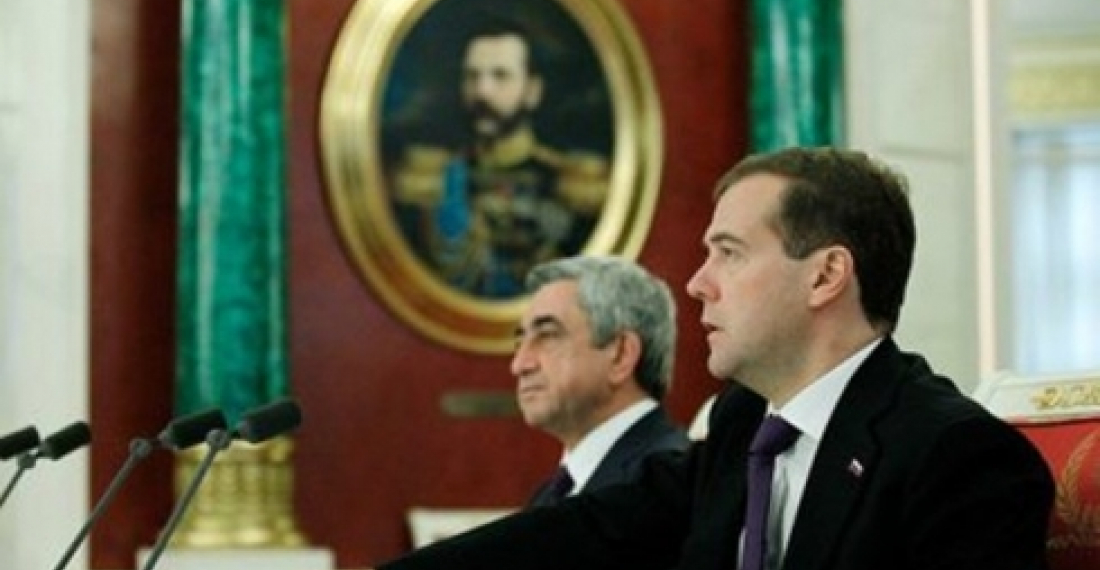
photo: President Sargsyan and President Medvedev in the Kremlin (picture courtesy of the Press Service of the President of Russia)

Related articles

Editor's choice
News
Borrell tells the European Parliament that the situation in Afghanistan was critical, but the EU will remain engaged

Borrell tells the European Parliament that the situation in Afghanistan was critical, but the EU will remain engaged

Borrell underlined that the European Union will make every effort to support the peace process and to remain a committed partner to the Afghan people. "Of course, we will have to take into account the evolving situation, but disengagement is not an option.  We are clear on that: there is no alternative to a negotiated political settlement, through inclusive peace talks.
Editor's choice
News
Mystery surrounds the crash of a Turkish airline in Georgia which resulted in the death of 20 Turkish Airforce personnel

Mystery surrounds the crash of a Turkish airline in Georgia which resulted in the death of 20 Turkish Airforce personnel

​ Twenty Turkish Airforce personnel died when a military plane crushed on the Georgian side of the Azerbaijan - Georgia border on Tuesday (11 November). The C130 took off from Ganja and was heading to Merzifon, transporting service members that had participated in Azerbaijan's Victory Day celebrations. Half an hour after takeoff, the aircraft lost altitude and broke apart in mid-air over a mountainous area on the Georgian border. Lockheed C130 Hercules have been in service with Turkey since the 1960s and are considered among the most reliable in their class. However, some of these aircraft are 50–60 years old. In October, the Turkish Ministry of Defense announced plans to replace them with new C130J Super Hercules models, with deliveries expected to begin in the coming years. All aircraft fragments have already been collected for technical examination. The cause of the crash has not yet been officially determined. A Turkish expert and retired military officer Coşkun Başbuğ noted on CNN Türk, a technical malfunction "should be ruled out" as the cause of the crash. "Various possibilities should be considered, but the first thing to consider is that the C-130 is a time-tested military transport aircraft, the last known incident involving which occurred in 1982." "A technical malfunction should be ruled out as the cause of the crash. The same applies to weather conditions, as the relevant authorities would have reported bad weather. The remaining theories include a mid-air collision, sabotage, or an attack," he emphasized. Former Turkish Armed Forces Logistics Commander and retired Army General Erdoğan Karakuş stated in an interview with Turkish television that although the C-130 aircraft are old, they have undergone a complete modernization in Turkey, and their technical condition is thoroughly inspected before each flight. The Turkish Air Force is expected to operate the C-130 aircraft until 2040. ​

Popular

Editor's choice
News
Mystery surrounds the crash of a Turkish airline in Georgia which resulted in the death of 20 Turkish Airforce personnel

Mystery surrounds the crash of a Turkish airline in Georgia which resulted in the death of 20 Turkish Airforce personnel

​ Twenty Turkish Airforce personnel died when a military plane crushed on the Georgian side of the Azerbaijan - Georgia border on Tuesday (11 November). The C130 took off from Ganja and was heading to Merzifon, transporting service members that had participated in Azerbaijan's Victory Day celebrations. Half an hour after takeoff, the aircraft lost altitude and broke apart in mid-air over a mountainous area on the Georgian border. Lockheed C130 Hercules have been in service with Turkey since the 1960s and are considered among the most reliable in their class. However, some of these aircraft are 50–60 years old. In October, the Turkish Ministry of Defense announced plans to replace them with new C130J Super Hercules models, with deliveries expected to begin in the coming years. All aircraft fragments have already been collected for technical examination. The cause of the crash has not yet been officially determined. A Turkish expert and retired military officer Coşkun Başbuğ noted on CNN Türk, a technical malfunction "should be ruled out" as the cause of the crash. "Various possibilities should be considered, but the first thing to consider is that the C-130 is a time-tested military transport aircraft, the last known incident involving which occurred in 1982." "A technical malfunction should be ruled out as the cause of the crash. The same applies to weather conditions, as the relevant authorities would have reported bad weather. The remaining theories include a mid-air collision, sabotage, or an attack," he emphasized. Former Turkish Armed Forces Logistics Commander and retired Army General Erdoğan Karakuş stated in an interview with Turkish television that although the C-130 aircraft are old, they have undergone a complete modernization in Turkey, and their technical condition is thoroughly inspected before each flight. The Turkish Air Force is expected to operate the C-130 aircraft until 2040. ​