


Can Georgia provide the region with the economic stimulus it desperately requires?

Georgia's Prime Minister, Giorgi Kvirikashvili is a man with a plan. Kvirikashvili has emerged from the recent parliamentary elections, held on 8 October, energised and empowered, as he pushes forward an ambitious development agenda for Georgia which boldly claims will turn it into a prosperous and successful country.

Once the last part of the election process is out of the way on Sunday (30th October), Kvirikashvili will put together his new government. Kvirikashvili's Georgian Dream party is expected to have a comfortable majority in the new parliament, enabling the prime minister to push ahead with his plans without delay.

Throughout the campaign, whilst others squabbled on issues of dubious importance and relevance to the current Georgian reality, Kvirikashvili kept the focus on the economy, and the plan to give Georgia the necessary breakthrough needed to ensure its future prosperity.

Kvirikashvili's plan, which he speaks about often, entails four elements which includes new tax incentives and reforms, infrastructure plans, governance reforms and an overhaul of the education system.

The plan is hugely ambitious. On infrastructure for example it envisages that the Government will spend $3.5 billion to build and reconstruct roads and highways. What the Georgian government is calling the Spatial Arrangement Plan also includes rehabilitating railway stations, ports and tourist infrastructure. It also envisions new airports - all part of a strategy to turn Georgia into an international transit and business hub.

One of the most ambitious projects within the Spatial Arrangement Plan is the Anaklia Deep Sea Port project, which will create a new, faster maritime corridor between China and Europe, and help restore the historic Silk Road. The Anaklia Development Consortium, which has been entrusted with the project, will invest $2.5 billion USD and develop the Port on a build, operate and transfer basis, allowing larger ships to enter Georgian waters for the first time, thus expanding the country's export potential and ability to act as a trade corridor.

Observers of the Georgian political scene say that this is the first time in modern Georgian history that a government is making the economy the most important aspect of its policy, approaching it with a holistic plan. Georgia needs this. In many respects the Georgian economy has been underperforming - lacking investment and good management, as well as the sound legal framework necessary for both. All this is now being redressed. The extensive and speedy reforms that Georgia has been implementing as part of the process of becoming an EU Associate state provide a very good basis on which the new economic plans can be founded. Results may not be immediate, but already positive signs can be seen. Georgia's economic growth is estimated by the IMF to reach 3.4 percent in 2016, and 5.2 percent in 2017.

Trade between Georgia and EU countries between January and September 2016 reached $2.5 billion. The latest figures from the National Statistics Office of Georgia (Geostat) showed external trade turnover between Georgia and EU countries grew 10 percent year-on-year. Increasing exports, especially in areas such as agriculture, is going to be crucial if Georgia's ambitions plans are to succeed.

All this is not only good news for Georgia, but also for the whole region. Both Armenia and Azerbaijan are facing tough decisions as they deal with economic challenges. In Azerbaijan the sudden and sharp fall in the price of oil has forced the government to do some hard thinking on the country's future economic model. The cushion that the oil revenues had provided over the last decade is no longer there. The Azerbaijani economy needs to grow fast if a slump is to be avoided. At the moment it is shrinking due to a sharp decline in the construction industry

In Armenia the economy faces serious structural problems, and the new prime minister has a big task in front of him as he tries to implement reforms which will require destroying the monopoly on sectors of the economy enjoyed by people close to the government.

Georgia in many ways offers a vision for the two countries - one that cannot be copied into the completely different governance and economic models that exist in Armenia and Azerbaijan, but one which still can inspire.

But Georgia may also, in the foreseeable future, be able to provide the region with the economic stimulus that it desperately requires. Investors like project clusters, and those investing in Georgia are likely to look at options in neighbouring countries too. An improved infrastructural framework in Georgia will also greatly help both Armenia and Azerbaijan to send their exports to international markets. The current regional situation, resulting from the ongoing conflict between Armenia and Azerbaijan on Nagorno-Karabakh, does not allow a normal regional co-operation arrangement, which the South Caucasus needs and deserves, to emerge yet. Georgia however should set its sights on ambitious bilateral economic co-operation agreements with the two countries, introducing as much as possible common elements in both agreements that in due course can form the basis on which a regional framework can be based. This will require, time , patience and some resources, but the Georgian government may find that this is one investment that it cannot do without.


source: Caucasus Concise Analytical Team

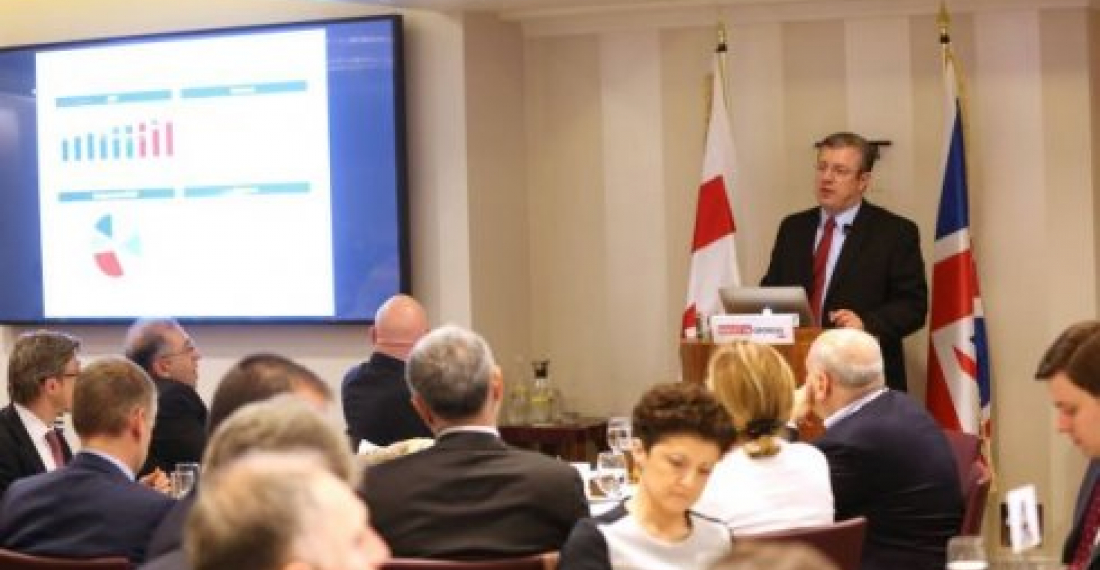
photo: Georgian Prime Minister Giorgi Kvirikashvili, addressing an investment forum in London in May 2016 (picture courtesy of the press service of the Prime Minister of Georgia).




Related articles

Editor's choice
News
Russia adds pressure on Armenia ahead of key elections; recalls Ambassador in Yerevan for consultations

Russia adds pressure on Armenia ahead of key elections; recalls Ambassador in Yerevan for consultations

Ahead of key parliamentary elections,scheduled to be held in Armenia on Sunday, 7 June, Russia continues to attempt to put pressure on the Armenian Government led by prime minister Nikol Pashinyan. On 30 May, Russia recalled its Ambassador to Yerevan for consultations. A terse statement, published on the website of the Russian Foreign Ministry, said, "The Ambassador of the Russian Federation to the Republic of Armenia , S.P. Kopyrkin, has been summoned to Moscow for consultations in connection with the steps taken by the Armenian leadership to move closer to the European Union, which are detrimental to cooperation within the EAEU." This followed a statement issued the day before, by the leaders of the Eurasian Economic Union (EAEU) that challenges the Armenian trajectory towards approximating to the European Union. Vladimir Putin is undertood to have personally pushed the other four EAEU leaders to issue the statement, which said: "Taking into account the significant risks to the economic security of the member states of the Eurasian Economic Union (hereinafter referred to as the Union) arising in connection with the preparation of the Republic of Armenia for accession to the European Union, as well as the need to prevent the associated damage to the member states of the Union: decided that the members of the Eurasian Intergovernmental Council from the Republic of Belarus, the Republic of Kazakhstan, the Kyrgyz Republic and the Russian Federation will report at the next meeting of the Supreme Eurasian Economic Council in December 2026 on the possible consequences of the suspension of the Treaty on the Eurasian Economic Union with respect to the Republic of Armenia. We share the position on the need to hold a national referendum in the Republic of Armenia as soon as possible on joining the European Union or continuing to be part of the Eurasian Economic Union."
Editor's choice
News
The leaders of the states of the Eurasian Economic Union issued a tough statement warning fellow-member state Armenia of the consequences of its desire to join the European Union.

The leaders of the states of the Eurasian Economic Union issued a tough statement warning fellow-member state Armenia of the consequences of its desire to join the European Union.

The leaders of the states of the Eurasian Economic Union (EEAS) issued a tough statement warning fellow-member state Armenia of the consequences of its desire to join the European Union. The stark, sharply worded,  warning, comes days before crucial parliamentary elections in Armenia, scheduled for 7 June. The full statement said, “We, the Presidents of the Republic of Belarus, the Republic of Kazakhstan, the Kyrgyz Republic and the Russian Federation, Taking into account the actions of the Republic of Armenia aimed at joining the European Union, including the approval in 2025 by the National Assembly of the Republic of Armenia and the signing by the President of the Republic of Armenia of the Law of the Republic of Armenia "On the Start of the Process of Accession of the Republic of Armenia to the European Union", as well as the confirmation by the European Union of the European aspirations of the Government of the Republic of Armenia, expressed in the joint declaration following the first Armenia-European Union summit, adopted on 5 May 2026, Taking into account the significant risks to the economic security of the member states of the Eurasian Economic Union (hereinafter referred to as the Union) arising in connection with the preparation of the Republic of Armenia for accession to the European Union, as well as the need to prevent the associated damage to the member states of the Union: decided that the members of the Eurasian Intergovernmental Council from the Republic of Belarus, the Republic of Kazakhstan, the Kyrgyz Republic and the Russian Federation will report at the next meeting of the Supreme Eurasian Economic Council in December 2026 on the possible consequences of the suspension of the Treaty on the Eurasian Economic Union with respect to the Republic of Armenia. We share the position on the need to hold a national referendum in the Republic of Armenia as soon as possible on joining the European Union or continuing to be part of the Eurasian Economic Union. Astana, May 29, 2026” A meeting of the Supreme Eurasian Economic Council was held in Astana, Kazakhstan, on May 29, 2026. The meeting of the Supreme Eurasian Economic Council in a restricted format was attended by Russian President Vladimir Putin, Belarusian President Alexander Lukashenko , Kazakh President Kassym-Jomart Tokayev , Kyrgyz President Sadyr Japarov , Armenian Deputy Prime Minister Mher Grigoryan, and Chairman of the Board of the Eurasian Economic Commission Bakytzhan Sagintayev. From the Russian side, the meeting was also attended by Deputy Prime Minister and member of the Council of the Eurasian Economic Commission Alexey Overchuk and Presidential Aide Yury Ushakov . The heads of delegations from EAEU observer states, including President of Uzbekistan Shavkat Mirziyoyev , Vice President of Cuba Salvador Valdés Mesa, Minister of Industry, Mines, and Trade of Iran Mohammad Atabak, and CIS Secretary General Sergei Lebedev, joined the expanded meeting . Following the meeting of the Supreme Eurasian Economic Council, a number of documents were signed .

Popular

Editor's choice
Interview
Thursday Interview: Murad Muradov

Thursday Interview: Murad Muradov

Today, commonspace.eu starts a new regular weekly series. THURSDAY INTERVIEW, conducted by Lauri Nikulainen, will host  persons who are thinkers, opinion shapers, and implementors in their countries and spheres. We start the series with an interview with Murad Muradov, a leading person in Azerbaijan's think tank community. He is also the first co-chair of the Action Committee for a new Armenian-Azerbaijani Dialogue. Last September he made history by being the first Azerbaijani civil society activist to visit Armenia after the 44 day war, and the start of the peace process. Speaking about this visit Murad Muradov said: "My experience was largely positive. My negative expectations luckily didn’t play out. The discussions were respectful, the panel format bringing together experts from Armenia, Azerbaijan, and Turkey was particularly valuable during the NATO Rose-Roth Seminar in Yerevan, and media coverage, while varied in tone, remained largely constructive. Some media outlets though attempted to represent me as more of a government mouthpiece than an independent expert, which was totally misleading.  Overall, I see these initiatives as important steps in rebuilding trust and normalising professional engagement. The fact that soon a larger Azerbaijani civil society visits to Armenia followed, reinforces the sense that this process is moving in the right direction." (click the image to read the interview in full)

