Commentary prepared by the editorial team of Commonspace.eu
The meeting of the OSCE Parliamentary Assembly in Baku highlights Azerbaijan's readiness to manoevre around complicated foreign and domestic political agendas in front of a home audience.
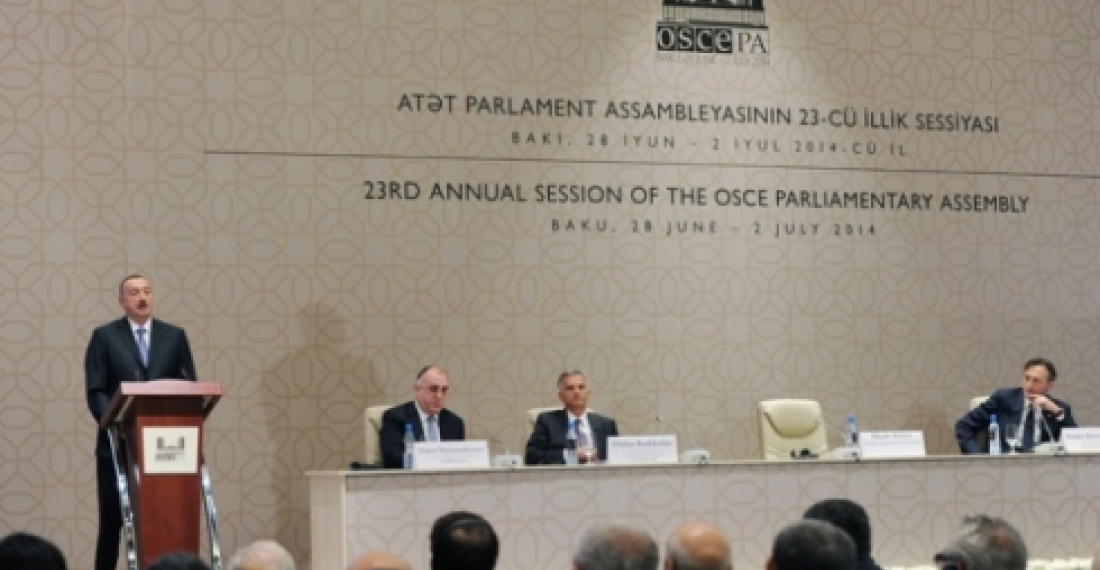
The 23rd Annual Session of the Parliamentary Assembly of the Organisation for Security and Co-operation in Europe (OSCE PA) is currently taking place in the Azerbaijani capital, Baku. Parliamentary delegations from the 57 member states of the OSCE, including Armenia, are participating in the event which opened on Saturday with keynote speeches by the current Chairman-in-Office of the OSCE, Didier Burkhalter, who is also the President of Switzerland, and by the President of Azerbaijan Ilham Aliev. This annual meeting has an ambitious agenda focusing on the challenges in the OSCE area. As expected Ukraine is one of the main topics under discussion. High level parliamentary delegations from both Russia and Ukraine are present in Baku and the issues connected with the Ukraine crisis are on the mind of many of the participants and a full debate on Ukraine will take place on the last day (Tuesday).
For the host country, Azerbaijan, the meeting is of the utmost significance. This is not only one of the largest and most prestigious meetings ever held in the Azerbaijani capital. It also has direct significance for the country's foreign and domestic policy.
First, there is the presence in the meeting of an Armenian parliamentary delegation. This is not the first time that a parliamentary delegation from Armenia is attending such an event in Baku. Indeed only three weeks ago a similar delegation attended an event of the NATO Parliamentary Assembly. That event was overshadowed by sharp exchanges between the Armenian visitors and their Azerbaijani hosts. But as commonspace.eu reported on that occasion, a precedent had been set. The OSCE event has also seen some sharp exchanges between the two, but at least until now, the atmosphere is calmer. The novelty is wearing off, and the media can focus on other things. Small demonstrations took place against the Armenian presence, but there was no huge public outcry against the Armenian presence. This will hopefully create conditions for more such visits in the future
The OSCE is also the framework for the Minsk Process that is seeking to resolve the Nagorno-Karabakh conflict. This process is stalled. The current Swiss Chairmanship has been trying to restart it, calling for another meeting between the Presidents of Armenia and Azerbaijan, with a structured agenda. President Burkhalter took the opportunity to repeat this at his opening address on Saturday. The meeting also enabled French MPs to criticise Azerbaijan for putting one of their colleagues on a blacklist for having visited Nagorno-Karabakh. Azerbaijan says that visitors to its occupied territories without co-ordinating with its embassies infringe Azerbaijani law. Overall, an open and honest discussion on the conflict in both Armenia and Azerbaijan is necessary if the conflict is to be resolved. The maximalist positions need to be challenged. We are not there yet, but the recent international meetings in Baku have started carving out some space for discussion and as such are an important contribution to the process.
That brings us to the second important significance of the meeting. Azerbaijan has been under a lot of criticism recently for its record on democratic governance. The OSCE's own Office for Democratic Institutions and Human Rights was highly critical of the Presidential elections held last year; there have also been tough statements in the past from the OSCE Commissioner on Media Freedom regarding the treatment of journalists. Azerbaijan has used heavy handed tactics in the OSCE Permanent Council in Vienna and forced the downgrade of the OSCE Office in Baku to that of a project office, threatening to veto the whole OSCE budget if it does not get its way. So holding the OSCE PA annual meeting in Baku has risks for both sides. President Aliev in his opening speech on Saturday sought to nip the problem in the bud by addressing issues of democratic governance and highlighting the importance for political reforms which he said need to move hand in hand with economic reforms. Aliev repeated the theme that he set when a few days before he addressed the Parliamentary Assembly of the Council of Europe in Strasbourg, stressing that Azerbaijan has no political prisoners. Of course nobody can deny that there are dozens of political activists, including some still in their teens, who are rotting in Baku's jails accused or convicted of a variety of crimes. Amnesty International calls them political prisoners. The government of Azerbaijan says they are simply criminals. Holding the OSCE PA annual assembly in Baku is on the one hand a prestige for the Azerbaijan government and adds to its legitimacy. However the focus on human rights and other shortcomings, in as much as it has taken place, puts the Azerbaijani government on the spot. There has been criticism that the Azerbaijani NGOs that were invited to attend as guests in the meeting were mainly the ones friendly to the government. If that is the case than this was a shortcoming of the leadership of the OSCE PA which needs to be addressed in the wider European context. In the end however this is a meeting of parliamentarians, and the onus is on the parliamentarians present to raise issues of human rights and democratic defecit as appropriate.
The meeting is also important because it tests Azerbaijan's carefully calculated balancing acts in foreign policy. Discussions on the crisis in Ukraine puts Azerbaijan in a difficult position. On the one hand it is committed in supporting Ukraine's territorial integrity, and has joined the other ninety-nine countries which a few weeks ago condemned Russia's annexation of Crimea at the UN General Assembly. On the other hand Azerbaijan's does not want to be seen as a part of an anti-Russia front. On Saturday, the Azerbaijani parliamentary delegation tried to fudge the issue when confronted with the opening shots of an anti-Russia move during the OSCE Parliamentary Assembly's meeting. It is difficult to see how they will be able to continue doing so by the time the meeting ends tomorrow.
These are difficult issues for Azerbaijan, but the fact that they are being discussed in the presence of the media, and mostly televised live at least on the internet may help create more space for these debates to take place in the wider Azerbaijani society once the foreign guests have gone home. Discussions such as the one that are taking place these days in the framework of the OSCE PA, and the ones held in the framework of the NATO PA earlier this month, open up the space for debate within Azerbaijan. It shows that the leadership of Azerbaijan is not averse to this, at least occasionally and in the controlled environments of international meetings. These meetings are creating a twilight zone in Baku. Time will tell whether this twilight is heralding sunrise, or whether it is the sign of sunset.
This commentary is prepared by the editorial team of commonspace.eu
photo: President Ilham Aliev of Azerbaijan addressing the OSCE Parliamentary Assembly Annual Session in Baku on 28 June 2014. (picture courtesy of the press service of the President of Azerbaijan.)