


Azerbaijan and EU find common ground.

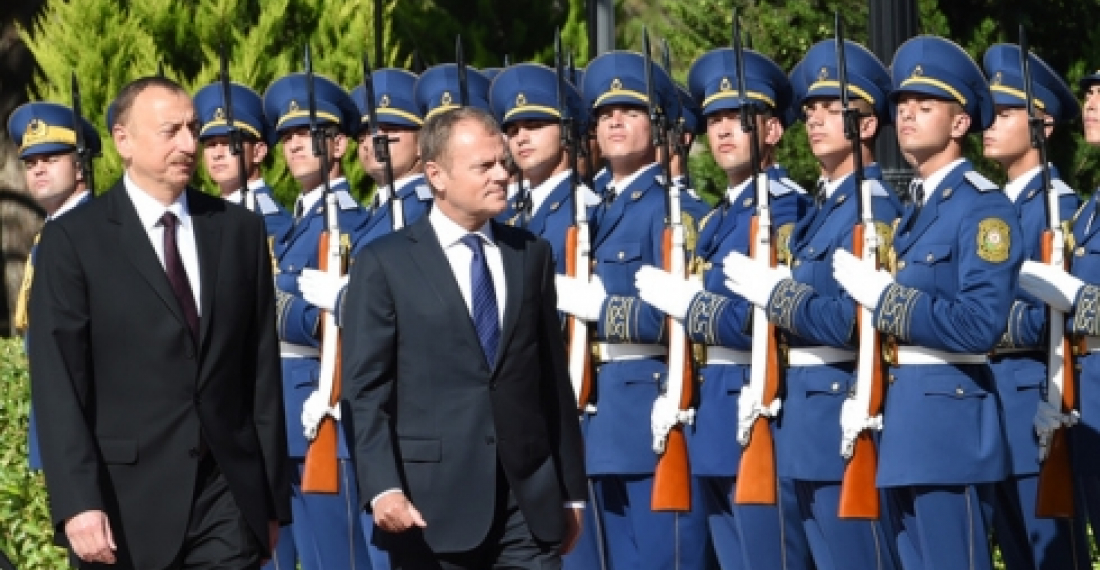
After a difficult period in relations between Azerbaijan and the European Union the two sides seem to have identified common ground during a crucial visit of EU Council President Donald Tusk to Baku on Wednesday.

After visiting Armenia on Monday, and Georgia on Tuesday, Tusk's last lap of his visit to the South Caucasus was clearly going to be the most difficult one. Relations between Azerbaijan and the European Union often appeared strained over the last months as Baku reacted sharply to criticism of its human rights record by European civil society groups and some of the member states. The Azerbaijan President snubed the last summit of the Eastern Partnership in Riga in May, and at one point even threatened to veto the final communique.

Tusk's visit seems however to have offered the two sides an opportunity to turn the page. Speaking after his meeting with President Ilham Aliev the president of the Council of the European Union stated that the two sides had "agreed to set a brisk pace for our talks toward an Agreement on Strategic Partnership". Azerbaijan has been seeking this format of relationship since it made it clear that it had no interest in signing an Association Agreement with the EU.

Donald Tusk also expressed the views of the European Union on the Nagorno-Karabakh conflict in clear and unambiguous terms, which would have pleased his Azerbaijani hosts:

"Let me also reiterate that the EU supports the territorial integrity, independence and sovereignty of Azerbaijan. The EU and its Member States have not recognised Nagorno-Karabach. 

The status quo is unsustainable and the peaceful resolution of the Nagorno-Karabakh conflict remains a priority for the EU. We continue to support the mediation efforts of the OSCE Minsk Group Co-Chairs."

However Tusk also made it clear that human rights issues remain an important factor in the relationship, once more speaking in clear and unambiguous language:

"I stressed the high importance we attach to human rights and fundamental freedoms. The EU believes that an open society is the best guarantee of long term stability and prosperity. I have discussed with the President our concerns with the detention of human rights defenders here and our hope that prompt action will be taken on the individual cases. We will continue to discuss these issues and to explore ways for good and mutually beneficial cooperation on human rights, also in the context of the future of our contractual relations. After this meeting, I will meet with representatives of the civil society."

On his part Azerbaijani president Ilham Aliev said that Tusk's visit was very important for the EU - Azerbaijan relations. Aliev remarked that these relations were very important for Azerbaijan. "We see good, positive development in the EU-Azerbaijan partnership," Ilham Aliyev said, also remarking that the EU accounted for half of the total trade of Azerbaijan. as well as foreign investment. "We have close political ties and we will develop them in the future," the president said.

Commonspace.eu political editor said in a comment that the visit seems to have helped the two sides turn the page in their relationship. Both sides understand that this relationship is not an artifical one, but is based on common interests. Azerbaijan would have been reassured by the comments of president Donald Tusk on the Karabakh conflict, even if it would like to see the EU exercising more pressure on Armenia in this regard. The issue of human rights remains however a real and unresolved one. Here the onus is on the Government of Azerbaijan to move swiftly with the release of civil society activists currently imprisoned and to create a better climate for civil society activity in the country."

source: commonspace.eu

photo: President Aliev of Azerbaijan and EU Council President Donald Tusk inspecting a guard of honour ahead of their talks in Baku on Wednesday 22 July 2015 (picture courtesy of the press Service of the president of Azerbaijan).


Related articles

Editor's choice
News
Council of Europe launches new International Claims Commission for Ukraine

Council of Europe launches new International Claims Commission for Ukraine

Thirty-four countries and the European Union have signed a new convention establishing an International Claims Commission for Ukraine at a diplomatic conference co-hosted by the 46-nation Council of Europe and the Netherlands in the Hague. The diplomatic conference was attended by leaders and high-level representatives from over 50 states, including the President of Ukraine, Volodymyr Zelenskyy, the President of the Republic of Moldova, Maia Sandu, and the Prime Minister of the Netherlands, Dick Schoof.  “Today marks a major step forward in ensuring accountability for Ukraine. The International Claims Commission represents justice and hope for tens of thousands of victims—our determination that those who have suffered will not be forgotten. I call for quick ratifications so we can get the commission rapidly up and running for the people of Ukraine,” said Council of Europe Secretary General Alain Berset. Ukrainian President Volodymyr Zelenskyy said: “We expect that every mechanism for compensation from the Register of Damage and Claims Commission to the actual payments – will start working and receive strong and sufficient international support, so that people can truly feel that any kind of damage caused by the war can be compensated. This war, and Russia’s responsibility for it, MUST become a clear example – so that others learn not to choose aggression.” “Accountability is about creating the conditions for peace that endures. And therefore, accountability is a condition of security – today and for the future. But accountability is not only about Ukraine. And it is not only about one aggressor and one victim. Accountability is about Europe. About every country in Europe. It is about whether Europe, as a whole, is willing to defend its peace,” said Maia Sandu, President of the Republic of Moldova, which currently holds the Presidency of the Council of Europe’s Committee of Ministers. The Prime Minister of the Netherlands, Dick Schoof, said: “Every day Russia is deliberately bombarding homes, destroying businesses and damaging infrastructure in Ukraine. Russia must compensate Ukraine for the damage caused. That is why we have launched the International Claims Commission for Ukraine and we are honoured to host it.” The International Claims Commission will be the second part of a comprehensive compensation mechanism related to Russia’s war of aggression, building on the existing Register of Damage for Ukraine. The claims commission will be established within the framework of the Council of Europe and will also be open to other countries. The Register of Damage for Ukraine, created in 2023, collects and records compensation claims submitted by individuals, organisations and public bodies in Ukraine. Forty-four states and the European Union have so far joined the Register, which has already received 86,000 claims. The International Claims Commission will review, assess and decide upon claims submitted to the Register of Damage for Ukraine and determine the amount of compensation, if any, which is due in each case. The convention establishing the commission will enter into force once it has been ratified by 25 signatories, as long as sufficient funds have been secured to support its initial work.

Popular

Editor's choice
News
Council of Europe launches new International Claims Commission for Ukraine

Council of Europe launches new International Claims Commission for Ukraine

Thirty-four countries and the European Union have signed a new convention establishing an International Claims Commission for Ukraine at a diplomatic conference co-hosted by the 46-nation Council of Europe and the Netherlands in the Hague. The diplomatic conference was attended by leaders and high-level representatives from over 50 states, including the President of Ukraine, Volodymyr Zelenskyy, the President of the Republic of Moldova, Maia Sandu, and the Prime Minister of the Netherlands, Dick Schoof.  “Today marks a major step forward in ensuring accountability for Ukraine. The International Claims Commission represents justice and hope for tens of thousands of victims—our determination that those who have suffered will not be forgotten. I call for quick ratifications so we can get the commission rapidly up and running for the people of Ukraine,” said Council of Europe Secretary General Alain Berset. Ukrainian President Volodymyr Zelenskyy said: “We expect that every mechanism for compensation from the Register of Damage and Claims Commission to the actual payments – will start working and receive strong and sufficient international support, so that people can truly feel that any kind of damage caused by the war can be compensated. This war, and Russia’s responsibility for it, MUST become a clear example – so that others learn not to choose aggression.” “Accountability is about creating the conditions for peace that endures. And therefore, accountability is a condition of security – today and for the future. But accountability is not only about Ukraine. And it is not only about one aggressor and one victim. Accountability is about Europe. About every country in Europe. It is about whether Europe, as a whole, is willing to defend its peace,” said Maia Sandu, President of the Republic of Moldova, which currently holds the Presidency of the Council of Europe’s Committee of Ministers. The Prime Minister of the Netherlands, Dick Schoof, said: “Every day Russia is deliberately bombarding homes, destroying businesses and damaging infrastructure in Ukraine. Russia must compensate Ukraine for the damage caused. That is why we have launched the International Claims Commission for Ukraine and we are honoured to host it.” The International Claims Commission will be the second part of a comprehensive compensation mechanism related to Russia’s war of aggression, building on the existing Register of Damage for Ukraine. The claims commission will be established within the framework of the Council of Europe and will also be open to other countries. The Register of Damage for Ukraine, created in 2023, collects and records compensation claims submitted by individuals, organisations and public bodies in Ukraine. Forty-four states and the European Union have so far joined the Register, which has already received 86,000 claims. The International Claims Commission will review, assess and decide upon claims submitted to the Register of Damage for Ukraine and determine the amount of compensation, if any, which is due in each case. The convention establishing the commission will enter into force once it has been ratified by 25 signatories, as long as sufficient funds have been secured to support its initial work.

