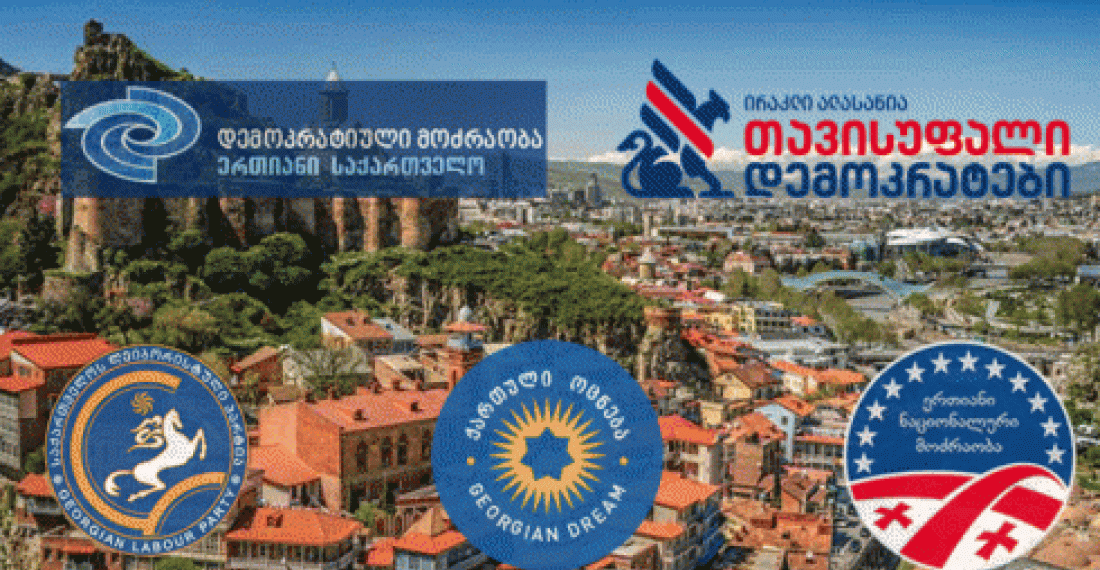
In this report from Tbilisi for commonspace.eu, Dr Carles Jovaní looks at the choices available to the Georgian people as they head to the polls on Saturday, unpacking the policies of the eight main contenders for seats in the 150-member parliament.
On Saturday 8 October, Georgians will head to the polls in the Caucasian republic's eighth parliamentary election since independence in 1991. The ballot will be also the first one to be held under the semi-presidential system introduced in the parliamentary elections of 2012, Georgia's first peaceful transfer of power since the collapse of the Soviet Union. Voters will elect 150 members of parliament -77 under a closed party list proportional system and 73 by a majoritarian vote in single-mandate constituencies-from among 25 election subjects -9 parties running separately, and 17 parties running in 6 blocs-and 763 majoritarian candidates nominated by political parties. It is also worth noting that the elections of the local legislative body in the Autonomous Republic of Adjara and by-elections in some local councils nationwide will be held on the same day.
The voting will take place in a domestic context defined by an economic performance with its lights and shadows, disenchantment of an important segment of the population with the mainstream political parties, and a largely peaceful but highly competitive campaign marked by a confrontational tone and with occasional incidents. Described as critical for the "routinisation" of democratic practices in the country by the OSCE, Georgians will have to choose from among a host of political parties, most afflicted by cults of political personality and ideological ambiguity, yet still offering plenty of choices on both domestic and foreign policy. The following is an analysis of the eight political forces with the greatest possibilities to enter parliament according to seasoned observers.
 Georgian Dream-Democratic Georgia (GDDG), the main force in the former coalition embracing six parties which won the elections of 2012, is widely considered the favourite to win the upcoming vote. Its leading candidate, the present prime minister Giorgi Kvirikashvili, hopes to retain the large majority his predecessors obtained four years ago, when the coalition had 85 MPs elected. Founded by the billionaire Bidzina Ivanishvili, GDDG covers a broad spectrum roughly in the centre-left of the political axis, and has the characteristics of a big-tent force aiming at becoming the leading political force in a new Georgia. Its proposal for the next four years can be summarized in a four-point programme, including structural economic reform, transparent governance, educational reform and infrastructural development. In order to fund the construction of major infrastructure, Kvirikashvili's party advocates for increasing public debt and implementing a series of neo-Keynesian policies that, while potentially raising the public deficit, could ultimately improve the credit rating and investment image of the country.
In foreign affairs, one of its main priorities is European integration, with speedy implementation of the Association Agreement and the Deep and Comprehensive Free Trade Area, and the introduction of a visa-free travel regime. Georgia's NATO ambitions is another key point in foreign policy, as is strategic partnership with the US. On the regional level, special emphasis is made on the development of strategic projects with neighbouring countries. Special mention must be made to the relations with Russia, with whom the Georgian Dream-led government has cultivated in the last few years a pragmatic relationship based on a non-violent approach to the conflict with the secessionist republics of Abkhazia and South Ossetia.
 The United National Movement (UNM), founded in 2001 by the former Georgian president Mikheil Saakashvili, is Georgia's main opposition party, and in the upcoming elections will stand as an electoral bloc together with European Georgia. With a liberal-conservative and moderate nationalist profile, two of its main bones of contention are the change of the electoral system and judiciary reform. In economic policy, it advocates the simplification of the bureaucratic apparatus, the protection of private property, the support for small and medium-sized companies and the liberalization of the national economy as the best recipe for returning to high rates of growth. To this end, it advocates reduction of taxes, the public debt and deficit, as well as more efficient public services. One of the most important measures along these lines isestablishing a mixed healthcare system.
The UNM is one of the most overtly pro-Western forces and argues for full-membership in the EU and NATO. Political and military cooperation with the United States stands as the linchpin of the foreign policy, and the list headed by Davit Bakradze further calls for a bigger EU involvement in the security of the country with a view to counterbalancing the influence of the Russian Federation.Normalization of relations with Moscow will depend, according to its programme, on its attitude vis-à-vis Abkhazia and South Ossetia, with whom Tbilisi should maintain a cooperative relation based on interaction with civil society. At the regional level, Georgia should aim to become an economic hub by capitalizing on its central position in a series of energy, transport and communication projects connecting Europe and Asia.
 Some analystsbelieve that Irakli Alasania- Free Democrats could become the third largest parliamentary faction. Founded in 2009, the party of the former Georgian Defence Ministerran in the last elections as part of Georgian Dream, although it left the coalition in 2014. Drawing on liberal and pro-European values, it champions the creation of a presidential republic with a well-defined separation of powers and a broad reform of the judicial system. In the economic area, it advocates free-market economy together with a solid and sustainable social security system. The Free Democrats includes among their proposals the promotion of free enterprise, the regulation of the booming gambling business and land reform. In the foreign policy arena, as with the other parties, Alasania's prioritiesare full integration within Euro-Atlantic structures and the deepening of good neighbourhood relations.
 When it burst on the political scene earlier this year Paata Burchuladze - State for the People was considered a serious player that could pull surprises in Georgian politics, but it has subsequently been negatively affected by in-fighting. The State for the People Movement, its parent party, was created by Burchuladze, a famous opera singer in August 2016.With liberal leanings, its demands cover the reinforcement of civil society and the restoration of people's confidence in the political process. Its anti-establishment tone, not without a populist element, seeks to attract non-voters and younger electors disappointed with traditional politics.Burchuladze has also sought to dispel any doubt about his orientation in foreign policy, defining his party as the "pro-Western opposition to Georgian Dream".
 Another of the parties with the possibility of winning parliamentary seats is Shalva Natelashvili-Labour Party of Georgia. Over the last decade and half, its mercurial leader has forged a political space of his own through the advocacy of centre-leftpositions,including opposition to privatization of strategic companies, pension reform and support for strengthening the welfare state. Natelashvili also advocates for returning of bank deposits lost after the dissolution of the Soviet Union. In foreign affairs, the Labour Party claims to holda pro-Europeanist approach, although the personality of its leading candidate has made him the protagonist of a number of controversies throughout his political career. As a matter of fact, he opposed to the Rose Revolution alleging to be an American ploy to undermine the stability of the country.In 2007, the UNM government went so far as to accuse him of being a Russian spy, even if afterwards he was accused of having become a political tool of the UNM.
 The electoral bloc Davit Tarkhan-Mouravi, Irma Inashvili - Alliance of Patriots of Georgia, United Opposition represents the most nationalist and conservative alternative with real options to enter the parliament since it strikes a chord with the still numerous socially conservative segment of Georgian society. Its rhetoriccomprises the promotion of the national feeling, religious sentiment, family values and respect for the Georgian language. It champions populist demandssuch as better social protection for the most disadvantaged and the approval of impeachment procedures for top-rank officials in case of dereliction of duty. Itfrequently gives voice to anti-Turkish and anti-Western themes, while de-emphasising membership of NATO and advocating revision of the terms of the AA/DCFTA signed with Brussels. Nevertheless, its leaders insist it is neither anti-Western nor anti-European.
 Nino Burjanadze - Democratic Movement is a conservative-leaning electoral bloc headed by the former Chairperson of the Parliament of Georgia. Burjanadze, who after the Rose Revolution brieflyserved as Georgia's first female acting head of state, frequently relies onEurasianist rhetoric that echoes Kremlin hardliners, envisaging constitutional reform which would prevent the country from joining any international alliance or military bloc. In her opinion, this would contribute to breaking the deadlock in the negotiations on the status of Abkhazia and South Ossetia. Her coalition has also put the spotlight on NGOs funded by foreign actor asalleged Trojan horses that could undermine Georgia's sovereignty.
 Last but not least, Usupashvili - Republicans are the most liberal of the major parties. The Republicans, who fought the 2012 elections alongside Georgian Dream, will stand alone this time for an election in which they argue for an increase in education spending, improvements to the public health system and support for small and medium-sized companies. Moreover, they champion respect for LGBT and protection for ethnic minority rights, advocating asymmetrical regionalism. Along these lines, the Law on Occupied Territories should be harmonized with the recommendations of the Venice Commission, and the main aim in foreign policy should be fully fledged membership in NATO and the EU, a vital counterweight to the Russian threat.
Dr Carles Jovaníholds a PhD in Law from the University of Valencia (Spain) and anMA in EU International Relations and Diplomacy Studies from the College of Europe (Bruges). He has been a visiting scholar at Columbia University and The London School of Economics and Political Science and among other achievements has received the Spanish National Award for Excellence in University Academic Performance. He is currently in Tbilisi covering the parliamentary elections in Georgia for commonspace.eu