


After twenty years of preparation, it is time to convene the Minsk Conference.

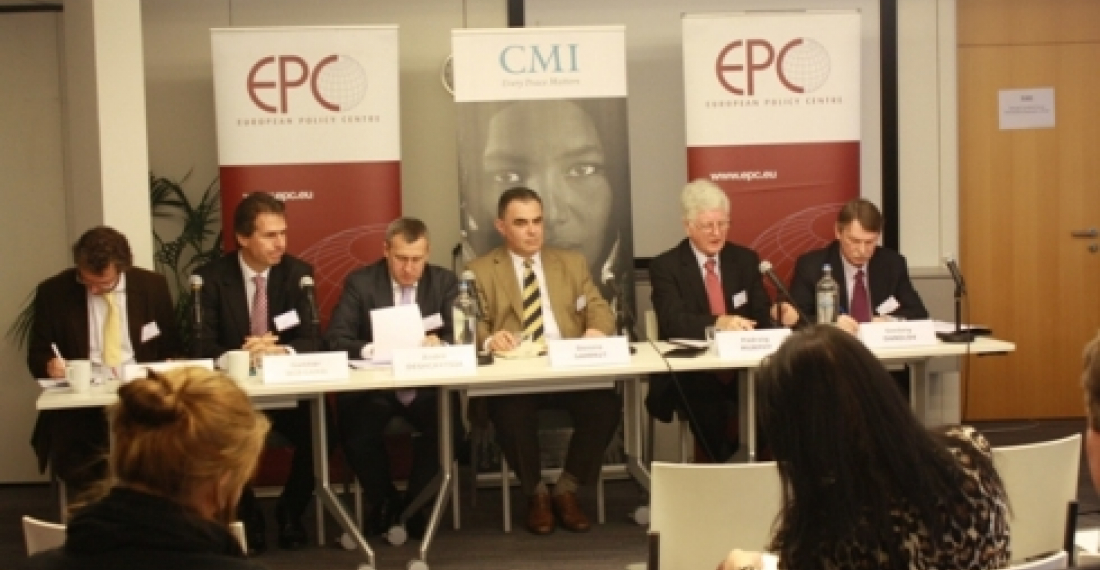
It has been twenty years since the Minsk Group was established within the framework of the OSCE to mediate a resolution of the conflict over Nagorno-Karabakh. The group was supposed to prepare the way for the convening of a full conference in Minsk to help bring the conflict to a final resolution. But twenty years later no major breakthrough has been achieved and there is now a call for the Minsk Conference to be convened in any case. It came during a conference focusing on the peacemaking experience of the OSCE which was held in Brussels on Monday, 10 December, and which was opened by the Foreign Minister of Ireland and current Chairman in Office of the OSCE, Eamon Gilmore. More than a hundred diplomats, EU officials, representatives of NGOs think tanks and the media attended the one day event which was organised by the European Policy Centre and Crisis Management Initiative.

The call for the convening the Minsk Conference was made by LINKS Director, Dennis Sammut, when he was speaking on the second panel of the conference which focused on the settlement of the Nagorno-Karabakh conflict. Dennis Sammut spoked about how the Minsk process has evolved over the last two decades and about its failure to achieve any significant breakthrough in its efforts to resolve the Nagorno-Karabakh conflict. He said that the present arrangement involving secret negotiations between the two conflict sides: Armenia and Azerbaijan; and the three co-Chair of the Minsk Process: France, Russia and the United States had become too cosy, with one or the other of the conflicting sides sometimes opting to stop negotiations for long periods of time. On the other hand a process of replacing the Minsk Process with another mechanism will take a long time and will probably be used by the sides for postruing rather to achieve a breakthrough. The international community had therefore to operate within the existing framework. Dennis Sammut said that both the participants and the scope of the negotiations needed to be widened, and it was time to switch on the spotlight on the negotiations since other methods had obviously failed. One way that this could be done was by convening the Minsk Conference.

Dennis Sammut also said that lessons from other conflict resolution processes showed that the political will to compromise does not happen on its own but needs to be induced through sticks and carrots from the part of the international community.

Earlier several participants spoke about the role of the OSCE in peacemaking in the Eurasian area. It was felt that whilst there were many significant contributions, and a few achievements, the overall picture is that the OSCE has a patchy record in this area.

source: commonspace.eu

Photo: The first panel of the conference "The OSCE peacemaking experience: What lessons and challenges for the EU" from left to right: James Nixey (Chatham House), Gunnar Wiegan (Director for Russia, Eastern Partnership, Central Asia, Regional co-operation and OSCE at the European External Action Service); Andreii Deshchytsia (Special Represnetative of the incoming Ukrainian Chairmanship of the OSCE), Dennis Sammut (Director, LINKS), Padraig Murphy (Special Representative of the Irish Chairmanship of the OSCE) and Dimitriy Danilov, (Head of the European Security Studies Department, Institute for Europe, Russian Academy of Sciences.) Picture courtesy of the European Policy Centre.

Related articles

Editor's choice
News
Council of Europe launches new International Claims Commission for Ukraine

Council of Europe launches new International Claims Commission for Ukraine

Thirty-four countries and the European Union have signed a new convention establishing an International Claims Commission for Ukraine at a diplomatic conference co-hosted by the 46-nation Council of Europe and the Netherlands in the Hague. The diplomatic conference was attended by leaders and high-level representatives from over 50 states, including the President of Ukraine, Volodymyr Zelenskyy, the President of the Republic of Moldova, Maia Sandu, and the Prime Minister of the Netherlands, Dick Schoof.  “Today marks a major step forward in ensuring accountability for Ukraine. The International Claims Commission represents justice and hope for tens of thousands of victims—our determination that those who have suffered will not be forgotten. I call for quick ratifications so we can get the commission rapidly up and running for the people of Ukraine,” said Council of Europe Secretary General Alain Berset. Ukrainian President Volodymyr Zelenskyy said: “We expect that every mechanism for compensation from the Register of Damage and Claims Commission to the actual payments – will start working and receive strong and sufficient international support, so that people can truly feel that any kind of damage caused by the war can be compensated. This war, and Russia’s responsibility for it, MUST become a clear example – so that others learn not to choose aggression.” “Accountability is about creating the conditions for peace that endures. And therefore, accountability is a condition of security – today and for the future. But accountability is not only about Ukraine. And it is not only about one aggressor and one victim. Accountability is about Europe. About every country in Europe. It is about whether Europe, as a whole, is willing to defend its peace,” said Maia Sandu, President of the Republic of Moldova, which currently holds the Presidency of the Council of Europe’s Committee of Ministers. The Prime Minister of the Netherlands, Dick Schoof, said: “Every day Russia is deliberately bombarding homes, destroying businesses and damaging infrastructure in Ukraine. Russia must compensate Ukraine for the damage caused. That is why we have launched the International Claims Commission for Ukraine and we are honoured to host it.” The International Claims Commission will be the second part of a comprehensive compensation mechanism related to Russia’s war of aggression, building on the existing Register of Damage for Ukraine. The claims commission will be established within the framework of the Council of Europe and will also be open to other countries. The Register of Damage for Ukraine, created in 2023, collects and records compensation claims submitted by individuals, organisations and public bodies in Ukraine. Forty-four states and the European Union have so far joined the Register, which has already received 86,000 claims. The International Claims Commission will review, assess and decide upon claims submitted to the Register of Damage for Ukraine and determine the amount of compensation, if any, which is due in each case. The convention establishing the commission will enter into force once it has been ratified by 25 signatories, as long as sufficient funds have been secured to support its initial work.

Popular

Editor's choice
News
Council of Europe launches new International Claims Commission for Ukraine

Council of Europe launches new International Claims Commission for Ukraine

Thirty-four countries and the European Union have signed a new convention establishing an International Claims Commission for Ukraine at a diplomatic conference co-hosted by the 46-nation Council of Europe and the Netherlands in the Hague. The diplomatic conference was attended by leaders and high-level representatives from over 50 states, including the President of Ukraine, Volodymyr Zelenskyy, the President of the Republic of Moldova, Maia Sandu, and the Prime Minister of the Netherlands, Dick Schoof.  “Today marks a major step forward in ensuring accountability for Ukraine. The International Claims Commission represents justice and hope for tens of thousands of victims—our determination that those who have suffered will not be forgotten. I call for quick ratifications so we can get the commission rapidly up and running for the people of Ukraine,” said Council of Europe Secretary General Alain Berset. Ukrainian President Volodymyr Zelenskyy said: “We expect that every mechanism for compensation from the Register of Damage and Claims Commission to the actual payments – will start working and receive strong and sufficient international support, so that people can truly feel that any kind of damage caused by the war can be compensated. This war, and Russia’s responsibility for it, MUST become a clear example – so that others learn not to choose aggression.” “Accountability is about creating the conditions for peace that endures. And therefore, accountability is a condition of security – today and for the future. But accountability is not only about Ukraine. And it is not only about one aggressor and one victim. Accountability is about Europe. About every country in Europe. It is about whether Europe, as a whole, is willing to defend its peace,” said Maia Sandu, President of the Republic of Moldova, which currently holds the Presidency of the Council of Europe’s Committee of Ministers. The Prime Minister of the Netherlands, Dick Schoof, said: “Every day Russia is deliberately bombarding homes, destroying businesses and damaging infrastructure in Ukraine. Russia must compensate Ukraine for the damage caused. That is why we have launched the International Claims Commission for Ukraine and we are honoured to host it.” The International Claims Commission will be the second part of a comprehensive compensation mechanism related to Russia’s war of aggression, building on the existing Register of Damage for Ukraine. The claims commission will be established within the framework of the Council of Europe and will also be open to other countries. The Register of Damage for Ukraine, created in 2023, collects and records compensation claims submitted by individuals, organisations and public bodies in Ukraine. Forty-four states and the European Union have so far joined the Register, which has already received 86,000 claims. The International Claims Commission will review, assess and decide upon claims submitted to the Register of Damage for Ukraine and determine the amount of compensation, if any, which is due in each case. The convention establishing the commission will enter into force once it has been ratified by 25 signatories, as long as sufficient funds have been secured to support its initial work.

