


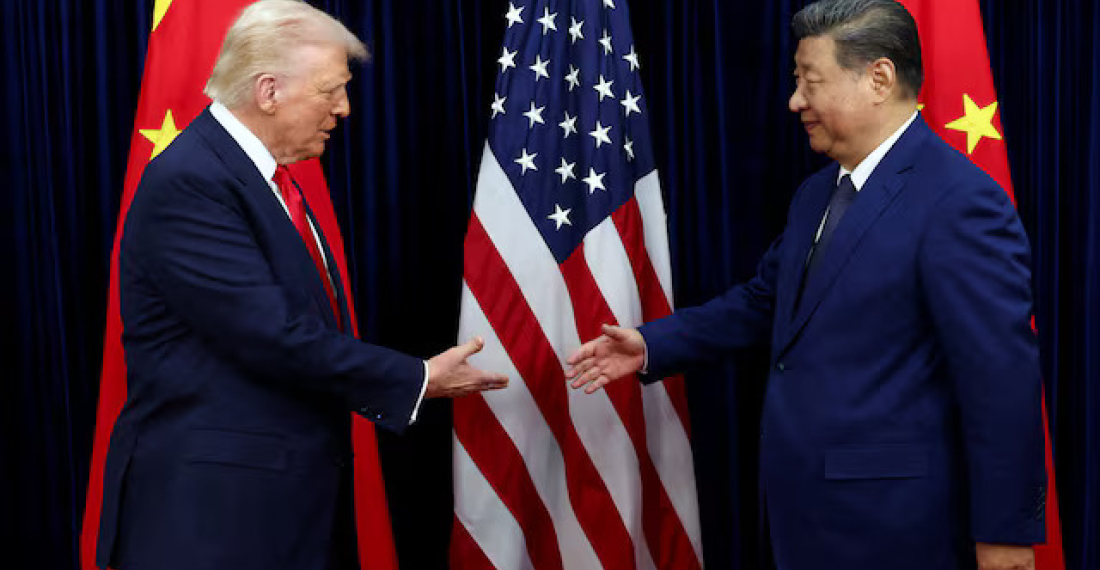
China sets sights on Iran peace deal ahead of meeting with Trump

China is mobilising efforts to end the war in Iran while walking a diplomatic tightrope between Washington and Tehran, in preparation for a summit with US President Donald Trump next month. The meeting with President Xi Jinping is expected to take place in mid-May, with 14–15 May reported as possible dates.

Beijing has responded with a diplomatic approach ahead of the summit, balancing its ties with both sides while seeking to ensure the meeting proceeds smoothly.

Xi’s mid-May meeting to discuss the US-China economic relationship is shaping Beijing’s approach to the Middle East conflict. China’s position is rooted in its reliance on the region for around half of its fuel imports, and the need to safeguard energy supplies.

China’s careful approach to the war has preserved its ability to maintain back-channel leverage, with Trump crediting Beijing with helping to bring Iran into peace talks in Pakistan last weekend.

Eric Olander, Editor-in-Chief of the China-Global South Project, said: “You've heard President Trump repeatedly mention how the Chinese talked to the Iranians, that puts them in the room with negotiators, even if it's not a seat at the table.”

The US naval blockade of Iranian ports presents a direct threat to energy transport, one that China has refrained from strongly criticising as it seeks to maintain diplomatic space ahead of the summit.

In response to Trump’s threat of taking out the entire country “in one night”, Chinese Foreign Ministry spokesperson Mao Ning refrained from direct criticism, saying instead that China was “deeply concerned” and urging all sides to play a “constructive role in de-escalating the situation”.

Foreign Minister Wang Yi has conducted nearly thirty calls and meetings with counterparts to promote a ceasefire, according to a Reuters count, and special envoy Zhai Jun has visited several Gulf and Arab capitals.

On Tuesday (14 April), Xi announced a four-point peace plan, emphasising peaceful coexistence, national sovereignty, international law, and balancing development and security.

The plan was presented during a meeting with Abu Dhabi Crown Prince Sheikh Khaled bin Mohamed bin Zayed Al Nahyan, signalling China’s engagement with regional actors while encouraging dialogue with Tehran.

Source: commonspace.eu with Reuters

Related articles

Editor's choice
News
Russian attacks on Kyiv and other Ukrainian cities highlights need of strengthening European resolve

Russian attacks on Kyiv and other Ukrainian cities highlights need of strengthening European resolve

Ukrainian President Volodymyr Zelensky condemned the attack, writing on X that it proved that US and European sanctions against Russia should not be weakened. Russia launched more than 700 drones and missiles at Ukraine in multiple waves overnight from Wednesday to Thursday, killing at least 18 people in what local officials said was the deadliest attack in months. Ukraine's air force said on Thursday morning that Russia had launched 659 drones and 44 cruise and ballistic missiles in the prior 24 hours. It said that 636 drones and 31 missiles had been shot down - but there had been direct hits in 26 locations. (click picture to read more)

Popular

Editor's choice
Interview
Thursday Interview: Murad Muradov

Thursday Interview: Murad Muradov

Today, commonspace.eu starts a new regular weekly series. THURSDAY INTERVIEW, conducted by Lauri Nikulainen, will host  persons who are thinkers, opinion shapers, and implementors in their countries and spheres. We start the series with an interview with Murad Muradov, a leading person in Azerbaijan's think tank community. He is also the first co-chair of the Action Committee for a new Armenian-Azerbaijani Dialogue. Last September he made history by being the first Azerbaijani civil society activist to visit Armenia after the 44 day war, and the start of the peace process. Speaking about this visit Murad Muradov said: "My experience was largely positive. My negative expectations luckily didn’t play out. The discussions were respectful, the panel format bringing together experts from Armenia, Azerbaijan, and Turkey was particularly valuable during the NATO Rose-Roth Seminar in Yerevan, and media coverage, while varied in tone, remained largely constructive. Some media outlets though attempted to represent me as more of a government mouthpiece than an independent expert, which was totally misleading.  Overall, I see these initiatives as important steps in rebuilding trust and normalising professional engagement. The fact that soon a larger Azerbaijani civil society visits to Armenia followed, reinforces the sense that this process is moving in the right direction." (click the image to read the interview in full)


