


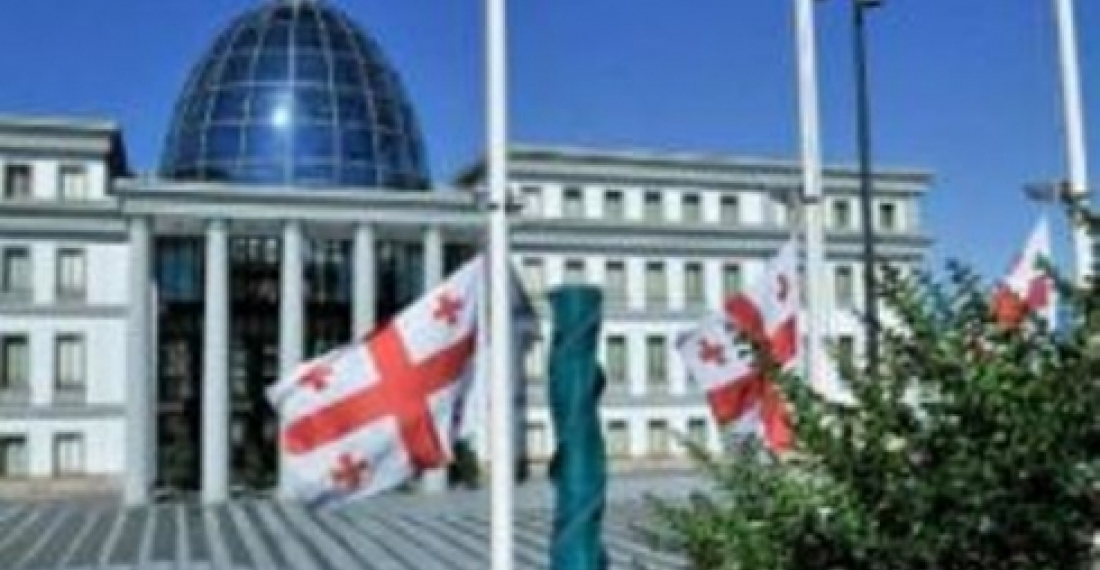
Georgia in mourning after flooding in Tbilisi claims many victims.

Georgia is in mourning following heavy rainfall and flooding which unexpectedly hit the Georgian Capital Tbilisi on Saturday night, leaving many people dead or missing, and which also resulted in considerable material damage. The number of casualties is still not known since dozens of people remain missing, but at least twelve bodies have now been recovered.

Georgians put aside political differences on Sunday to give a helping hand in the rescue operations. The situation was at first complicated because the flooding also resulted in many animals escaping from Tbilisi Zoo, and it was feared that they could be a danger to the public. Most of the animals have now been captured, or where this was not possible, killed. Surreal scenes of roaming bears, tigers and even a crocodile in downtown Tbilisi were broadcast all over the world.

Georgia Prime Minister Irakli Gharibashvili authorised the release of ten million Georgian Laris (approximately 4.5 million US$)  to the Tbilisi Municipality for the emergency response.

Monday has been declared a day of national mourning to honour those who died in the natural disaster.

There have been expressions of solidarity from all over the world, including from neighbouring countries, Armenia and Azerbaijan.

The European Union in a statement said that it was ready to deploy assistance to help Georgia in its hour of need. A statement from the Office of Federica Morgherini, the EU High Representative for Foreign and Security Policy said that the European Union stands in full solidarity with Georgia. The Statement said that the EU's Emergency Response Coordination Centre was closely monitoring the developments and that EU officials were in contact with Georgian authorities and were "ready to deploy assistance to help the country in the aftermath of this disaster that claimed lives, caused severe damage to the infrastructure in the capital and disrupted the basic services in the city".

source: commonspace.eu with agencies.
Related articles

Editor's choice
News
Borrell tells the European Parliament that the situation in Afghanistan was critical, but the EU will remain engaged

Borrell tells the European Parliament that the situation in Afghanistan was critical, but the EU will remain engaged

Borrell underlined that the European Union will make every effort to support the peace process and to remain a committed partner to the Afghan people. "Of course, we will have to take into account the evolving situation, but disengagement is not an option.  We are clear on that: there is no alternative to a negotiated political settlement, through inclusive peace talks.
Editor's choice
News
Pope's visit to Türkiye and Lebanon has a strong ecumenical character, and places interreligious dialogue at its centre

Pope's visit to Türkiye and Lebanon has a strong ecumenical character, and places interreligious dialogue at its centre

Pope Leo XIV has begun the first overseas trip of his pontificate, a six-day visit to Türkiye and Lebanon, which started yesterday (27 November) and ends on Tuesday (2 December). According to Vatican Radio, the visit "carries a strong ecumenical character and places interreligious dialogue at its centre. It will also be a moment of closeness to Christian communities and local populations across the region".   During nearly a week in the region, Pope Leo XIV will meet civil and religious authorities, visit mosques and ancient churches, pray at Beirut’s port in memory of the victims of the 2020 explosion, and hold private meetings with Presidents Recep Tayyip Erdoğan and Joseph Aoun.   A highlight of the visit will be a visit to Nicaea, where the Pope will mark the anniversary of the Council of Nicaea. Christians of many traditions recognise the Council of Nicaea as a foundation of shared faith. One of the most anticipated moments will be the Pope’s encounter with Lebanese youth in Bkerké, at the Maronite Patriarchate, a meeting expected to carry strong messages of hope in the Jubilee Year. A central event will be the ecumenical celebration in İznik, where the Pope and Ecumenical Patriarch Bartholomew will walk together toward the ruins of the Basilica of St Neophytos. The prayer, held before icons of Christ and the Council, will conclude with the lighting of a candle—a symbolic gesture of unity. The journey will also highlight interreligious engagement.   Memorable moments are expected throughout the trip: a wreath at Atatürk’s mausoleum, prayer inside the Blue Mosque, Mass at Istanbul’s Volkswagen Arena, the planting of a cedar at the presidential palace in Beirut, and prayer at the tomb of St Charbel in Lebanon. The Vatican said that "Pope Leo XIV’s pilgrimage to Türkiye and Lebanon aims to offer a voice of peace, unity, and hope at the heart of the Middle East."

Popular

Editor's choice
News
Pope's visit to Türkiye and Lebanon has a strong ecumenical character, and places interreligious dialogue at its centre

Pope's visit to Türkiye and Lebanon has a strong ecumenical character, and places interreligious dialogue at its centre

Pope Leo XIV has begun the first overseas trip of his pontificate, a six-day visit to Türkiye and Lebanon, which started yesterday (27 November) and ends on Tuesday (2 December). According to Vatican Radio, the visit "carries a strong ecumenical character and places interreligious dialogue at its centre. It will also be a moment of closeness to Christian communities and local populations across the region".   During nearly a week in the region, Pope Leo XIV will meet civil and religious authorities, visit mosques and ancient churches, pray at Beirut’s port in memory of the victims of the 2020 explosion, and hold private meetings with Presidents Recep Tayyip Erdoğan and Joseph Aoun.   A highlight of the visit will be a visit to Nicaea, where the Pope will mark the anniversary of the Council of Nicaea. Christians of many traditions recognise the Council of Nicaea as a foundation of shared faith. One of the most anticipated moments will be the Pope’s encounter with Lebanese youth in Bkerké, at the Maronite Patriarchate, a meeting expected to carry strong messages of hope in the Jubilee Year. A central event will be the ecumenical celebration in İznik, where the Pope and Ecumenical Patriarch Bartholomew will walk together toward the ruins of the Basilica of St Neophytos. The prayer, held before icons of Christ and the Council, will conclude with the lighting of a candle—a symbolic gesture of unity. The journey will also highlight interreligious engagement.   Memorable moments are expected throughout the trip: a wreath at Atatürk’s mausoleum, prayer inside the Blue Mosque, Mass at Istanbul’s Volkswagen Arena, the planting of a cedar at the presidential palace in Beirut, and prayer at the tomb of St Charbel in Lebanon. The Vatican said that "Pope Leo XIV’s pilgrimage to Türkiye and Lebanon aims to offer a voice of peace, unity, and hope at the heart of the Middle East."


