


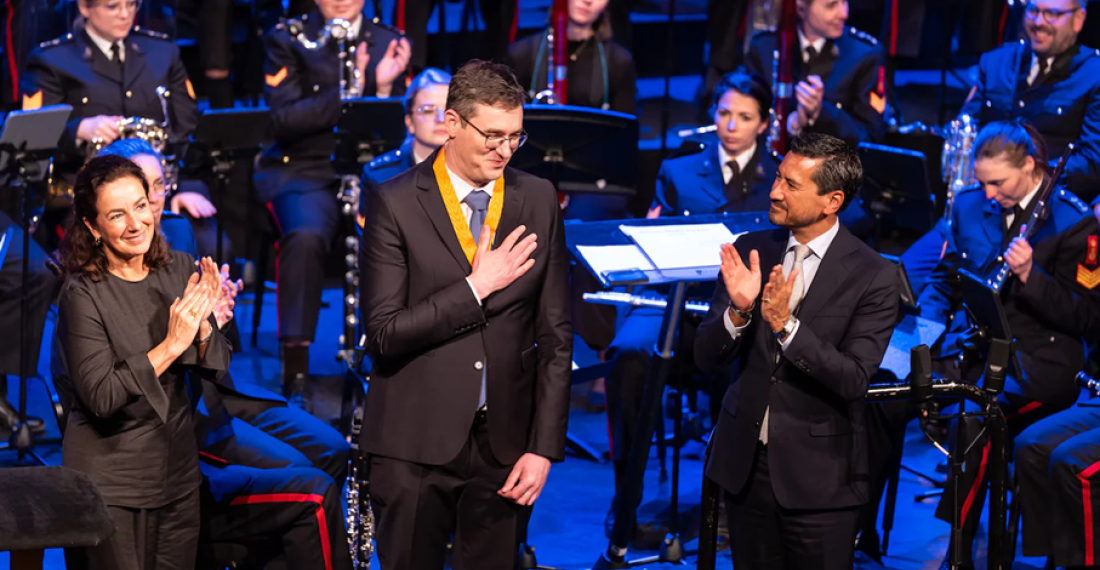
The Mayor of Budapest, Gergely Karácsony, has been awarded the 40th Geuzenpenning (Beggar Medal), the most prestigious award in the Netherlands, dedicated to honouring individuals and organisations that demonstrate exceptional civil courage in fighting for democracy and against dictatorship, racism and discrimination, for his outspoken defence of democratic values and civil liberties in Hungary under the government of Prime Minister Viktor Orbán. The ceremony took place on Friday, 13 March in the Stadsgehoorzaal in the Dutch city of Vlaardingen, which was packed with local and international officials, diplomats, and representatives of human rights organisations.
The Geuzenpenning has been awarded annually since 1987 to individuals and organisations that have distinguished themselves in the struggle for human rights and democracy. It is named after the Geuzen, the Netherlands' first organised resistance group during the Second World War, who revolted against the German occupation shortly after the country's surrender in May 1940. On 13 March 1941, exactly 85 years ago, fifteen Geuzen and three February strikers were executed at the Waalsdorpervlakte. The design of the award is inspired by the original Geuzenpenning from the Eighty Years' War (1568–1648) and features two clasped hands to symbolise solidarity. Recent recipients include the 5 AM Coalition from Ukraine (2025), Afghan human rights activist Laila Haidari (2024), and Polish judge Małgorzata Gersdorf (2021).
Harald Bergmann, the chairman of the Geuzenpenning Foundation and Mayor of Schiedam, described Karácsony as “a champion of an open and inclusive society”, whose political conviction is to “build bridges instead of walls”. Mr Bergmann noted that Mr Karácsony actively defends press freedom and civil rights in Hungary and has become a beacon of hope for many.
A democratic warning
In his acceptance speech, Karácsony reflected on the award's broader significance. While expressing his respect for the Geuzenpenning legacy and the prominent figures who have received it before him, he also raised a troubling question: why has the defence of basic democratic values in an EU Member State become worthy of such recognition? He argued that Hungary has become a political laboratory where the ruling Fidesz party has been testing the limits of how far democracy can be dismantled over the past fifteen years.
Karácsony leads the Párbeszéd Magyarországért party and first won the Budapest mayoral election in 2019 as an opposition candidate against Fidesz. He secured a second term in 2024. As mayor, he has faced sustained financial pressure from the Orbán government, which he claims has exploited a so-called 'solidarity tax', a redistribution mechanism from wealthier to poorer municipalities, as a political tool to undermine his administration. In May 2025, Karácsony warned that the tax was pushing Budapest to the brink of bankruptcy. A Hungarian court subsequently ruled the levy illegal.
Karácsony is the second Hungarian to receive the Geuzenpenning, after László Tőkés, a clergyman of Hungarian origin from Transylvania, Romania, who was honoured in 1991 for his role in the 1989 uprising against the Ceaușescu regime.
Bridge over the Danube
The award was presented by Amsterdam's mayor, Femke Halsema, who collaborates closely with Karácsony through the Pact of Free Cities. On 28 June 2025, Halsema joined the Budapest Pride march, organised by Karácsony as a municipal event to circumvent a government ban. The march attracted a record number of participants and was described as the largest demonstration in modern Hungarian history. On 9 July 2025, Karácsony received a standing ovation in the European Parliament for his defence of LGBTIQ+ rights.
In her speech, Halsema also warned that democratic institutions in the Netherlands should not be taken for granted, drawing a comparison with the situation in Hungary.
Prior to the ceremony, commemorations were held at the Geuzengraven in the Emaus cemetery and at the Geuzen monument in the Markt square in Vlaardingen. Karácsony also opened the Minimuseum De Geuzen, a new 9-square-metre exhibition space beneath the portico of Vlaardingen’s 17(th)-century city hall dedicated to the history of the wartime Geuzen resistance. The ceremony was part of Geuzenmaand, an annual programme of events held in Vlaardingen under the theme of 'Colourful Freedom' this year.
Source: commonspace.eu with AD Rotterdams Dagblad, Foundation Geuzenpenning and Municipality of Vlaardingen.



