

Updated, Monday 16 March 2026
Kazakh voters in a referendum on Sunday approved a new constitution, exit polls showed. Two exit polls said around 87% of voters had backed the new constitution. Turnout stood at 73%, the electoral commission earlier said. The new constitution streamlines the country's parliament, and recreates the office of vice president, which was abolished in 1996.
-------
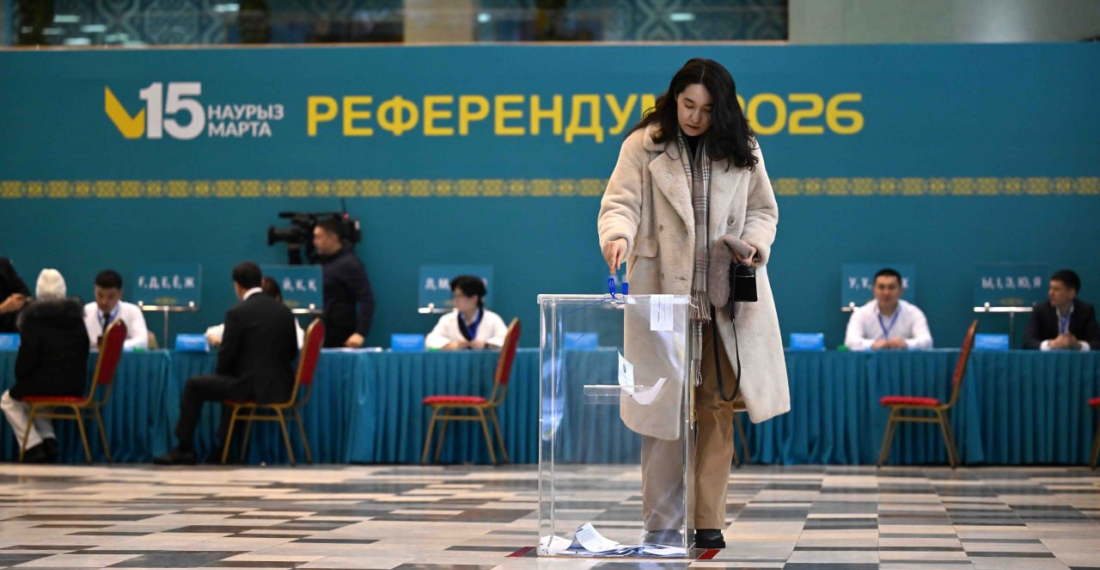
Voting is taking place on Sunday (15 March) in Kazakhstan in a nationwide referendum on a new draft Constitution.
According to the Central Referendum Commission of Kazakhstan, 12,046,617 citizens are eligible to participate in the referendum.
359 international observers and 206 foreign journalists were accredited to monitor the referendum in order to ensure the transparency of the voting process.
International organizations monitoring the referendum include the Organization for Security and Cooperation in Europe, the CIS, the Shanghai Cooperation Organization, the Organization of Turkic States, and the Organization of Islamic Cooperation.
The Central Referendum Commission must announce the final results of the vote within seven days after the referendum.
A total of 10,401 polling stations are operating inside and outside the country to organize voting. 71 of them were opened at diplomatic missions in 54 countries. If citizens support the proposed changes, the new Constitution will enter into force on July 1, 2026. After that, elections for a new parliament are planned in the country, and these elections are expected to be organized by the end of August.
The position of vice president will be implemented after the formation of the new parliament.
The referendum is the fifth in the history of independent Kazakhstan and may lead to the adoption of a new fundamental law that will determine the direction of the country's political and legal development in the coming years.
The Referendum is being held at the initiative of the President of Kazakhstan Kassym-Jomart Tokayev and envisages the implementation of large-scale constitutional reforms in the country. According to the submitted draft, approximately 84 percent of the text of the Constitution has been updated and new articles and sections have been developed. The question on the ballot paper asks, "Do you accept the new Constitution of the Republic of Kazakhstan?" Voters express their position by answering "for" or "against" this question.
Currently, the Constitution adopted on August 30, 1995, is in force in Kazakhstan. Since its adoption, the document has been repeatedly amended and supplemented. The latest amendments entered into force in September 2022. However, the scale of the proposed reforms necessitated the preparation of a new Constitutional document. Thus, the amendments cover approximately 84 percent of the text of the existing basic law.
The draft of the new Constitution was presented to the public in early February 2026. After the document was published, the country's citizens were given more than a month to familiarize themselves with it and discuss the proposed changes.
The President of Kazakhstan said that the adoption of a new Constitution is the need of the hour. According to him, the country has reached a stage of maturity and responsibility when important decisions that determine the future of the state should be made.
According to Elvira Azimova, the Chairperson of the Constitutional Court of Kazakhstan, the new Constitution will be a confirmation of the country's statehood maturity and international obligations.
Tokayav’s initiative
The idea of constitutional reform was first voiced during the annual address to the people of Kazakhstan by the President Tokayev on September 8, 2025. At that time, Kassym-Jomart Tokayev proposed changing the current parliamentary model from a bicameral system to a unicameral one.
On January 20, 2026, at a meeting of the National Congress, which performs advisory functions to the government, he presented additional proposals for reforming the political system. These proposals included the creation of the position of vice president, the reorganization of advisory institutions, and the updating of the preamble to the Constitution.
On January 21, 2026, the president signed a decree on the establishment of the Constitutional Commission. The commission included representatives of state bodies, experts, scientists and public figures. Initially, it was planned to make amendments to the existing Constitution. However, during the discussions, it became clear that the amendments covered more than 80 percent of the text of the document, and as a result, a decision was made to prepare a new basic law.
On February 11, 2026, the Chairperson of the Constitutional Court, Elvira Azimova, who heads the Constitutional Commission, presented the final version of the new draft Constitution to the President. On the same day, president Tokayev signed a decree on the republican referendum set for March 15, 2026.
On February 12, the text of the draft Constitution was published in national media, allowing for the start of public debate.
New preamble and values
The new draft Constitution begins with a revised preamble. This section reflects the historical and cultural foundations of the state. The document refers to the history of the Great Steppe, emphasizes the idea of a just Kazakhstan, and enshrines the principle of the rule of law.
The text also affirms the unitary nature of the state, the inviolability of state borders, and the territorial integrity of the country.
The document also pays special attention to issues such as strengthening interethnic and interfaith solidarity, developing science and education, protecting the environment, and maintaining ecological balance.
Economic and legal provisions
One of the innovations is the definition of the country's national currency at the Constitutional level. For the first time, the text of the Basic Law clearly states that the currency of the Republic of Kazakhstan is the tenge.
The document confirms that the presidential form of government will be preserved. At the same time, according to the draft, national legislation will be considered a priority, and the procedure for implementing international treaties will be determined by separate laws.
Political system and parties
The new version of the Constitution expands certain restrictions on political parties and trade unions. The ban on funding these organizations by foreign states and international structures remains in force.
In addition, financial support to political parties by foreign citizens, stateless persons, and companies with foreign capital is prohibited.
Language and religion policy
The draft constitution establishes the principle of separation of religion and state. The country's education system maintains its secular character, with the exception of religious educational institutions.
The state language of Kazakhstan remains Kazakh. However, Russian will be officially used alongside Kazakh in state and local government bodies.
The state also undertakes to create conditions for the development of the languages of all peoples living in Kazakhstan and to ensure the inadmissibility of discrimination on the basis of language and other grounds.
Powers of the President
According to the draft constitution, the presidential term remains seven years. The same person can only hold the position of head of state once.
Also, the ban on appointing close relatives of the president to high state positions remains in force.
The document also includes a new norm, according to which the president can voluntarily resign by applying to the Constitutional Court.
In addition, it is also possible for the head of state to be dismissed from office if he is unable to continuously fulfill his duties due to his health condition.
Parliamentary reform
One of the main changes is the transition of the parliament to a unicameral system. It is proposed to create a single legislative body called the Kurultay, instead of the existing Senate and Mejlis.
The parliament will consist of 145 deputies, who will be elected on party lists for a five-year term.
The new model is expected to increase the efficiency of legislative activities and speed up decision-making.
Creation of the position of Vice President
The draft constitution envisages the creation of a new state position, the post of vice president.
The candidate for this position will be nominated by the president and appointed with the approval of parliament. The vice president will be the second person in the state power system and will perform the duties of the head of state in the event of the president's premature termination of his powers.
He/She will also interact with parliament and perform other functions as determined by the president.
Establishment of the People's Council
The document also envisages the creation of a supreme consultative body called the People's Council of Kazakhstan.
This body will combine the functions of the Assembly of the Peoples of Kazakhstan and the National Congress. The People's Council will develop recommendations on domestic policy, strengthening public consensus, and strengthening national unity.
In addition, this body will be able to initiate legislation and propose holding referendums.
Government and Prime Minister
According to the draft constitution, the president will nominate a candidate for the post of prime minister. Once appointed, the prime minister will head the executive branch.
The government will be accountable to parliament and will hand over its powers to the new parliament after the next parliamentary elections.
Procedure for amending the Constitution
One of the main innovations is the change in the procedure for making amendments to the Constitution.
According to the draft, any changes to the Constitution can only be adopted through a nationwide referendum.
The changes will be considered adopted if they are supported by the majority of citizens who participated in the vote and a positive result is achieved in at least two-thirds of the country's regions.
Citizenship and security
The draft constitution also includes provisions on citizenship. The document reaffirms the ban on dual citizenship.
Acquisition of citizenship of another country may be grounds for deprivation of Kazakh citizenship. These grounds also include terrorist activities or actions that seriously harm the national interests of the state.
How is voting conducted?
In the referendum, citizens are presented with only one question - whether they support the adoption of the new Constitution of the Republic of Kazakhstan.
Voters must choose one of two options: support the project or oppose it.
If a voter marks both boxes at the same time, the ballot will be considered valid, but will not be taken into account when counting the votes. Ballots with no markings or where the voter's will cannot be determined are considered invalid.
A referendum is considered valid if more than half of the citizens included in the voter lists participate in the vote.
source: commonspace.eu with agencies
picture: Voting taking place in Kazakhstan in a referendum on 15 March 2026.